Your weather app doesn’t know it’s raining on your lawn. It knows it’s raining somewhere within a few kilometres of an airport, which is a very different claim. That gap is why backyard weather stations still sell in 2026, and why the good ones have quietly become some of the most useful sensors in a smart home — feeding irrigation logic, shade automations, humidity setpoints and “close the windows” alerts with data that actually comes from your property.
It’s also a category Matter has almost entirely ignored. Matter 1.6 shipped on 17 June 2026 and added no new device categories at all — it focused on NFC commissioning, Joint Fabric, thermostat suggestions and security infrastructure. There is still no device type for a rain gauge, an anemometer, a lightning detector or a solar radiation sensor. Which means that in the year of “everything just works together,” the single most weather-aware device you can bolt to your roof talks to your smart home over Wi-Fi, a vendor cloud, and a lot of goodwill.
Here’s what’s worth buying, and how to get the data somewhere useful.
What Matter actually knows about the weather
Matter has device types for temperature sensors, humidity sensors and pressure sensors. That’s it. That trio is genuinely useful, and it’s exactly why Eve Weather works so cleanly — at $79.95 it’s a Matter-over-Thread puck that reports outdoor temperature, humidity and barometric pressure to Apple Home, Google Home, Alexa or SmartThings with no hub, no cloud and no app tax.
But Eve Weather is not a weather station. It doesn’t measure rain, wind, UV or solar radiation, because Matter has no vocabulary for any of those. Every real weather station you can buy today reaches your smart home through a bridge, a cloud API, a local polling integration, or a community-maintained hack. None of them are Matter devices, and nothing in the Matter 1.6 release suggests that changes soon.
So evaluate these on two axes: how good is the hardware, and how easily does the data escape the vendor’s app. A rain total that lives only inside a phone app cannot skip your irrigation cycle.
Tempest: the one most people should buy
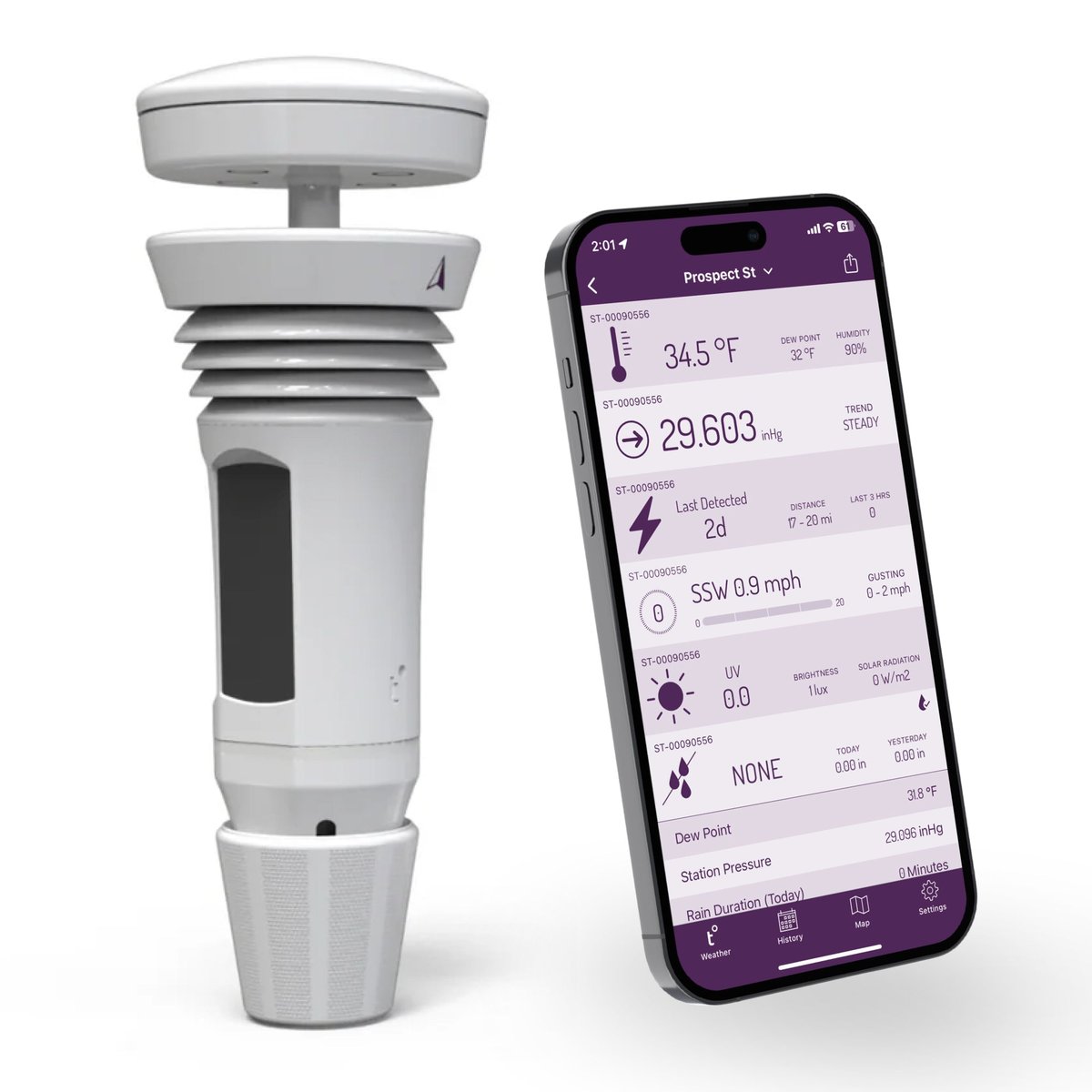
The Tempest Weather System is $349 and it is the default recommendation for a reason. It’s a single solar-powered pod with no moving parts — an ultrasonic anemometer instead of spinning cups, a haptic rain sensor instead of a tipping bucket. It reports temperature, humidity, dew point, heat index, wind chill, barometric pressure, wind speed and direction, lightning detection out to 25 miles, rain onset and accumulation, UV index, solar radiation, air density and wet bulb temperature. There’s no subscription; the vendor explicitly promises lifetime access to data, forecasting and API integrations, and lists Alexa, Siri, IFTTT and Rachio support.
Setup is about as close to trivial as outdoor hardware gets: mount the pod, pair the hub, done. TechHive’s long-running review has called it the best home weather station available, and the consensus across reviewers in 2026 hasn’t moved much.
The honest caveats: it’s a closed all-in-one system, so there’s no add-on ecosystem — no soil moisture probes, no extra indoor sensors, no lightning-only node. If you want a second temperature reading in the greenhouse, Tempest can’t help you. And the AI forecast that WeatherFlow markets so heavily needs weeks to months of local data before it’s calibrated to your microclimate, so don’t judge it in week one.
For Home Assistant users there’s a genuinely excellent story here: the core WeatherFlow integration is 100% local, reading UDP broadcasts on port 50222 with no internet dependency at all. The catch is that it requires Home Assistant and the Tempest hub to be on the same subnet — if you’ve segmented your IoT gear onto its own VLAN (and you probably should have), UDP broadcasts won’t cross the boundary and you’ll need a relay like WeatherFlow2MQTT or a broadcast forwarder.
Ecowitt: the value pick, and the best one for tinkerers
Ecowitt has spent five years undercutting everyone, and in 2026 it’s the brand I’d point most enthusiasts toward. The core sensor is the WS90 “7-in-1” array: piezoelectric rain gauge, ultrasonic wind speed and direction, temperature, humidity, solar intensity and UV index, all solar powered.
Two ways to buy it. The Wittboy Pro HP2564 pairs the WS90 with a 7-inch colour TFT touch console for $299.99. Or skip the display entirely and get the GW3001 gateway kit — WS90 plus a Wi-Fi/Ethernet gateway with an SD card slot — for $204.99 to $214.99 depending on radio frequency variant. If your “display” is a Home Assistant dashboard on a wall tablet, the gateway kit is the obvious choice and saves you a hundred dollars.
Ecowitt’s real advantage is that it’s an ecosystem, not a sealed pod. Soil moisture probes, leaf wetness sensors, PM2.5 and CO₂ monitors, lightning detectors, extra multi-channel temperature sensors — all of it hangs off the same gateway and all of it shows up in Home Assistant automatically via the official Ecowitt integration. There’s also a well-regarded ecowitt_local custom integration on HACS that polls the gateway’s local web interface directly and — importantly — builds entity IDs from sensor hardware IDs, so replacing a dead battery doesn’t silently break every automation and history graph you’ve built.
Global availability is a genuine strength: Ecowitt sells direct with regional storefronts and 868/915 MHz variants, so buyers in the EU, UK and Asia aren’t stuck importing US-frequency hardware that’s illegal to operate.
The trade-off is polish. The consoles look like 2014, the app is functional rather than pleasant, and firmware updates arrive without much ceremony. If you want something that feels like an Apple product, keep reading. If you want the most sensors per dollar and the cleanest local data path, stop here.
Ambient Weather WS-2902: the reliable middle
At $199.99, the WS-2902 is the traditional-shaped station that keeps showing up on best-of lists. Wind speed and direction, rainfall, outdoor temperature and humidity, solar radiation and UV from the outdoor array; indoor temperature, humidity and barometric pressure from the console. Ambient publishes support for IFTTT, Alexa, SmartThings, Home Assistant, Weather Underground and PWSWeather, which is a broader integration list than most competitors bother with.
It uses a conventional tipping-bucket rain gauge and cup anemometer — moving parts that will eventually need cleaning, but also a measurement method that behaves predictably in heavy rain and doesn’t get confused by hail the way piezo sensors sometimes do. Reviewers have consistently found it performs close to far more expensive gear.
The catch for a global audience: Ambient Weather is overwhelmingly a North American brand. Outside the US and Canada, availability and support get thin quickly, and you’re often better served by Ecowitt hardware that’s frequently built in the same factories.
Davis Vantage Vue: buy it when the numbers have to be right
The Vantage Vue with WeatherLink Console is $725, which is more than three of the stations above combined. It measures the same basic set — temperature, humidity, wind speed and direction, rainfall, barometric pressure, plus derived wind chill, heat index and dew point.
You’re not paying for features. You’re paying for a company that builds instruments used by agricultural and research operations, hardware that survives a decade of weather rather than three winters, and readings that other stations get benchmarked against. If you’re farming, running a vineyard, managing a site where a wind reading has consequences, or you simply refuse to wonder whether your rainfall total is real, Davis is the answer and the price is not negotiable.
For everyone else — someone who wants to automate blinds and skip a watering cycle — it’s overkill, and the Home Assistant path (via WeatherLink Live or the WeatherLink cloud) is workable but less elegant than Tempest’s local UDP or Ecowitt’s local polling.
Netatmo: beautiful, HomeKit-native, and gone from North America
This one comes with news attached. The Netatmo Weather Station — those two anodised aluminium cylinders that have been the design-conscious choice since 2013 — is now unavailable in the United States and Canada. Netatmo has permanently closed its US and Canadian online stores as of 1 June 2026, refocusing the business (now part of Legrand) on Europe. There are currently no certified resellers in either country. Existing owners keep their devices and app access, but if you’re in North America, this is no longer a product you can meaningfully buy.
In Europe it remains a legitimate option at around $189 / €200 for the base kit, and it has one feature nobody else matches: native Apple HomeKit support, with data landing directly in the Home app, usable in HomeKit automations, and available on Apple Watch complications. No bridge, no Home Assistant, no cloud detour.
But read the fine print. The base station only measures indoor and outdoor temperature, humidity, barometric pressure and CO₂. Rain and wind require separate add-on modules at roughly $80–$100 each — and those modules are not supported by HomeKit, appearing in the Home app as “unmanaged.” So the one station with first-class Apple integration can’t give Apple the two measurements you’d most want to automate on. Netatmo has also confirmed it doesn’t support Thread or Matter, since those need dedicated radio hardware rather than a firmware update.
The pretenders
Two products will show up in your search results that aren’t weather stations, and it’s worth naming them.
Eve Weather ($79.95) is a superb Matter-over-Thread outdoor sensor and a terrible weather station. Temperature, humidity, pressure and a 12-hour trend line. If that’s all you need, it’s the cheapest, cleanest, most ecosystem-agnostic way to get outdoor conditions into any smart home — and it pairs well with the indoor sensors we covered in our temperature and humidity sensor showdown. Just don’t expect rain.
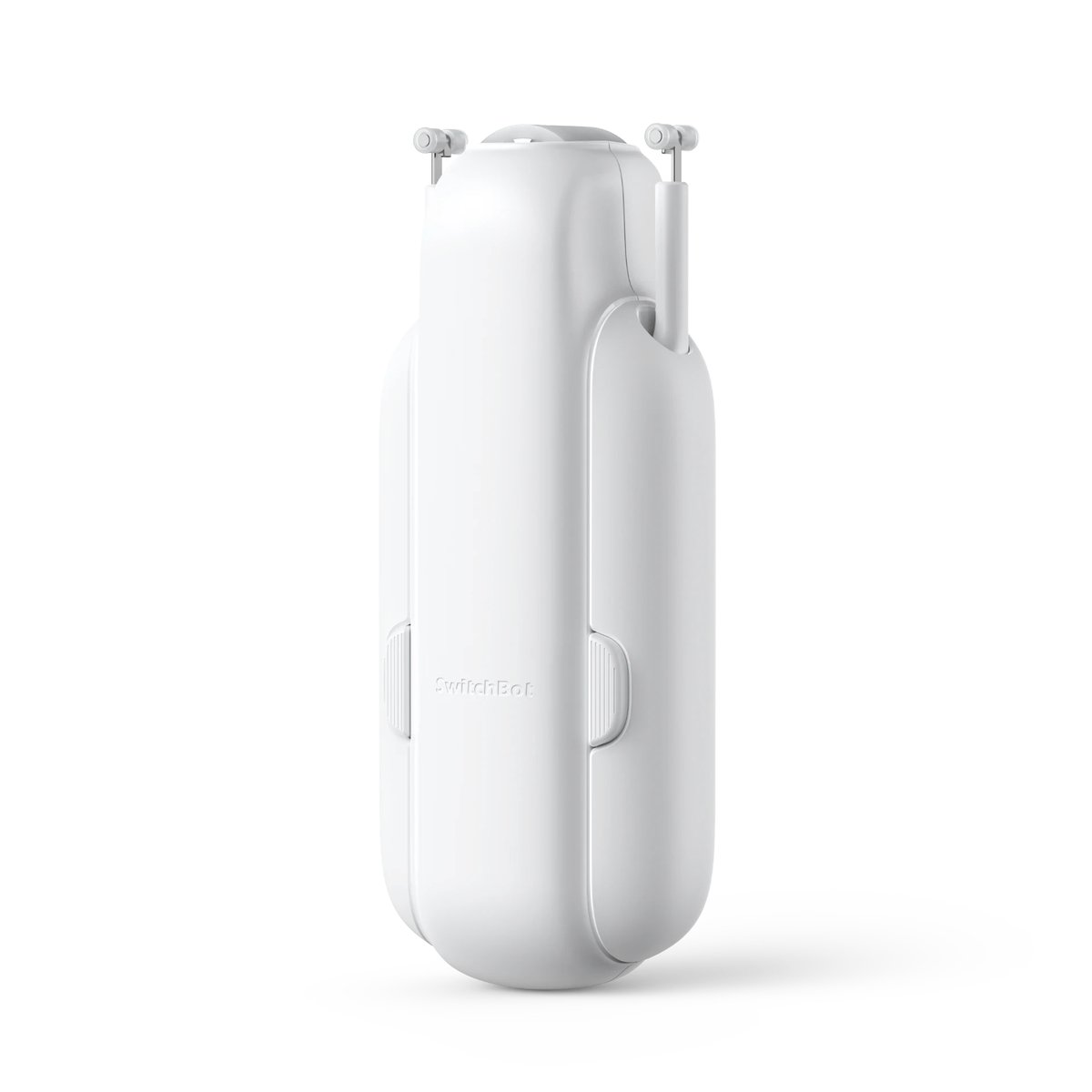
SwitchBot Weather Station ($109.99 / CA$119.99 / £109.99, launched 3 June 2026) is a 7.5-inch e-ink display, not a sensor array. It shows weather, calendar events and environmental data, runs up to a year on a charge, connects over 2.4 GHz Wi-Fi, and reads its own built-in temperature and humidity sensor plus up to three SwitchBot Bluetooth environmental sensors. Its Matter support is narrow to the point of being a footnote: the two physical buttons can be exposed as programmable Matter controls, and only when paired with a Matter-enabled SwitchBot Hub. The weather it displays comes from an online forecast, not from your yard.
Getting the data somewhere useful
Buying the station is the easy half. The question that determines whether it earns its keep is whether a rain total can reach an automation.
Three patterns work well in 2026:
Local-first with Home Assistant. Tempest’s UDP integration and Ecowitt’s local polling both work with the internet unplugged. This is the setup that lets you write “if rainfall in the last 24 hours exceeds 5 mm, skip the irrigation cycle” and trust it. It’s also the only approach that keeps working when a vendor changes its API terms.
Cloud-to-cloud via the vendor’s partners. Tempest talks natively to Rachio for irrigation and to Alexa and IFTTT for everything else. Ambient’s integration list is long. This is less fragile than it sounds for mainstream use, but you’re one business decision away from losing it.
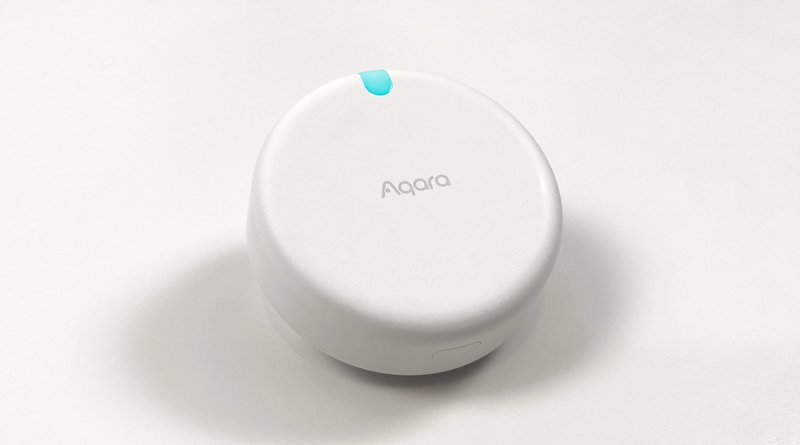
A Zigbee or Thread indoor layer alongside it. Outdoor stations are bad at telling you what’s happening in individual rooms. Pairing a station with cheap indoor climate sensors — an Aqara Climate Sensor W100 on a hub, for instance — gives you the inside/outside delta that actually drives good ventilation and HVAC automations. Outdoor humidity alone doesn’t tell you whether opening a window helps.
One more automation worth building regardless of brand: wind. If you have motorised awnings, outdoor shades, or a robot lawn mower that shouldn’t be out in a storm, a real anemometer on your own roof is worth more than any forecast API. Forecasts are regional. Gusts are local.
What I’d actually buy
If you want one recommendation and no homework: Tempest at $349. No moving parts to maintain, no subscription, genuinely local Home Assistant support, and the best out-of-box experience in the category.
If you run Home Assistant and enjoy the hobby: Ecowitt GW3001 kit at ~$205, then spend the savings on soil moisture probes. Best data-per-dollar, best expandability, cleanest local integration, ugliest console.
If you’re in North America on a budget and want something conventional: Ambient WS-2902 at $199.99.
If the readings have professional consequences: Davis Vantage Vue at $725, and don’t agonise over it.
If you’re in Europe, deep in Apple Home, and only care about temperature: Netatmo — accepting that rain and wind will never appear in the Home app.
And if you just want outdoor temperature in every ecosystem at once for under a hundred dollars, Eve Weather remains the single best-value Matter device in this entire conversation. It’s just not a weather station, and until the Connectivity Standards Alliance defines a rain gauge, nothing that measures rain will be either.