The problem nobody talks about
You have spent hundreds — maybe thousands — on smart home gear. Your lights respond to voice commands, your thermostat adjusts itself, and your locks know when you are home. But your ceiling fan still needs a remote you lose between couch cushions. Your air conditioner has a perfectly functional IR receiver, but it might as well be from 1997 as far as Apple Home or Google Home are concerned.
This is the dirty secret of the smart home in 2026: Matter and Thread are incredible, but they do not help the billions of IR and RF-controlled devices already sitting in our homes. TVs, air conditioners, fans, projectors, soundbars, roller blinds with RF motors — none of these speak Matter, and most never will.
The good news? A new generation of IR blasters and smart hubs can bridge that gap. And with Home Assistant 2026.4 adding native infrared support, the timing has never been better.
Here are the four best options for bringing your dumb devices into a modern smart home.
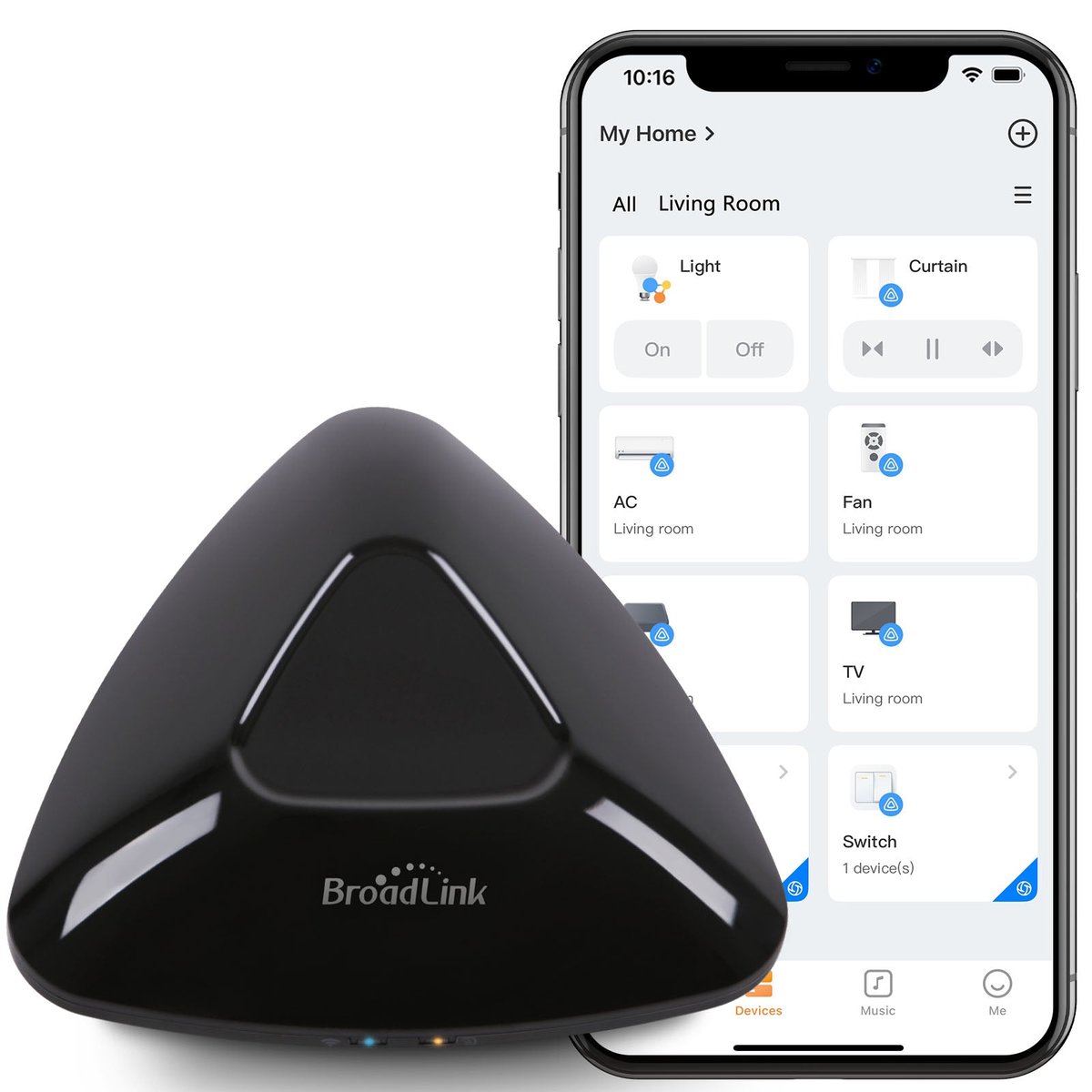
Broadlink RM MAX — the Matter SuperBridge ($49.99)
The Broadlink RM MAX is the most exciting IR blaster launch of the year, and it earned the “Matter SuperBridge” label for a reason. This is the first device from Broadlink to ship with native Matter support, meaning your IR and RF devices can appear as controllable accessories in Apple Home, Google Home, and Amazon Alexa — without cloud hacks or third-party workarounds.
What makes it special
- IR + RF 433 MHz — controls both infrared devices (TVs, ACs, fans) and radio-frequency devices (motorized blinds, RF switches, some garage doors)
- Matter bridge — exposes legacy devices to Matter-compatible platforms natively
- BLE local control — once configured, the RM MAX works without internet via Bluetooth, so your AC still responds during an outage
- FastCon mesh networking — supports up to 4,096 devices on a single local network with an 80-meter range per node
- Massive device library — claims 98% coverage of IR and RF appliance brands globally
Who it is for
The RM MAX is the pick if you want the widest device compatibility in one box. The RF 433 MHz support is a genuine differentiator — no other Matter-compatible IR blaster in this price range handles RF devices. At $49.99, it undercuts most competitors while offering more protocol coverage.
The catch
Broadlink historically relied on cloud processing and its own app ecosystem. While Matter support is a major step forward, the app experience has been a sore point for long-time users. If you are coming from a polished ecosystem like Aqara Home or SwitchBot, expect a rougher setup process.
You can find the RM MAX on Amazon or the Broadlink Global Store.
Aqara Hub M3 — the do-everything hub ($90)
If you are already invested in Aqara’s ecosystem — or you want a single hub that handles Zigbee sensors, Thread devices, and IR control — the Aqara Hub M3 is the most capable option on this list.
What makes it special
- Multi-protocol: Zigbee 3.0, Thread border router, Matter controller, Bluetooth, Wi-Fi, and a 360-degree IR blaster — all in one device
- Matter bridge: exposes your entire Aqara Zigbee device library to Apple Home, Google Home, and other Matter platforms
- Smart AC thermostat: pair the IR blaster with an Aqara temperature sensor and the M3 acts as an intelligent AC thermostat, maintaining your target temperature by cycling your air conditioner on and off
- Two-way IR: the M3 can detect when someone uses a physical IR remote and update the device state accordingly — a surprisingly rare feature
- PoE support: power it over Ethernet for a clean, reliable installation
- Local automations: all automations run locally on the hub, so they execute even when your internet drops
Who it is for
The M3 makes sense if you want one hub to rule your entire smart home. Between the Zigbee radio, Thread border router, and IR blaster, you can consolidate three or four separate devices into one. The AC thermostat feature alone is worth the price if you have a window unit or mini-split that only came with a basic remote.
If you are already running Aqara switches or presence sensors, the M3 is a natural upgrade path.
The catch
At $90, it costs nearly twice the Broadlink RM MAX. And if you do not need Zigbee or Thread support, you are paying for radios you will not use. The IR blaster is also a secondary feature — Aqara’s IR device database is smaller than Broadlink’s, and there is no RF support.
SwitchBot Hub 2 — the friendly all-rounder ($69.99)
The SwitchBot Hub 2 sits in a sweet spot between the budget options and premium hubs. It is an IR blaster, Matter bridge, and environmental sensor rolled into a compact, well-designed package.
What makes it special
- Matter bridge: exposes SwitchBot locks, curtains, and blind tilts to Apple Home and Google Home
- Built-in thermometer and hygrometer: Swiss-made sensor chip with ±1.8% RH accuracy and ±0.36°F temperature accuracy, displayed on an always-on screen
- Light sensor: triggers automations based on ambient light levels
- Smart Learning: point any IR remote at the Hub 2 and it learns the signal in about five seconds
- Clean design: the small touchscreen panel looks good sitting on a shelf, unlike most IR blasters that look like networking equipment
Who it is for
The Hub 2 is ideal if you are already in the SwitchBot ecosystem and want to add IR control alongside Matter bridging for your SwitchBot physical devices. The built-in climate sensor is genuinely useful — you can trigger automations when humidity spikes or temperature drops without buying a separate sensor.
The catch
Matter support is limited to roughly six to eight SwitchBot-branded devices. You cannot expose arbitrary IR devices as Matter accessories the way the Broadlink RM MAX can. And there is no RF support. The IR blaster is capable but it is really a bonus feature on what is primarily a SwitchBot ecosystem hub.
XIAO Smart IR Mate — the hacker’s choice ($9.99)
If you run Home Assistant, the XIAO Smart IR Mate from Seeed Studio is absurdly good for ten dollars.
What makes it special
- ESPHome pre-flashed: plugs directly into Home Assistant with zero configuration — no cloud account, no app, no subscription
- 360-degree coverage: three high-power IR emitters cover the entire room
- Signal learning: tap “Learn” in the Home Assistant UI and the device vibrates with haptic feedback to confirm it is ready — a surprisingly polished touch for a $10 device
- Tiny form factor: 65 mm diameter, 19 mm tall, USB-C powered — you can tuck it behind a TV or on a bookshelf and forget about it
- Fully local: everything runs on your network with no cloud dependency whatsoever
This device pairs perfectly with the new Home Assistant 2026.4 infrared integration, which treats ESPHome IR devices as “infrared proxies” — similar to how Bluetooth proxies work. Your IR-controlled TV or AC appears as an actual controllable device in Home Assistant, complete with proper state management and entity controls.
Who it is for
Home Assistant users who want cheap, local, cloud-free IR control. At $9.99 you can buy one for every room and still spend less than a single Aqara Hub M3. It is the ultimate bang-for-buck option if you are comfortable with Home Assistant.
The catch
No Matter support, no RF, no standalone app. This is a Home Assistant peripheral, full stop. If you do not run Home Assistant, this device does nothing for you. And while ESPHome is fantastic, signal learning and device configuration requires more hands-on work than the plug-and-play experience of Broadlink or SwitchBot.
Quick comparison
| Feature | Broadlink RM MAX | Aqara Hub M3 | SwitchBot Hub 2 | XIAO IR Mate |
|---|---|---|---|---|
| Price | $49.99 | ~$90 | $69.99 | $9.99 |
| IR control | Yes | Yes (360°) | Yes | Yes (360°) |
| RF 433 MHz | Yes | No | No | No |
| Matter bridge | Yes | Yes | Yes (limited) | No |
| Zigbee/Thread | No | Yes | No | No |
| Local control | BLE | Full | Cloud-dependent | Full (ESPHome) |
| Climate sensor | No | No (add-on) | Built-in | No |
| Best for | Widest compatibility | Aqara ecosystem | SwitchBot ecosystem | Home Assistant |
Which one should you buy?
You want the most devices controlled for the least money: Broadlink RM MAX. The combination of IR, RF, and native Matter support at $49.99 is hard to beat. It is the most versatile single device on this list.
You want one hub for everything: Aqara Hub M3. If you are building an Aqara-centric smart home with Zigbee sensors and Thread devices, the M3 consolidates your entire setup into one box. The IR blaster is the cherry on top, not the main course. Check out the IKEA Matter lineup if you want affordable devices to pair with it.
You are already in the SwitchBot ecosystem: SwitchBot Hub 2. The Matter bridging for SwitchBot devices plus IR control plus the built-in climate sensor make it a solid hub upgrade.
You run Home Assistant and want maximum control: XIAO Smart IR Mate. Buy three of them for the price of one Broadlink and put fully local IR control in every room. Combined with Home Assistant 2026.4’s native infrared support, this is the most powerful and flexible option — if you are willing to invest the setup time.
The bigger picture
The real story here is not any single product — it is that 2026 is the year IR and RF devices finally became first-class citizens in the smart home. Between Broadlink’s Matter SuperBridge, Aqara’s multi-protocol hub, and Home Assistant’s native infrared integration, the excuses for leaving your AC or ceiling fan outside your smart home are running out.
The ceiling fan remote lost between your couch cushions? Time to retire it for good.