Smart home standards have had a remarkable few years. Matter can now control your dishwasher, your solar inverter, your robot vacuum, your irrigation valves and — as of Matter 1.5 — your security cameras. Thread has passed a thousand certified products. Every major ecosystem speaks the same language for a light bulb.
And yet in 2026, there is still no standard way to arm a burglar alarm.
That is the strange hole at the centre of this category. The alarm panel — the one device in your house whose entire job is to know whether you are home — remains the most locked-in, most subscription-dependent, least interoperable thing you can buy. Choosing one is less a hardware decision than a decision about whose app you want to open every day for the next five years, and how much you are willing to pay for the privilege.
Here is how the five systems worth considering actually compare, what they really cost over three years, and why Matter has nothing to say about any of it.
Why Matter still can’t arm your alarm
Matter has had the raw ingredients for a security system since almost the beginning. Contact sensors and occupancy sensors were there from the start. Matter 1.2 added smoke and CO alarm device types back in late 2023. Matter 1.5 added cameras. Matter 1.6, released on 17 June 2026, even added a way for security sensors to advertise whether they keep historical event data, along with NFC-based commissioning and the Joint Fabric feature that lets ecosystems share a network.
What Matter does not have is a security panel. There is no standard device type representing “the alarm system,” no standard cluster for armed-away / armed-home / disarmed, no standard way for a keypad to authenticate a disarm code, and no standard path for a triggered alarm to reach a monitoring centre. The Connectivity Standards Alliance has never committed to adding one, and there are decent reasons for the hesitation: alarm panels are regulated products in most markets, tied to UL and EN certification regimes, false-alarm ordinances and police response agreements that a consumer interoperability spec was never designed to touch.
The practical consequence is simple and worth internalising before you spend money. Your Matter sensors can talk to any ecosystem. Your alarm cannot. Arming and disarming will happen in the vendor’s app, on the vendor’s schedule, under the vendor’s subscription terms — and if you want the state of your alarm to influence the rest of your smart home, you will be doing it with automations that read a proprietary integration, not a certified Matter attribute. If you want more background on where the spec actually stands, we broke down everything new in Matter 1.6 separately.
Ring Alarm and Alarm Pro: the ecosystem play
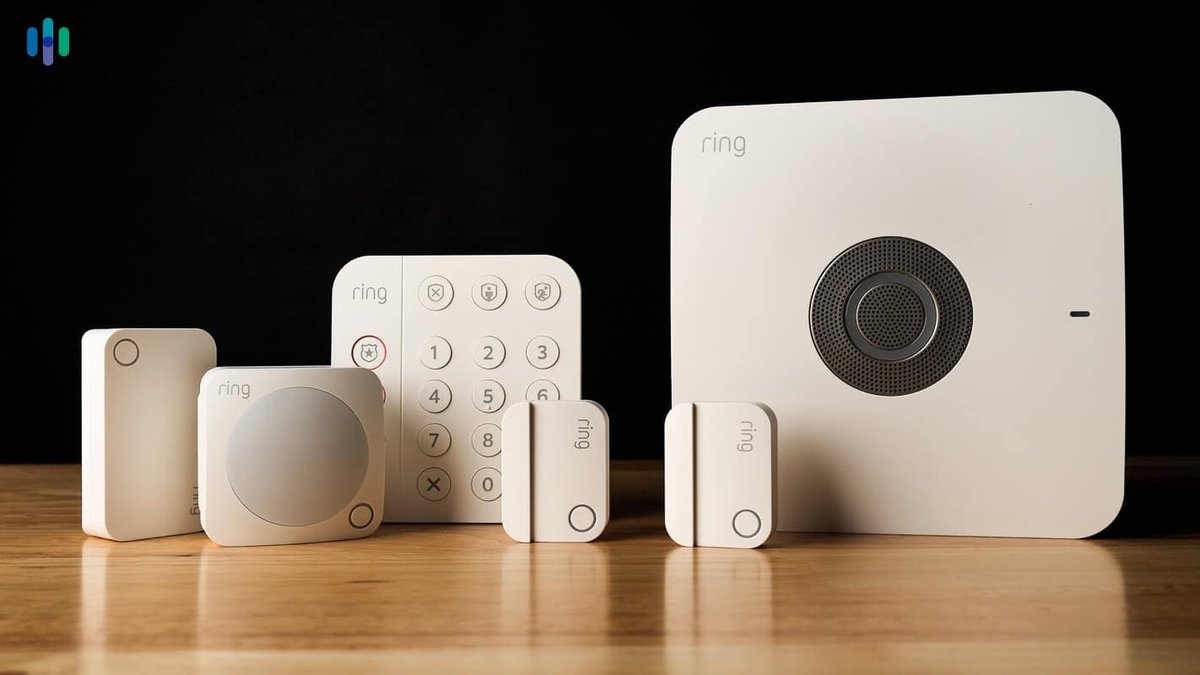
Ring’s system is the one most people end up with, and not without reason. The hardware is cheap, the sensors are reliable, and the coverage map is by far the widest of any DIY system — Ring Alarm works across the UK, Ireland, Germany, Austria, Switzerland, France, the Netherlands, Belgium, Spain, Italy, Portugal, Poland and most of the Nordics, which no competitor comes close to matching.
Kits run $244.95 for the 5-piece, $304.92 for the 8-piece and $464.96 for the 14-piece. The step up to Ring Alarm Pro — $434.92 for the 8-piece — buys you a base station with an eero Wi-Fi 6 router built in, covering around 1,500 sq ft, plus Ring Edge, which stores and processes camera footage locally on a microSD card, plus cellular backup that keeps both the alarm and your home network alive during an outage. That last detail is genuinely clever and genuinely useful, and it is the one piece of Ring hardware I would call best-in-class.
The catch is the subscription. Ring’s current tiers are Ring Solo at $4.99/month ($49.99/year) for a single device, Ring Multi at $9.99/month ($99.99/year) for everything at one address, and Ring Pro at $19.99/month or $199.99/year — which is the only tier that includes 24/7 professional monitoring. There is also a Virtual Security Guard add-on at $99/month if you want humans watching live video, which is a different product for a different budget.
Unsubscribed, a Ring Alarm degrades into a loud siren and some push notifications. No cellular backup, no video history, no dispatch. Ring is honest about this, but it means the sticker price is close to fiction: the real cost is the kit plus $600 over three years.
The other limitation is philosophical. Ring has no HomeKit support and no meaningful third-party radio story — no Z-Wave, no Zigbee, no Matter controller. It is an Amazon product that assumes you live in an Amazon house. If you do, the Alexa integration is genuinely excellent. If you don’t, you are buying a walled garden.
SimpliSafe: the best monitoring, the worst value
SimpliSafe has spent twenty years perfecting one thing — the professional monitoring experience — and in 2026 it is still the best in the business at it. It is also, by a wide margin, the most expensive way to secure a house.
The packages themselves are reasonable: the Foundation kit is $250.96, the Starter is $282.94, the Hearth $437.91, and the range tops out around $730 for whole-home bundles. SimpliSafe also discounts aggressively and near-constantly — cuts of 40–60% are routine, so paying full MSRP is a rookie mistake.
The monitoring is where it gets expensive. There are five tiers: Self Monitoring with Camera Recordings at $9.99/month, Standard at $22.99, Core at $32.99, Pro at $49.99, and Pro Plus at $79.99. Core is the one most buyers land on, and it unlocks Intruder Intervention — when the alarm trips, a monitoring agent can pull up your indoor camera feed, assess whether it’s a real break-in, and talk through the two-way audio. Pro adds Active Guard Outdoor Protection between 8pm and 6am, where AI flags a person loitering outside and a live guard speaks through the camera, triggers the siren and turns on the lights before anyone gets to a door. Pro Plus extends that to 24/7.
This is real, differentiated value. Talking an intruder off your driveway at 2am is a meaningfully better outcome than dispatching police after a window breaks. But at $32.99/month, Core alone is $1,187 over three years — more than the entire Ring Pro plan and hardware combined.
The other problem is reach. SimpliSafe operates only in the US and the UK; there is no service anywhere else, and the hardware is useless without it. There is also no HomeKit, no Matter, and essentially no third-party integration beyond voice assistants. SimpliSafe is a security company that happens to sell connected devices, not a smart home company. Judge it on that basis and it does very well.
Abode: the one that plays nicely with others
Abode is the enthusiast’s pick, and it earns that mostly by being the only DIY system with real Apple Home support.
The Smart Security Kit is $199 (list around $220, frequently discounted to $149), and the all-in-one iota — hub with a built-in camera — sits at $399 with regular sales down toward $279. The hub speaks Z-Wave and Zigbee alongside Alexa, Google and HomeKit, which means the same door sensor that arms your alarm can also trigger a Hue scene without a cloud bridge in between. Note that Abode’s own documentation still lists Z-Wave and Zigbee — not Matter — as its third-party radios, so don’t buy it expecting to pair Matter devices directly.
Pricing is the genuinely interesting part. Abode’s free tier is not a token gesture: you keep the app, push notifications, automations and smart home integrations with no payment at all. Standard is $8.49/month or $84.99/year and adds cellular backup and event history. Pro, the 24/7 professional monitoring tier, is $26.99/month — but $245.99 if you pay annually, which works out to about $20.50/month and is the single largest annual-vs-monthly saving in this comparison. Pay monthly on Abode and you are simply lighting money on fire.
The weaknesses are real. Abode’s app is the least polished here, its sensor catalogue is thinner than Ring’s, and its availability is essentially North America. But for an Apple household that wants an alarm without a mandatory subscription, nothing else comes close. If you’re building around Apple Home, it pairs naturally with the kind of hardware we covered in our biometric smart lock showdown.
eufy: local-first, subscription-optional
eufy’s approach is the mirror image of Ring’s. The 5-piece Home Alarm Kit with a HomeBase 3 is $159.99 — the cheapest real entry point in this comparison — and the pitch is that you never pay again.
HomeBase 3 (sold separately as the S380) does person detection and AI processing on-device and stores recordings on 16GB of local storage rather than shipping everything to a cloud. Self-monitoring is free and complete. Professional monitoring exists at $9.99/month, which is a third of SimpliSafe’s Core price, though the feature set behind it is correspondingly thinner — you are getting dispatch, not an agent watching your camera feed and talking to people.
eufy is the correct answer if your threat model is “I want to know when someone opens my back door and I want a siren to go off,” and the wrong answer if it’s “I want a monitoring centre to intervene.” It is also worth knowing that eufy’s local-first architecture has historically had cloud-storage stumbles, so verify current firmware behaviour before treating “local” as absolute. eufy’s cameras remain some of the best value in the category, as we found in our 2026 outdoor camera comparison.
Aqara: not an alarm system, and that’s the point
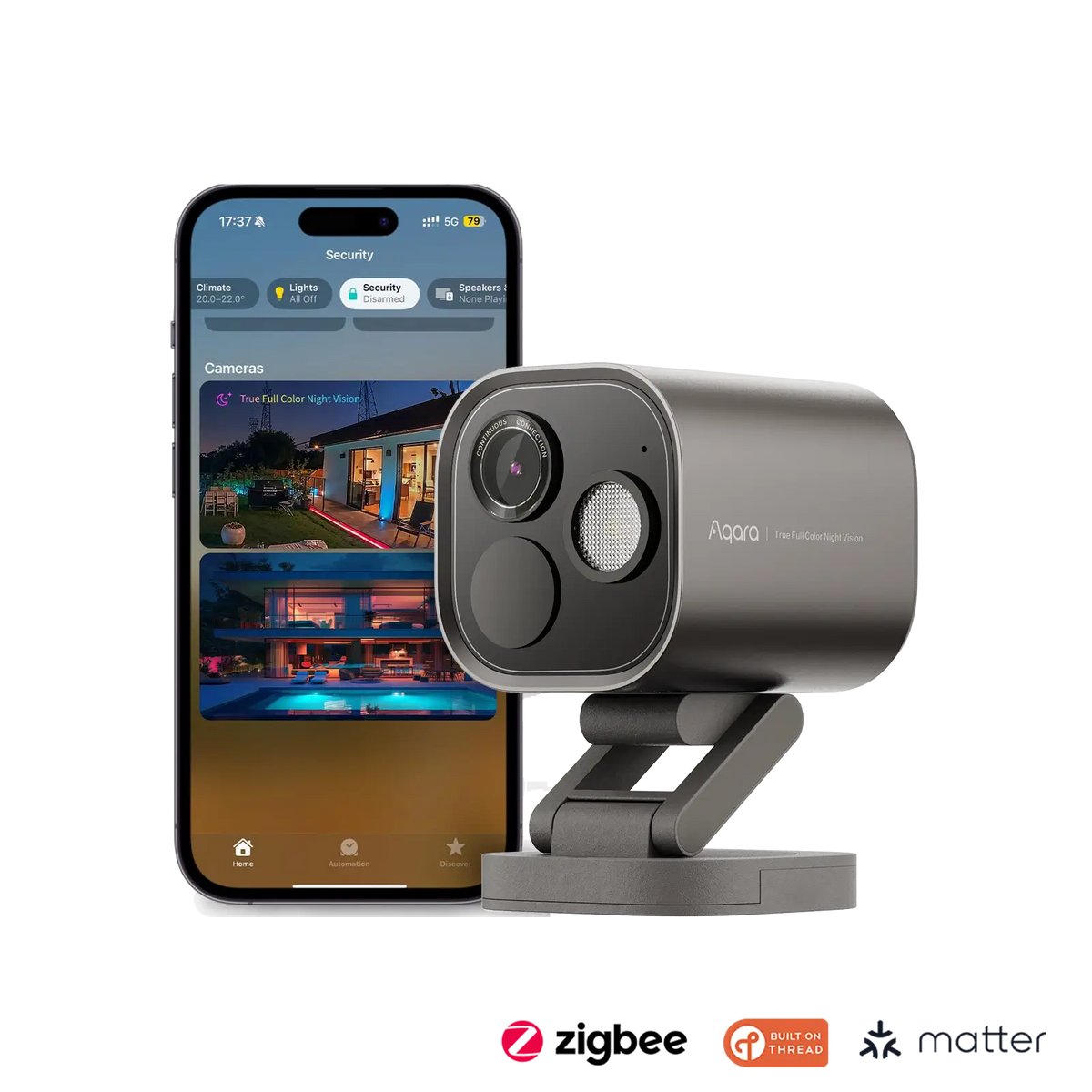
Aqara belongs in this comparison precisely because it refuses to be a security company. There is no monitoring centre, no cellular backup, no UL-listed central station, no dispatch. What there is, is the best sensor-to-ecosystem plumbing money can buy.
The Hub M3 is $159.99 and does more than any competitor’s base station: Zigbee 3.0, Thread border router, Matter controller and Matter bridge, dual-band Wi-Fi, Power over Ethernet, a 360° IR blaster and a 95dB speaker that works as your siren — and keeps working with no internet connection. It handles up to 127 child devices. Door and window sensors are $17.99 each. A four-door setup with a hub lands at around $232, once, forever.
What you build with that is a security system in the smart home sense: sensors that trigger sirens, lights, cameras and notifications through Apple Home, Google Home, Alexa, SmartThings, Home Assistant or Homey, with automations you actually control. What you do not get is anyone calling the police. Aqara’s own security modes live in the Aqara app because — as covered above — Matter has no armed-state device type to expose, so even this Matter-native hardware can’t share its arming state with other ecosystems.
Availability is Aqara’s other advantage: it ships essentially everywhere, including markets that Ring, SimpliSafe and Abode have never entered. Regional buyers can pick up the Aqara Hub M3 and door and window sensors locally rather than importing.
The three-year cost, which is the only number that matters
Sticker prices in this category are close to meaningless. Here’s what each system actually costs over three years, using a mid-tier kit and the cheapest plan that delivers each system’s headline capability:
| System | Hardware | Plan (3 yr) | 3-year total |
|---|---|---|---|
| Aqara Hub M3 + 4 sensors | $231.95 | $0 | $231.95 |
| eufy 5-piece, self-monitored | $159.99 | $0 | $159.99 |
| eufy 5-piece + pro monitoring | $159.99 | $359.64 | $519.63 |
| Abode Smart Security Kit + Standard | $199.00 | $254.97 | $453.97 |
| Abode Smart Security Kit + Pro (annual) | $199.00 | $737.97 | $936.97 |
| Ring Alarm 8-piece + Ring Pro (annual) | $304.92 | $599.97 | $904.89 |
| SimpliSafe Foundation + Core | $250.96 | $1,187.64 | $1,438.60 |
SimpliSafe costs roughly six times what a comparable eufy setup does, and about 55% more than Ring for the same core function of “somebody calls the police.” Some of that premium buys real capability. Most of it buys brand.
Do you actually need professional monitoring?
Be honest about this before you sign up for something. Professional monitoring earns its money in three situations: you travel often and nobody’s watching your phone; your insurer discounts a monitored system enough to offset the fee; or you live somewhere police won’t respond to an unverified alarm, which is increasingly common in the US and makes verified-response services like SimpliSafe’s Intruder Intervention genuinely valuable rather than a gimmick.
If none of those apply — if you’re home most nights, your phone is always in your hand, and your realistic worry is a package thief or a forgotten open window — free self-monitoring on eufy or Abode does the same job for nothing. Also check your local false-alarm ordinance before you commit; in many jurisdictions monitored systems require a permit and charge escalating fines for repeat false dispatches, which is a cost nobody puts on the comparison page.
One thing worth paying for regardless of tier: cellular backup. An alarm on a cut broadband line is a decoration. Ring bundles it into Ring Multi and above, Abode into Standard and above, and Aqara doesn’t offer it at all.
What to actually buy
Amazon household, want monitoring, want it simple: Ring Alarm Pro 8-piece with the annual Ring Pro plan. The eero-plus-cellular base station is the best hardware idea in the category, and the European availability means it’s the only one of these you can buy in most of the world.
You want the best chance of somebody stopping a break-in: SimpliSafe with Pro or Pro Plus. Wait for a sale on the hardware, and understand you’re signing up for $600/year.
Apple household, subscription-averse: Abode Smart Security Kit. Free tier is real, HomeKit support is real, and if you do want monitoring, pay annually.
Cheapest competent system: eufy 5-piece with HomeBase 3. $160, no recurring cost, local storage.
Automation-first, or you live outside the US/UK/EU: Aqara Hub M3 plus sensors, driven by Home Assistant or Apple Home. No dispatch, total control, and a fraction of the price. Pair it with a solid network — a flaky 2.4GHz band ruins more smart security setups than any protocol gap, which is why we wrote a whole guide to smart home Wi-Fi.
The uncomfortable truth is that none of these will interoperate with each other, and nothing on the Matter roadmap suggests that changes in 2027 either. Every other category in the smart home has been slowly converging for four years. Security is still five separate islands, and the only real decision you’re making is which island you want to live on.