IFA 2026 opened its doors in Berlin on September 4, but as usual the news broke two days early, in a blur of press conferences and embargo drops on September 2 and 3. I’ve been through all of it, and there’s a pattern underneath the noise that nobody put on a slide.
For about four years, the smart home hub has been getting less important. Matter’s whole pitch was that your devices would talk to each other directly, over Thread and Wi-Fi, and the little white box on your shelf would fade into a border router you never think about. Buy a bulb, tap a QR code, done.
IFA 2026 was the show where that trend reversed. Almost every significant announcement in Berlin this week was, in one way or another, about making the hub smarter — giving it local compute, local storage, local decision-making, and a say in what your devices actually do. Anker built a hub with a neural processor and 48TB of disk. Shelly turned a wall thermostat into a Matter controller with a firmware update. Philips is putting AI behaviours inside the Bridge Pro. The box on your shelf is coming back, and this time it wants to be a brain.
Here’s what actually got announced, what it costs, and which of it is worth caring about.
Anker’s MindBase is the boldest — and vaguest — thing at the show
The headline product of IFA 2026 is Anker’s MindBase, and it’s genuinely unlike anything else on the floor.
It’s a two-bay box that holds up to 48TB of storage and functions as a NAS. It has 64GB of onboard flash, two Gigabit Ethernet ports and three USB 3.0 ports. It’s a Matter 1.5 controller with Thread and Zigbee radios built in. And at its centre sits an in-house “AI Core” compute card rated at 26 TOPS, running a local language model Anker calls the TrueSmart Agent.
The pitch is that your existing eufy cameras stop being motion-detectors that ping your phone and start being sensors feeding a system that reasons about what it sees. Anker’s demo showed a yard sensor spotting strangers at 15 metres, identifying family members by phone credential at 30 metres, then escalating on its own — light, then verbal warning, then active deterrence — without a single cloud round-trip.
Capacity is real: up to 20 cameras, 34 sensors, roughly 100 Anker devices, and hundreds of third-party Matter products via its EasyOmni Link platform. It works alongside Apple Home, Alexa, Google Home and Home Assistant rather than replacing them, which is the correct call.
Now the catch, and it’s a big one: Anker announced no price and no release date. None. The first commercial product, a MindBase Security Kit bundling a TrackLight Cam S1, an S4 Video Doorbell and a Smart Security Shield sensor, isn’t slated until later in 2026. For a device that represents Anker’s entire strategic repositioning, that silence is loud. A 26-TOPS NPU, two drive bays and a Matter 1.5 radio stack is not a $199 product, and everyone in Berlin knows it.
I want this to be good. Local-first AI in the home is the right architecture, and it’s the direction I’ve argued for repeatedly — it’s the same reason Home Assistant Voice PE beats the cloud assistants on the things that actually matter. But an unpriced, undated hub is a press release, not a product. Judge it when it ships.
Shelly did roughly the same thing, for free, and shipped it
While Anker was demoing the future, Shelly quietly shipped a version of it.
Firmware 2.8.0 — a free over-the-air update for the existing Shelly Wall Display range — turns those panels into full Matter controllers and Matter devices simultaneously. You can add third-party Matter lights, blinds, thermostats, fans, plugs and sensors directly to the display, where they appear alongside your Shelly gear on the home screen. More usefully, those third-party devices can be pulled into Shelly scenes, automations and scripts, all running locally on the panel itself.
Check your model before you get excited. Full controller and device functionality lands on the Wall Display X1i, X2i, XL, U1, S1, S2 and XT. The original Wall Display and the Wall Display X2 get a consolation prize — they can control Matter devices shared from a newer panel, but they can’t act as controllers themselves.
That’s the whole “hub becomes a brain” thesis, delivered as a firmware update to hardware people already own, at a cost of zero. No new SKU, no subscription, no waiting for a launch date. If you have a Wall Display sitting in a hallway acting as a glorified thermostat, it just became the most capable device in your house.
Shelly also refreshed the BLU TRV radiator valve with a quieter motor and battery life of up to two years (Bluetooth and Zigbee), and showed two new door/window sensors: the BLU Door Window Mini ZB for narrow frames, and an IP55-rated BLU Door Window Outdoor ZB for garden gates and sheds. Unglamorous, useful, and exactly what Shelly is good at.
Philips Hue went wide — and made peace with Nanoleaf
Hue had the busiest launch of the show, and two of the announcements genuinely change the calculus.
TV sync got dramatically cheaper. The new Play Screen Sync is a $119 camera-based sync unit — a single fisheye camera that sits on top of your TV and reads the colours off the screen directly. Because it’s input-agnostic rather than pulling from an HDMI feed, it works with your TV’s native apps, which is the exact scenario where the old sync boxes fell over. Alongside it, a new Play HDMI Sync Box 4K lands at $149: one HDMI 2.0 input instead of the flagship’s four HDMI 2.1 ports, capped at 4K60. Both went on sale September 3 and — this is the underrated bit — both can connect over Bluetooth without a Hue Bridge at all.
For context, the flagship 8K box lists around $350. Hue just cut the entry price to TV sync by roughly two-thirds. If you looked at ambient TV lighting and decided it wasn’t worth it, that math has changed. Pair either with a gradient strip and you’re in for less than the box alone used to cost.
And then the surprise: Hue and Nanoleaf are now friends. A new $39.99 Philips Hue x Nanoleaf Wall Light Module lets compatible Nanoleaf Shapes panels join the Hue ecosystem, appearing in Hue scenes and automations like native hardware. Two companies that have spent years as direct rivals — and that I’ve spent a lot of words pitting against each other — just built an official bridge. If you own Shapes and have been eyeing Hue, or vice versa, the wall between those two piles of hardware is now $40 tall.
On the software side, Custom AI Behaviours are coming to the Bridge Pro from autumn 2026, letting the bridge build lighting behaviour around individual household patterns rather than fixed schedules. That’s the third IFA product this week putting intelligence in the hub instead of the cloud — and it’s the feature the Bridge Pro’s extra horsepower was obviously always for.
Hardware-wise, the Liane 360° rope light headlines the design side, starting at $399.99 for a cuttable 3-metre run (up to 2,400 lumens) and $549.99 for 5 metres (4,000 lumens). It’s gorgeous and it’s priced like jewellery. A new gradient strip light pro arrives September 15 at $179.99, and an 85-inch gradient strip follows on October 6 at $149.99.
Aqara’s Thread lighting blitz — with a familiar asterisk
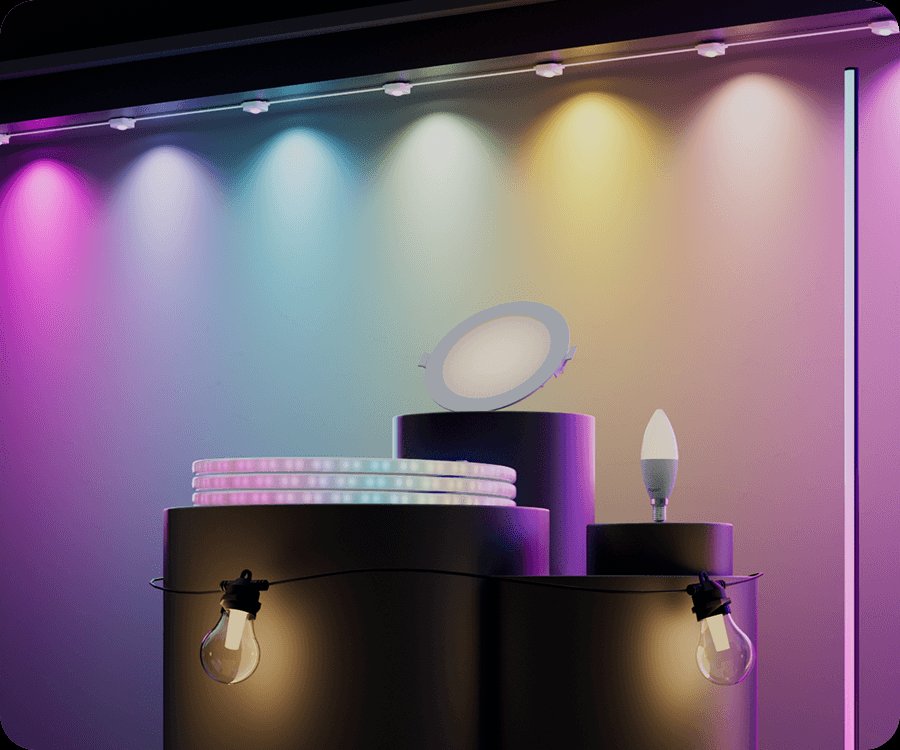
Aqara used IFA to expand its lighting range with five products, every one of them supporting Matter over both Thread and Zigbee. That dual-radio approach remains Aqara’s quiet advantage: you’re not forced to pick a mesh, and existing Aqara hub owners aren’t stranded.
- Floor Lamp T1 — 1,420mm tall, 16-bit five-channel lighting engine, 18 individually controllable zones, 2,000K–9,000K, 1,000 lumens max
- LED Downlight T2 — ultra-thin, in RGB CCT (16 million colours, 2,000K–9,000K) and CCT-only (up to 1,200 lumens) versions, with power-off memory
- LED Strip T2 — 108 LEDs per metre, 18 controllable zones per 3-metre section, trimmable, music-reactive
- Outdoor String Lights H1 — weather-resistant, individually controllable zones, 2,000K–9,000K whites
- Permanent Outdoor Lights H1 — year-round weatherproof, individually controlled LEDs, extendable and cuttable
The 16-bit five-channel engine on the Floor Lamp T1 and LED Strip T2 is the interesting bit — that’s the same class of colour hardware Hue reserves for its premium gradient products, and 18 addressable zones per 3 metres puts the T2 strip squarely in gradient territory. Aqara has been closing the gap on strips for two years; this is the release where the spec sheet stops apologising.
The asterisk: Aqara announced no pricing and no availability dates for any of the five. Historically Aqara undercuts Hue by a wide margin, and if the T2 strip lands anywhere near the current LED Strip T1 — which remains the value pick across most of Asia — Hue has a problem. But “historically” isn’t a price tag.
Aqara also launched Aqara Builder, a community platform for enthusiasts, installers and developers to share real automation projects, with AI-assisted tools to adapt shared scenarios to your own setup. Worth noting: the Edge Hub M300, Camera G510 and Security Station M410 on Aqara’s IFA stand are earlier announcements being demoed, not new this week. The official IFA page lists the full booth.
SwitchBot brought face and palm recognition to Europe’s front doors
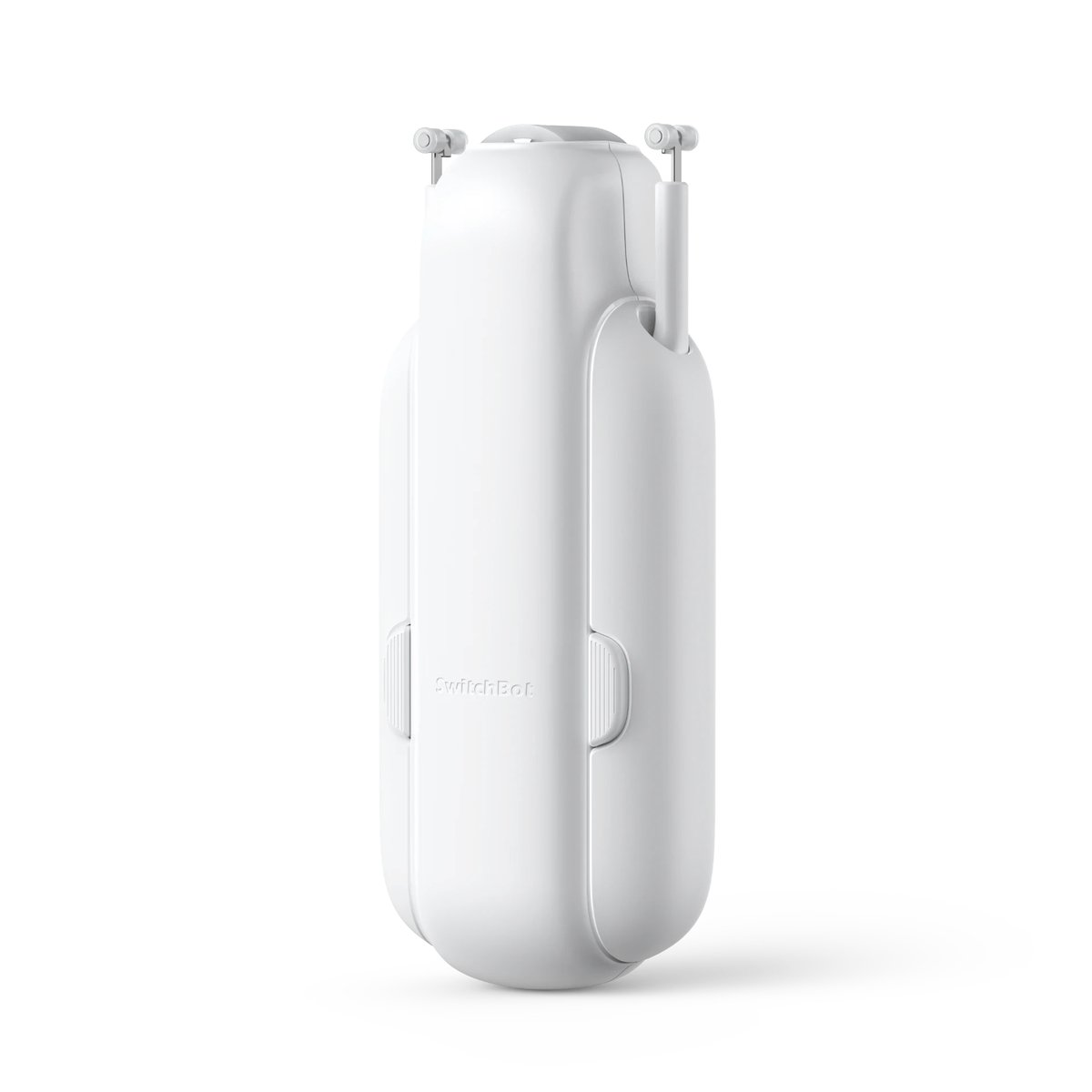
SwitchBot launched the Lock Ultra Max Vision Pro Combo at IFA — a bundle of the new Lock Ultra Max, the Keypad Vision Pro, and a Matter-enabled Hub Mini. It does 3D face recognition and palm vein scanning locally, offers up to 19 different ways to unlock, and in Max Mode opens a door in as little as 1.1 seconds.
Pre-orders opened September 3 on SwitchBot’s EU and UK sites at €339.99 / £339.99, with a free year of extended warranty during the launch window. Note the framing: this is a Europe-and-UK launch, not a global one, and there’s no US pricing yet.
Biometric entry has moved fast this year, and the thing that stands out here isn’t the face scanner — it’s that the biometrics are processed on the keypad rather than in a cloud. That’s the same local-first instinct running through everything else at this show.
Third Reality’s first Thread devices
A smaller story with a longer tail: Third Reality, the budget Zigbee specialist that’s been quietly propping up a lot of Home Assistant setups, took its first independent IFA booth and showed its first Matter-over-Thread hardware — a Smart Soil Moisture Sensor, Smart Button, Smart Plug and Smart Bulb. It also demoed a smart care system aimed at older people living independently.
Launch is vague (second half of 2026) and pricing is unannounced, but Third Reality moving to Thread matters for the same reason IKEA’s cheap Matter range mattered: Thread’s biggest weakness has been that entry-level devices are all still Zigbee or Wi-Fi. Every budget brand that crosses over makes the mesh in your house denser and more reliable.
What I’d actually do about any of this
Three practical takeaways.
If you have a Shelly Wall Display X1i, X2i, XL, U1, S1, S2 or XT, update it. Free, and it meaningfully upgrades hardware you already paid for. Nothing else announced this week has that risk-to-reward ratio.
If you’ve wanted TV light sync, this is the moment. $119 for the camera-based Play Screen Sync, or $149 for the 4K HDMI box, with no Bridge required. That’s a completely different proposition to the $350 flagship, and the camera version sidesteps the native-TV-app problem that made the old boxes frustrating.
If you’re buying lights, wait a beat. Aqara’s T2 strip and downlights are unpriced but likely to undercut Hue substantially, and they speak Matter over Thread and Zigbee. Unless you need something today, letting Aqara show its pricing costs you nothing.
And the broader read: the industry has decided that the answer to “my smart home is dumb” isn’t a better cloud, it’s a smarter box in your house. Anker, Shelly, Philips and Aqara all arrived at that conclusion independently and announced it in the same 48 hours. That’s not a coincidence — it’s what happens when Matter’s plumbing finally works well enough that the interesting problem moves up a layer, from can these devices talk to what should they decide.
The cloud assistants spent 2026 fighting over who gets to answer your questions. IFA suggests the more consequential fight is over who gets to run the automation — and for the first time in years, the answer might be a box you own.