Go into any appliance showroom in 2026 and you’ll be told the fridge is “smart,” the dishwasher is “connected,” and the oven has an app. All true. Ask whether any of it speaks Matter — the universal standard that was supposed to end exactly this kind of fragmentation — and you’ll get a blank stare, or worse, a confident “yes” that turns out to mean “it works with Alexa.”
Here’s the uncomfortable number. The Connectivity Standards Alliance specified Matter dishwashers and laundry washers in October 2023. Nearly three years later, the public list of Matter-certified products contains exactly one dishwasher and two laundry washers — and one of those washers is a chipset reference design from Quectel, not something you can install in a laundry room.
The spec is finished. The products aren’t. Let’s talk about why, what actually works today, and how to build a kitchen that isn’t a dead end.
What Matter already promises on paper
This isn’t a case of the standard lagging behind the hardware. It’s the exact opposite — the standards body did its homework years ago.
Matter 1.2 arrived on October 23, 2023 with nine new device types, and the appliance haul was substantial: refrigerators, dishwashers, laundry washers, robotic vacuums, room air conditioners, air purifiers, fans, air quality sensors, and smoke/CO alarms. These weren’t token definitions either. Dishwashers got remote start, progress notifications, and a proper alarm model covering water supply and drain faults, temperature errors, and door lock failures. Refrigerators got temperature control and monitoring — and the spec explicitly extends to deep freezers, wine fridges, and kimchi fridges, which tells you the CSA was thinking globally rather than just about American side-by-sides.
Matter 1.3 followed on May 8, 2024 and finished the kitchen. Ovens landed with per-compartment control across operational modes — standard, convection bake, roast, steam, broil, proofing — plus preheat and target-temperature-reached notifications. Cooktops arrived with per-element temperature control and measurement, where local regulation permits it. Extractor hoods got fan and light control plus filter end-of-life status. Microwave ovens got cooking control. Laundry dryers completed the pairing that washers started in 1.2.
Add it up and Matter has a complete, well-specified vocabulary for the modern kitchen and laundry room. Everything since — including the Matter 1.6 release in June 2026 — has been refining commissioning, cameras, closures, and energy management, not adding missing appliance categories. There is nothing left to wait for on the spec side.
The certification reality check
Now the part the marketing decks skip.
Search the Matter certified-product listings for dishwashers and you get a single entry: the Midea Built-In Dishwasher — the same machine Midea showed off as the world’s first Matter-connected dishwasher at IFA 2023. It certified on November 8, 2023, against Matter 1.2, over Wi-Fi. Nearly three years on, it’s still the only one. Search laundry washers and you get two: a Midea Washer and a Quectel reference design. Robot vacuums are healthy. Room air conditioners are healthy — Midea alone has shipped over two million Matter-capable AC units, which is why Midea’s window units are the only ones worth buying if you care about Matter. But the big-ticket kitchen and laundry categories are essentially empty.
Meanwhile the announcements never stopped. Whirlpool put out a press release back in November 2023 saying it had actively participated in developing the Matter 1.2 appliance specs for washers, refrigerators, and dishwashers, with its global technology officer promising “more interoperability across these devices.” At CES 2026, Hisense announced Matter support was coming to its ConnectLife platform alongside a Series 9 dishwasher with a 6.86-inch touchscreen and a PureSmart fridge with dual displays — with no pricing, no dates, and Matter itself described only as “coming soon.”
That gap between announcement and certification is the whole story of Matter appliances so far.
Why appliance makers are dragging their feet
I don’t think this is incompetence. I think it’s rational, if annoying.
The data is the product. Samsung’s Bespoke AI fridges track how often each compartment gets opened and adjust cooling accordingly. LG’s ThinQ platform reads washer vibration patterns to predict drum bearing failure. Those features exist because the manufacturer owns the telemetry pipeline end to end. A Matter device type exposes cycle state and a start button — it doesn’t carry proprietary AI diagnostics, and it doesn’t route anything through the manufacturer’s cloud. Shipping Matter means handing the daily interaction to Apple Home or Home Assistant and keeping only the parts nobody opens an app for.
The lifecycle is brutally long. A smart bulb is a two-year product. A dishwasher is a ten-to-fifteen-year product. Committing to firmware updates and Matter certification renewals across a fifteen-year installed base is a genuinely expensive promise, and appliance margins are thin.
The certification isn’t free. Every device type, every spec revision, every firmware branch is real engineering and real test-lab money — spent on a feature that, today, most buyers don’t ask for at the point of sale.
And the walled gardens still pay. Samsung and LG publicly committed back in 2023 to making their appliances work in each other’s apps. As of 2026, that interoperability exists in Korea and still hasn’t properly landed in the US. If two Korean giants can’t open up to each other after three years, expecting them to open up to a neutral standard on a faster timeline was always optimistic.
What actually works today
Enough pessimism — here’s the working set.
Robot vacuums: the one unambiguous win
Robot vacuums are the proof that Matter appliances can work. Apple finally shipped Matter robot vacuum support in iOS 18.4 in April 2025 — years late, having promised it at WWDC 2024 for iOS 18 and slipped twice — and it works properly: start and stop, power levels, vacuum and mop status, return to dock.
Roborock’s flagship Saros line supports it, as do the Qrevo series and the older S8 MaxV Ultra. Ecovacs covers the Deebot X2, T50 Omni, and X8/X9 Pro Omni families. Dreame’s X40 and X50 Ultra are in. SwitchBot’s S20 line speaks Matter directly, while its ultra-compact K11+ needs the Hub 2 acting as a bridge. Even iRobot got there, with the Roomba Combo 10 Max and the newer Roomba Plus 500 series.
One caveat worth setting expectations on: Matter gives you the basics, not the good stuff. Room-by-room selection, no-go zones, map editing, and dirt detection all still live in the manufacturer’s app. Matter is your automation hook — “everyone left the house, start a clean” — not a replacement for the vendor app. If you’re buying the Roborock Saros 10R at its $1,599.99 list price (it’s discounted to around $1,000 often enough that paying list feels silly), buy it for the hardware and treat Matter as a bonus.
Room air conditioners and air quality
Room ACs are the other genuine success, and it’s basically a Midea story. If you want a window unit that talks to Apple Home or Home Assistant natively without a bridge or an IR blaster, the Midea U remains the answer, and our window AC guide covers the alternatives and their compromises.
Air purifiers are a sadder case despite being specified in the same Matter 1.2 release — Dyson, Coway, and Blueair still won’t play, for the same walled-garden reasons.
The Bosch bridge: the best big-appliance option going
The most interesting workaround comes from BSH, the group behind Bosch, Siemens, Neff, and Gaggenau. Rather than putting Matter radios in the appliances, BSH made the Smart Kitchen Dock — a speaker-and-charging-dock for a tablet or phone — into a Matter bridge for the whole Home Connect fleet. It’s Matter 1.2 certified and picked up Matter 1.3 certification in 2025, and it exposes laundry washers, dishwashers, and fridge/freezers, with ovens, cooktops, hoods, microwaves, and dryers certified and rolling out.
It works. But read the compatibility table before you buy, because platform support is wildly uneven:
- Home Assistant gets the full picture — mode selection, start/stop, sensor data.
- Google Home gets mode selection, start/stop, and automation triggers.
- Aqara Home gets status monitoring plus start, stop, pause, and resume.
- Apple Home gets… a hub. The appliance device types simply aren’t supported, so the bridge shows up and the appliances effectively don’t.
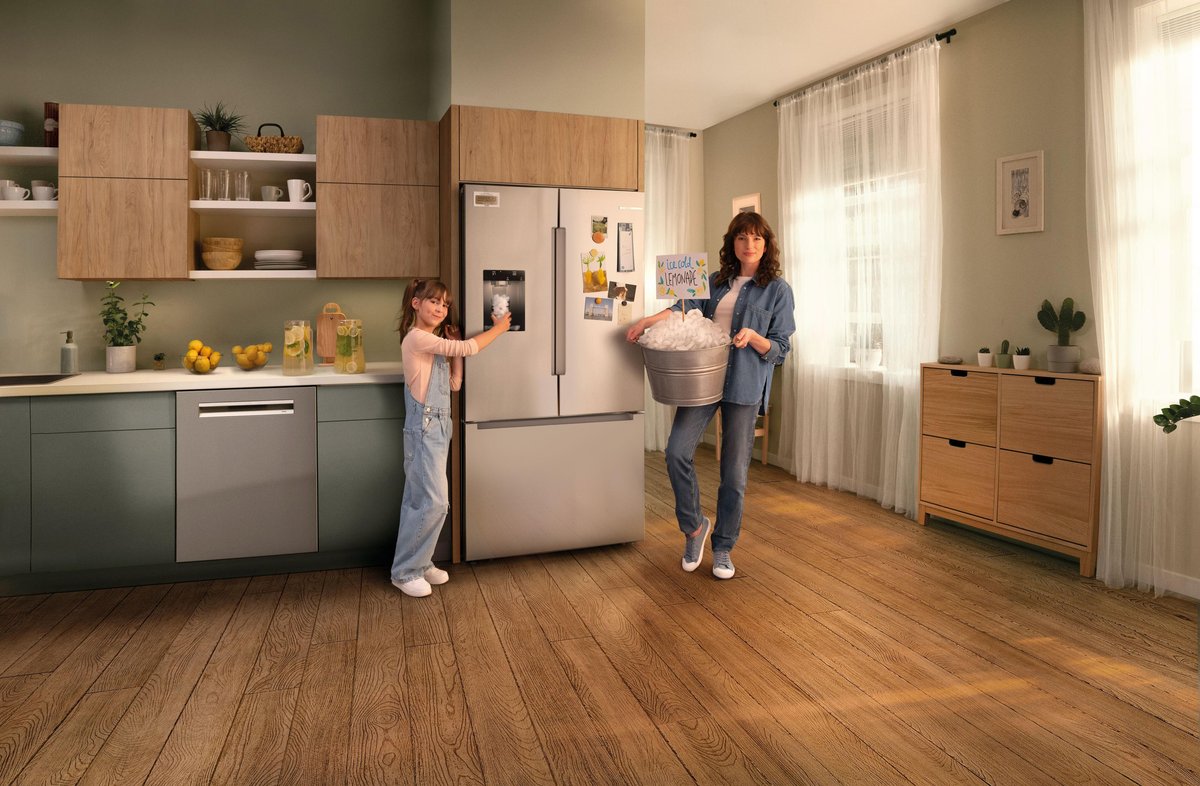
Credit where it’s due, though: BSH claims it was the first company globally to bring a Matter-enabled home appliance to consumer market, at IFA Berlin in 2024, and at CES 2025 it announced a Matter-enabled Bosch 100 Series French Door Bottom Mount refrigerator for the US, with Alexa compatibility. BSH lists Matter capability on Bosch 100, 300, and 500 Series refrigerators, and its 2025 lineup also covered a 500 Series dishwasher, an 800 Series espresso machine, and an 800 Series microwave drawer, with a Series 8 oven and Series 6 venting cooktop for Europe only.
The catch is that rollout is uneven and region-dependent — Bosch’s own North American support material has stated Matter isn’t currently supported on Bosch appliances in the US and Canada, even while the fridges ship with the capability. Check Home Connect’s Matter page and your specific model and region before you spend anything. Europe is clearly first in line here.
Your controller matters more than your appliance
Here’s the thing that trips people up: even if you buy a Matter appliance, whether you can see it depends entirely on what’s running your smart home.
Home Assistant and Homey lead. Home Assistant’s Matter Server 9.0, shipped in June 2026 after roughly four months of beta, moved the platform to Matter 1.5.1 with 1.6 on deck, and it’s noticeably more stable. Homey went further on appliances specifically — firmware 13.1.0, released April 1, 2026, added dishwashers, laundry dryers, microwaves, ovens, EV chargers, water heaters, and smart water valves in one shot. If you want appliance support today, one of these two is the answer, and it isn’t close.
SmartThings is solid and supports Matter broadly, though Samsung’s own Bespoke appliances reach you through Samsung’s cloud rather than as Matter devices offered to other fabrics. Great if you’re already Samsung. Less useful as a bridge out.
Apple, Google, and Alexa are the laggards. All three handle robot vacuums and the basics well. None of them exposes a dishwasher, washer, dryer, oven, or cooktop as a first-class device. Apple in particular has been slowest — the Bosch bridge situation above says it all.
If your smart home runs on Apple Home and you want appliance automation this year, running Home Assistant alongside it isn’t optional. It’s the workaround. A Home Assistant Green or Yellow sitting next to your Apple TV, with appliances landing in Home Assistant and useful states pushed back into HomeKit, is the pattern that actually works. Note that Green needs a Connect ZBT-2 dongle to run Thread or Zigbee — and the ZBT-2 does one or the other, not both at once — while Yellow has an integrated radio.
What to actually buy in 2026
Don’t pay a premium for “Matter-ready” on a large appliance. Marketing claims and actual certification are different things. Verify on the CSA’s own product listings before you believe a spec sheet — if it isn’t there, it isn’t certified.
Do buy Matter for robot vacuums and room ACs. These categories work, the certified product list is real, and the automation payoff is immediate.
Buy the appliance, not the app. Pick your dishwasher on wash performance, noise, and rack layout. The connectivity is going to be vendor-locked for the life of the machine either way, and a 42 dBA dishwasher you love beats a noisy one with a nicer app.
Bridge the dumb stuff instead. Most of what you want in a kitchen — knowing when the laundry finished, whether the oven is still on, whether someone left the hob running — can be solved with sensors rather than a new appliance. A vibration sensor on the washer gives you finish notifications for a fraction of the price. A smart plug with energy monitoring tells you an appliance’s state from its draw. For gas hobs specifically, a dedicated gas leak detector is worth more than any Matter oven integration, and it works with the hardware you already own. And for anything with a remote, a Matter IR blaster covers a surprising amount of ground.
If you’re in Europe and buying BSH, the Smart Kitchen Dock is genuinely worth it — as long as you’re not on Apple Home. Elsewhere, wait.
What to watch next
Three things would change this picture.
The first is Apple adding appliance device types. Apple has historically been last to Matter device categories and then implements them cleanly — vacuums took until iOS 18.4 but arrived in decent shape. Appliance support in a future release would immediately make every Bosch dock and Midea dishwasher more useful.
The second is more brands actually certifying the big categories. BSH has moved — refrigerators, a bridge, a stated 2025 lineup — but Midea and Quectel still hold the entire dishwasher and washer certification list, which is embarrassing for an industry that put out press releases about this in 2023. One Whirlpool, Samsung, LG, or Electrolux certification would break the logjam, because appliance makers move in herds.
The third is regulatory pressure. EU energy labelling and right-to-repair rules keep pushing toward standardised, non-proprietary device interfaces. Matter is the obvious vehicle if that pressure lands on connectivity — and Europe is already where the Bosch bridge shipped first.
Until then, the honest summary is this: Matter has a beautifully complete appliance specification and almost nothing to run it on. The categories that work — robot vacuums, room ACs, air quality — work because a handful of manufacturers decided interoperability was worth more than lock-in. The kitchen is still waiting for someone big enough to make the same call. It’s frustrating, same as it is with faucets, but it’s not permanent. Buy the appliance you’d want if it were dumb, automate around it with cheap sensors, and let the standard catch up on its own schedule.