Outdoor security cameras are the one smart-home category where the buying decision has almost nothing to do with the camera. The hardware converged years ago — nearly everything worth buying now shoots at least 2K, sees in color at night, and runs for months on a battery. What actually separates these products is the part nobody puts on the box: whether you’ll be paying a monthly fee for the rest of your life, where your footage physically lives, and whether the camera will ever talk to the rest of your smart home.
That last question got genuinely interesting in the last twelve months. Matter 1.5 finally added cameras to the standard — and, in classic Matter fashion, almost nobody actually ships it yet. So let’s sort out what’s real. Here are the outdoor cameras worth your money in 2026, grouped by the only thing that matters: the business model behind them.
The real dividing line: subscription vs. no subscription
Ignore megapixel counts for a second. The single biggest financial decision you’ll make with an outdoor camera is whether it records to a card in your hand or to a cloud you rent.
A no-subscription camera stores footage on a microSD card or a local hub, and everything the camera can do, it does out of the box, forever. A subscription camera typically streams live for free but records nothing unless you pay — and the “smart” features (person vs. package detection, activity zones, longer video history) are paywalled on top.
Over a five-year ownership window, a $10/month plan across a couple of cameras quietly costs more than the cameras themselves. That’s not automatically a rip-off — cloud recording is genuinely safer if a burglar walks off with the camera and the SD card inside it — but you should decide with eyes open. Everything below is sorted with that in mind.
The no-fee champions: Reolink and Eufy
If “I never want to pay a monthly fee” is your line in the sand, these two brands own the category.
Reolink Argus 4 Pro and Altas PT Ultra
Reolink is the enthusiast favorite for a simple reason: it sells 4K, no-subscription cameras and then gets out of your way. The Reolink Argus 4 Pro (around $189.99 at the time of writing, often discounted to ~$150 during sales) stitches two lenses into a single seamless 180-degree panoramic view at 4K — no blind spot down the middle, which is the usual failing of ultra-wide cameras. It’s battery-powered with an optional solar panel, and records to a microSD card up to 512GB or to a Reolink Home Hub. No cloud account required to do any of it.
If you’d rather have pan-and-tilt coverage, the Altas PT Ultra (typically found around $130) is the one to beat: 4K, 360-degree rotation with auto-tracking that follows a person across the yard, ColorX night vision that produces genuinely usable color images in near-darkness, dual-band Wi-Fi 6, and a battery Reolink rates at up to ~500 days between charges. Same deal on storage — local card, no fees.
The catch with Reolink is polish. The app is powerful but busy, the ecosystem integrations are thin (HomeKit support is limited to certain models, and there’s no Matter), and the design language is unapologetically “security gear,” not “decor.” If you want maximum capability per dollar and don’t care about a slick app, this is the value king.
Eufy SoloCam S340 and eufyCam S3 Pro
Eufy is the more consumer-friendly take on the same no-fee philosophy. The SoloCam S340 is a clever piece of hardware: it pairs a 3K wide-angle lens with a second telephoto lens for up to 8x hybrid zoom, sits on a 360-degree pan-and-tilt head, and ships with an integrated solar panel that keeps it topped up on as little as two hours of daily sun. Footage lands on 8GB of built-in storage or a HomeBase, and there’s no monthly fee. Street price bounces between roughly $130 and $200 depending on the sale.
Step up to the eufyCam S3 Pro and you get 4K, Eufy’s “MaxColor” night vision, on-device face recognition, and expandable local storage through a HomeBase — sold as multi-camera kits for whole-home coverage. It’s the most polished no-subscription system you can buy, and the local face recognition is genuinely useful for cutting down false alerts.
One honest caveat, because we don’t do sponsored fluff here: Eufy’s “local-only, no cloud” marketing took a real credibility hit a few years back when researchers showed some footage was reachable via the cloud despite the promises. The company has since tightened things up and added toggles, but if airtight privacy is the reason you’re buying Eufy, go into the settings and verify the cloud/encryption options yourself rather than trusting the box. If a nursery or indoor camera is on your list too, the same trust math applies — we dug into it in our smart baby monitor showdown.
The subscription ecosystems: Arlo and Ring
These two make excellent hardware and then ask you to keep paying for it. That’s the trade.
Arlo Pro 6
Arlo quietly refreshed its lineup, and the current Arlo Pro 6 (6th Gen, about $124.99 for a single camera) is a much better deal than the older Pro 5S it replaces, which still lingers on shelves at a higher price. You get 2K HDR video, a 160-degree field of view, color night vision, an integrated spotlight and siren, USB-C charging, and dual-band Wi-Fi. The AI detection — distinguishing people, vehicles, animals, and packages — is among the best in the business.
Here’s the rub: almost none of that AI, and no cloud recording at all, works without an Arlo Secure plan. That’s $7.99/month for a single camera, or $17.99/month for the Secure Plus tier that covers unlimited cameras and adds emergency response. Skip the plan and your $125 camera becomes a live-view-only doorstop with no saved footage. Arlo’s hardware is genuinely great; just budget for the rent.
Ring Stick Up Cam Pro
Ring’s advantage is the ecosystem: if you’re already in Amazon’s world — Echo, Alexa, a Ring doorbell — the Stick Up Cam Pro slots in effortlessly and shows up on your Echo Show with a voice command. It comes in battery, plug-in, and solar flavors (roughly $100 for the battery version), with color night vision, HDR, and Ring’s “3D Motion Detection” that maps where in your yard motion happened.
Same catch as Arlo, and arguably worse: without a Ring subscription (their entry plan runs about $4.99/month for a single device), the camera records nothing — you get live view and real-time notifications only. Ring also carries more privacy baggage than most, given its history of law-enforcement data-sharing programs. It’s a fine camera; it’s a philosophy you should opt into deliberately, not by accident. If a doorbell is what you’re really shopping for, Ring shows up again in our 2026 smart doorbell buyer’s guide.
The smart-home native: Aqara Camera Hub G5 Pro
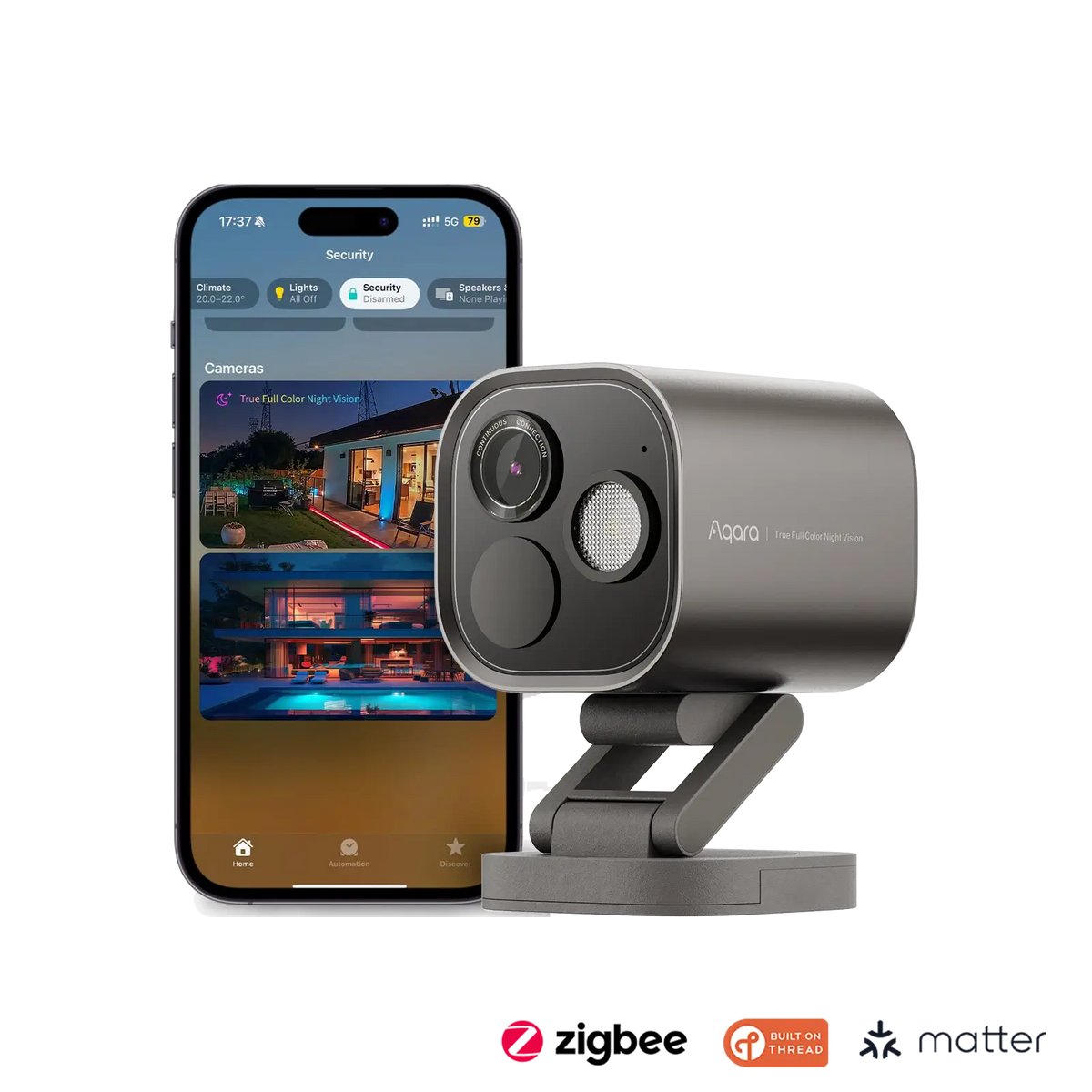
Here’s the pick for people who think of a camera as one node in a larger system rather than a standalone gadget. The Aqara Camera Hub G5 Pro (around $170–180) does something none of the above can: it’s a camera and a full smart-home hub in one weatherproof (IP65) body. It houses a Zigbee 3.0 radio and a Thread border router, so it connects your sensors and lights while it watches your driveway.
The camera itself is no slouch — a 4MP sensor with a bright lens and a built-in spotlight delivers true-color night vision that’s among the best you can get, footage records locally to microSD (or a NAS) with no mandatory subscription, and it supports HomeKit Secure Video with end-to-end encryption for Apple households. Crucially, Aqara is one of the very few brands actually chasing Matter camera support (more on that below), with beta rollouts underway for the G5 Pro. The trade-off is that it’s a wired camera, not a battery one, so you’ll need power at the mounting point. For anyone building an Aqara- or Apple Home-centric setup, it’s the most future-proof option here — and if you want to see how the rest of the Aqara ecosystem fits together, that’s exactly what a smart-home starter setup is built around.
The budget pick: TP-Link Tapo C425
Not everyone needs 4K and face recognition. If you just want a competent, no-drama camera watching a side gate, the TP-Link Tapo C425 is the value shock of the category — frequently on sale around $89.99 (down from $129.99). You get 2K QHD, a 150-degree field of view, color night vision, an IP66 weatherproof rating, a magnetic mount that installs in seconds without drilling, and a battery TP-Link rates at up to 300 days. It records free to a microSD card up to 512GB, needs no hub, and charges no subscription. It won’t match a Reolink or eufyCam on outright image quality or smarts, but dollar for dollar, nothing else comes close.
So where does Matter actually stand?
This is the question everyone’s asking, so let’s be precise instead of hopeful. In November 2025, Matter 1.5 officially added camera and doorbell support to the standard. On paper, that means any Matter camera should stream to any Matter platform — Apple Home, Google Home, Alexa, SmartThings — regardless of brand. It’s the fix the whole category has been waiting years for.
In practice? It’s barely real yet. As of mid-2026, only Samsung SmartThings has actually implemented Matter camera support on the controller side. Aqara’s tiny G350 became the world’s first Matter-certified camera, shipping since March — but for now it onboards only through SmartThings. Apple, Google, and Amazon are all “expected to follow,” which, if you’ve watched Matter’s track record, means don’t hold your breath for this year. And the big camera incumbents — Reolink, Eufy, Arlo, Ring — haven’t committed to Matter cameras at all. They have thriving subscription and app businesses that a universal standard would only commoditize.
The takeaway: do not buy an outdoor camera in 2026 for its Matter support. Buy it for the app, the storage model, and the ecosystem it lives in today. Matter cameras are a 2027-and-beyond story. If you want the full picture of what the standard did and didn’t deliver this cycle, our breakdown of what Matter 1.6 actually changed is the honest version.
How to actually choose
- You never want a monthly bill: Reolink (max capability) or Eufy (max polish). Both record locally, both do everything on day one.
- You’re deep in Amazon or want the simplest possible setup: Ring — just accept the ~$5/month to record anything.
- You want the best AI detection and don’t mind renting it: Arlo Pro 6 on a Secure plan.
- You’re building an Apple Home, Aqara, or Matter-forward smart home: Aqara Camera Hub G5 Pro, hands down — it’s the only one that’s also a hub.
- You just need a solid camera for under $100: TP-Link Tapo C425. Done.
Two universal tips before you mount anything. First, put local storage in everything you can — an SD card is a one-time $15 that makes you subscription-optional. Second, aim cameras at your own property lines, not your neighbor’s windows; good coverage is about entry points and driveways, not surveilling the whole street.
The verdict
The outdoor camera market in 2026 is, quietly, a great place to be a buyer. Battery life is measured in months, 4K and color night vision have trickled down to sane prices, and the no-subscription options are finally good enough that you don’t have to choose between quality and freedom from monthly fees. My default recommendation for most people is a Reolink or eufyCam for the no-fee freedom, an Aqara G5 Pro if you’re building a real smart home around it, and a Tapo C425 if you just need eyes on a door for cheap.
As for Matter — it’s coming, it’s real in the spec, and it’s still a promise rather than a product for all but SmartThings users. Buy for what your camera does today, and treat any future Matter update as a pleasant surprise rather than a reason to wait. The best security camera is the one that’s already recording.