For years, robot lawn mowers were the awkward cousin of the smart home — fenced into your yard with a literal buried boundary wire, controlled by an app that talked to nothing else, and priced like a used car. The category felt frozen in 2015 while every other outdoor device — sprinklers, lights, sensors — quietly joined the connected fold.
That ended in 2026. The new generation of robot mowers throws out the wire entirely, navigates with LiDAR and AI cameras, and ships at prices that finally make sense for normal-sized lawns. Mammotion, Segway, Eufy, and Worx are now shipping mowers that map your yard from your phone in under an hour, with no perimeter trench and no specialist install.
But here’s the catch: not a single mainstream robot mower in 2026 supports Matter. So if you’ve spent the last two years building a unified Apple Home, Google Home, or SmartThings setup, your new $2,000 yard robot is going to live in its own app, with its own cloud, talking only to Alexa and Google Assistant via voice — and that’s it. The wire is gone. The walled garden, less so.
This is the buyer’s guide to the wire-free revolution, what’s actually worth your money in 2026, and where the smart home gap still hurts.
What “wire-free” actually means in 2026
The old way: dig a trench around your lawn, bury a low-voltage wire, plug it into a base station. The mower follows the magnetic field. Move a flowerbed, you re-trench. It worked, but it was the smart home equivalent of stringing Cat5 between your light bulbs.
The new way splits into three navigation approaches, and the choice matters more than the brand:
RTK GPS — A second base station gives the mower centimeter-accurate satellite positioning. Reliable in open lawns, struggles under heavy tree cover where signal drops. Used by older Segway and Husqvarna models.
Vision AI — Cameras and a neural network identify grass vs. non-grass in real time, no satellites needed. Set boundaries by walking the perimeter with the mower or tracing them in an app. Eufy E15/E18 and Worx Landroid Vision pioneered this.
LiDAR + Vision fusion — A spinning laser scanner builds a 3D map while cameras handle obstacle classification. Works in shade, around trees, in tight beds. The 2026 Mammotion LUBA mini 2 AWD is the first to combine all three (LiDAR, RTK, and vision), and it’s a noticeable jump in reliability.
The takeaway: if your yard has trees, fences, or any signal-blocking structures, vision or LiDAR-based mowers will outperform pure RTK every time. Pure-RTK was a 2023 compromise. In 2026, you can do better.
The contenders worth your money
Eufy E15 and E18 — the simplest entry into wire-free
The Eufy E15 ($1,799) and the larger E18 ($2,599, US-only) are the easiest robot mowers to set up, full stop. There’s no RTK base station, no boundary wire, no QR-code dance. You walk the perimeter once with the mower in tow — it learns the edge by camera — and it gets to work.
The E15 handles up to 800 m² (about 0.2 acres); the E18 stretches that to 1,200 m² (0.29 acres). Both run a vision-only “FSD-style” navigation system that’s genuinely impressive in obstacle avoidance — Tom’s Guide tested it against garden hoses and pet toys and found it dodged most things cleanly.
The honest limitation: vision-only mowers struggle when light conditions change abruptly — heavy shade transitioning to bright sun can confuse the AI, and a few reviewers report the E15 occasionally getting “stuck” rerouting around the same obstacle. It also caps out at 0.3 acres, so anyone with a meaningful yard is out.
Buy if: You have a small-to-medium suburban lawn under 0.3 acres, you want zero-fuss setup, and you live mostly inside Apple Home or Google Home but are willing to use a separate Eufy app for outdoor.
Segway Navimow i105N / i110N — the value play
The Navimow i105N and i110N are the cheapest credible wire-free mowers in 2026. The i105N now sits at $799 (regular price $999), the i110N at $1,099 (regular $1,299). They use RTK GPS with a vision assist for obstacle avoidance — not as forgiving as the Eufy under tree cover, but a noticeable price advantage.
The i105N covers 0.125 acres, the i110N covers 0.25 acres. Both run at 58 dB — quieter than a normal conversation, which means you can run them at 7 AM without your neighbors plotting your demise.
For 2026, Segway also released the X3 series for larger lawns, but for the typical suburban quarter-acre, the i110N is the sweet spot. Setup involves placing the RTK base station with a clear sky view, which is the one constraint — if your yard is heavily wooded or your only base station spot is under an eave, this isn’t your mower.
Buy if: You have an open suburban lawn, you want the lowest credible price, and the idea of mounting a small RTK antenna doesn’t bother you.
Mammotion LUBA mini 2 AWD — the LiDAR flagship for tricky yards
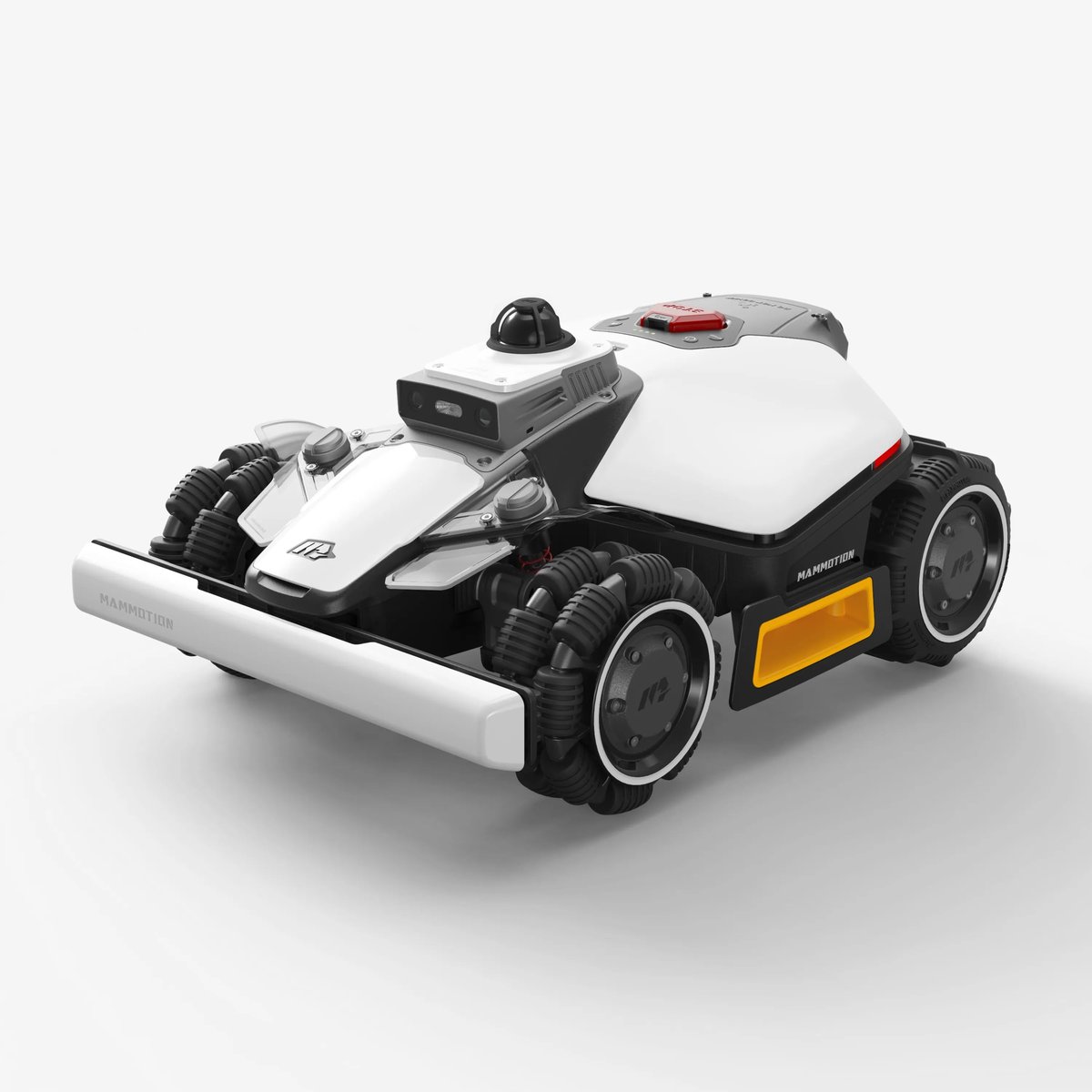
This is the technically most impressive mower of 2026. The LUBA mini 2 AWD 1500 at $1,999 fuses 360° LiDAR, dual cameras with AI vision, and RTK into a single navigation stack. The result is a robot that handles complicated yards — irregular shapes, multiple zones, narrow passages between flowerbeds — better than anything else in this price range.
It’s rated for 0.37 acres, climbs slopes up to 80% (38.6°) thanks to all-wheel drive, and supports 20 independently programmable mowing zones. The “DropMow” feature lets you draw a boundary on the app and drop the mower at any spot — no return-to-base required to start a job.
The trade-off is software polish. Mammotion’s app has improved dramatically over 2025, but it’s still less refined than Eufy’s, and customer support is firmly on Chinese-business hours. Firmware updates are frequent (usually a good thing) but occasionally introduce regressions. There’s also a mature Home Assistant integration on GitHub, which is more than most competitors offer for power users.
Buy if: You have a complicated yard with slopes, trees, or tight spaces; you want the best obstacle handling money can buy under $2K; and you’re comfortable with a slightly rougher software experience in exchange for top-tier hardware.
Worx Landroid Vision Cloud — the camera AI veteran
Worx pioneered camera-based AI navigation back in 2023 with the original Landroid Vision, and the 2026 Vision Cloud lineup refines the formula. The WR310 covers 1/4 acre at $1,799, the WR320 handles 1/2 acre, and the WR344 4WD scales to a full acre.
The pitch is “set it and walk away” — no boundary mapping at all. The mower’s full-HD wide-angle camera identifies grass vs. not-grass and stays where it should, processing one frame every 0.05 seconds via an onboard neural network. It also auto-schedules based on local weather, sun exposure, and grass species, which sounds gimmicky until you see it actually skip mowing the day before a heat wave.
The Cloud variant adds lifetime free RTK service for backup positioning when vision struggles — a useful belt-and-braces upgrade. Worx has been at this longer than the new entrants, and it shows in how few “stuck” reports the Vision Cloud generates compared to first-gen vision systems.
Buy if: You want the longest-running track record in vision-based mowing, and you value a true zero-mapping setup over the precision of LiDAR or RTK.
Husqvarna Automower 450X NERA EPOS — the premium workhorse
If you have a serious lawn — multiple acres, complex terrain, the kind of yard where a $2,000 mower would be perpetually overwhelmed — the Husqvarna Automower 450X NERA EPOS remains the benchmark. It handles up to 7,500 m² (1.85 acres), uses Husqvarna’s EPOS satellite-based virtual boundary system, and is built like a Volvo. The full bundle with reference station runs around $5,000.
It’s not the most exciting mower of 2026 — Husqvarna is iterating slowly — but it’s the most reliable, the most serviceable through professional dealers, and the one your neighbor’s lawn-care company is most likely to actually fix when it breaks. For lawns where downtime matters, it’s still the answer.
Buy if: You have a large or commercial-grade lawn, you want dealer support, and “professional install” is a feature, not a bug.
The Matter problem: why your robot mower is still an island
Here’s the awkward truth that nobody selling these mowers wants to highlight: none of them speak Matter in 2026. Not Mammotion, not Segway, not Eufy, not Worx, not Husqvarna.
This matters because Matter actually has a device type that fits — the spec includes a RoboticVacuumCleaner cluster with operational status, operating mode, and a serviceArea cluster that maps cleanly to “mow this zone.” Robot vacuums like the Roborock S9 MaxV and Dreame X50 Ultra are starting to ship with Matter 1.4 support. Robot mowers, mechanically and conceptually similar, have not.
The result is that a 2026 smart home loses some genuinely useful automations:
- Pause when sprinklers run. Your Rachio fires the irrigation cycle. Your mower keeps mowing through the spray. There’s no Matter handshake to coordinate them.
- Mow when you leave for work. Apple Home or Google Home knows you’ve left geo-fence. Without Matter, it can’t tell the mower to start.
- Stop when the doorbell sees a delivery. The Aqara G410 or Nest Doorbell detects a package. The mower keeps going. No coordination layer.
You can hack around this with Home Assistant — the Mammotion and Husqvarna integrations are actually quite good — but that’s a power-user solution, not a mainstream one. If you’re invested in HomeKit, Apple’s recent Matter updates make robot vacuum integration native. Mowers? Still nothing.
The most honest framing: in 2026, a robot mower is a smart device the way a robot vacuum was in 2018 — connected, app-controlled, but not really part of your smart home. It’ll get there. It’s just not there yet.
If local control matters to you, see our breakdown of why local voice and local automation are pulling ahead in 2026.
How to choose: a 60-second decision tree
- Lawn under 0.2 acres, want simplicity: Eufy E15 ($1,799). Walk the perimeter, you’re done.
- Lawn 0.2–0.3 acres, tight budget: Segway Navimow i105N ($799) or i110N ($1,099). Best dollar-per-square-meter in the category.
- Lawn up to 0.4 acres, complex terrain or slopes: Mammotion LUBA mini 2 AWD ($1,999). LiDAR earns its keep.
- Lawn 0.5–1 acre, want zero mapping: Worx Landroid Vision Cloud (WR320 or WR344, ~$1,800–$2,500).
- Lawn over 1 acre, or you want dealer support: Husqvarna Automower 450X NERA EPOS (~$5,000).
If you’re outfitting a rental or a property where you can’t drill or trench at all, the same logic applies as with other no-install smart home gear for renters — vision-based mowers like the Eufy E15 are the cleanest fit because they require zero infrastructure.
What I’d actually buy in 2026
If I were buying for a typical 0.25-acre suburban lawn today, I’d take the Eufy E15 over the Mammotion LUBA mini 2 — even though the Mammotion is technically the better machine. Here’s why: the Eufy’s setup is genuinely 30 minutes from box to first cut, the app is the most polished in the category, and I’d rather have less navigation sophistication that I can trust than more sophistication that occasionally gets weird.
If my yard had real complications — slopes, heavy tree cover, multiple zones — the Mammotion LUBA mini 2 AWD becomes the obvious answer. The LiDAR isn’t marketing fluff; it’s the difference between a mower that confidently traces the edge of your flowerbed and one that politely backs off and leaves a foot of unmown grass.
For anyone on a tight budget, the Segway Navimow i105N at $799 is a remarkable price point that didn’t exist a year ago. It won’t be your forever mower if your needs grow, but it’s the best on-ramp to the category.
The category will look very different in 2027 once Matter 1.6 (or 1.7) inevitably extends to outdoor robotics. Until then, treat your robot mower as a great standalone appliance — not a smart home citizen — and you’ll be happy with the purchase.
Either way: the boundary wire is dead, and that alone is worth celebrating.