There’s a particular kind of household chore that smart home tech has spent a decade conspicuously ignoring: cleaning your windows. We automated the vacuuming, the mopping, the lawn, even the pool. But the glass? Still you, a bucket, a squeegee, and a step ladder you don’t entirely trust. In 2026, a small but maturing category of robot window cleaners is finally trying to fix that — and the good ones have quietly gotten very good.
I’ve been skeptical of these gadgets for years. The early models were loud, dumb, and prone to mapping a window like a drunk Roomba. The 2026 generation is a different animal: AI path planning, cordless battery stations, ultrasonic misting, and safety systems engineered specifically so the thing doesn’t peel off your third-floor window and shatter on the patio. Here’s an honest breakdown of what’s actually worth buying, who should skip the category entirely, and why — like so many home robots — none of these speak Matter.
How robot window cleaners actually work
The basic premise is simple and a little unnerving: a robot sticks itself to a vertical pane of glass using suction (or a vacuum impeller), then crawls across the surface wiping as it goes. A microfiber pad on the bottom does the scrubbing, and most models spray a fine mist of water or cleaning solution ahead of the pad.
The two things that separate a good unit from a scary one are navigation and safety. Cheap robots clean in fixed, random-ish patterns and miss patches. The better ones use onboard sensors and edge detection to map the pane, find the borders, and clean in efficient overlapping passes. On the safety side, every reputable model now pairs its suction motor with a backup battery (UPS) that keeps the robot clamped to the glass for 20+ minutes if your power cuts out, plus a physical safety tether you anchor before letting it loose on an upper-floor window. Trust the tether. Always use the tether.
One more practical note up front: these are for glass and other smooth, sealed surfaces — windows, glass doors, mirrors, shower enclosures, tiled walls. They are not for textured, frameless-but-beveled, or heavily divided panes. If your home is all small French-door panes, no robot here will fit, and you should stop reading and buy a good squeegee.
The premium pick: Ecovacs Winbot W2 Pro Omni
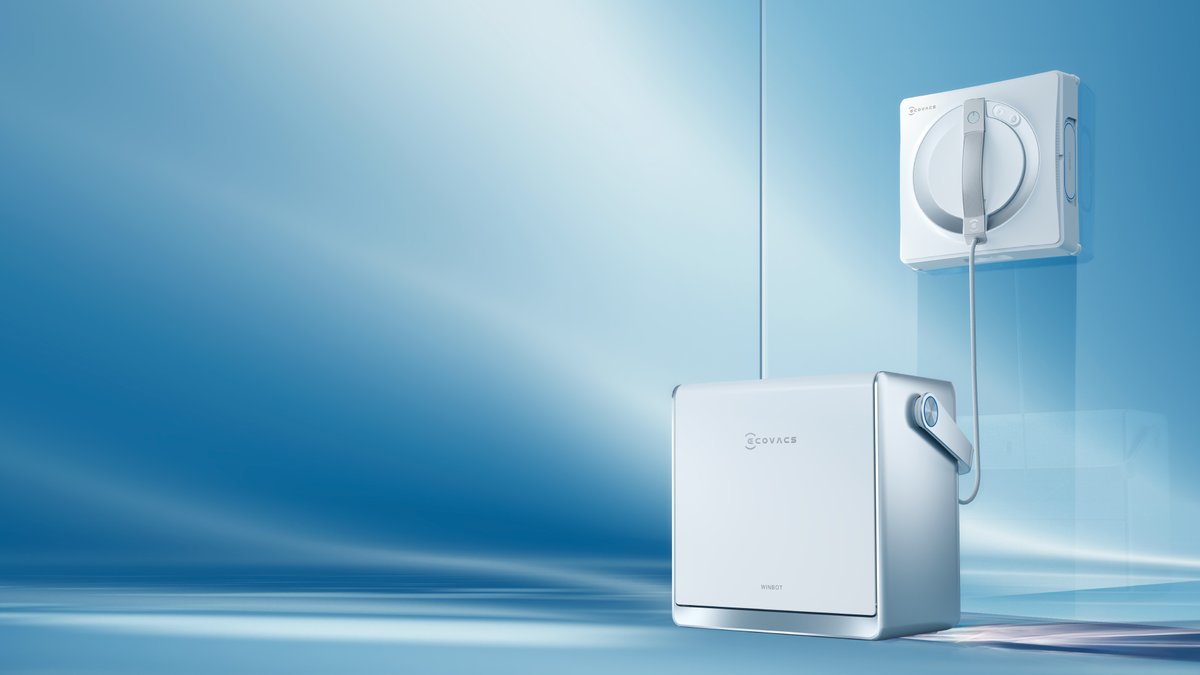
The Ecovacs Winbot W2 Pro Omni is the closest thing this category has to a flagship, and it’s the one I’d hand to someone who just wants the most capable machine and isn’t squeezing every dollar.
The headline feature is the cordless portable station. Instead of trailing a wall-outlet cable across your living room, the W2 Pro Omni docks to a 5.5 kg battery base that powers the robot and acts as control panel, charger, and anchor. The station delivers over 800N of holding force as a fail-safe, and a single charge runs roughly 110 minutes — about 55 square meters of glass — on its 4,500 mAh battery. For anyone cleaning a lot of windows in one session, ditching the extension cord is genuinely liberating.
It’s smart, too. Ecovacs’ WIN-SLAM 4.0 navigation maps each pane and, the company claims, cleans about 37% faster than the previous generation, with a dedicated edge-following mode and a three-nozzle wide-angle spray that wets the glass more evenly than older single-jet designs. It handles both framed and frameless windows, with a minimum working size of 30 × 40 cm.
At $499 MSRP (and frequently discounted to the $399–450 range), it’s not cheap. And it’s not perfect: you’ll want to swap the microfiber pad after roughly every window to avoid streaking, the solution tank empties faster than you’d like, and like every robot here it leaves a 1–2 mm unreached strip in tight 90° corners. It also gets nervous on windows with wide, sloped exterior trim. But for streak-free results on big, standard panes with zero cord wrangling, nothing else is quite as polished.
If you want to save money without losing cleaning quality, the step-down Winbot W2S Omni is worth a look — reviewers consistently find it leaves glass just as clean as the Pro. The roughly $180 premium on the Pro mostly buys you the enhanced edge mode, not better core cleaning. Most people don’t need it.
The big-window specialist: Hobot S7 Pro
Hobot has been making window robots longer than almost anyone, and the Hobot S7 Pro takes a fundamentally different approach to the problem. Where Ecovacs slides a pad across the glass, the S7 Pro uses dual reciprocating cleaning pads that oscillate at around 600 strokes per minute with a 4 mm stroke — physically mimicking the back-and-forth of hand-wiping. The result, as TechRadar found in testing, is a robot that’s a genuinely big help on large picture windows and one of the few that can actually clean into corners, because those twin pads reach all the way to the edges.
It also brings the highest suction figure in the category — a quoted 4,800 Pa — which translates to confidence on big exterior panes where adhesion is everything. At around $439–459, it lands right next to the Ecovacs W2 Pro Omni, so the choice between them is really about philosophy: Ecovacs gives you cordless freedom and slick app navigation; Hobot gives you superior corner coverage and that hand-wipe finish, tethered to a power adapter with a battery backup for safety.
The catch — and there’s always a catch with these — is that the S7 Pro’s strength is also its constraint. It’s optimized for big, open glass. On smaller or oddly trimmed windows, all that corner-reaching hardware has less room to shine. Buy it if your home has expansive windows, sliding glass doors, or a sunroom; look elsewhere if your panes are modest.
The value play: Hobot 2S
Not everyone needs a $450 robot. The Hobot 2S sits in the $250–300 range and is the model I’d point most first-time buyers toward. Its standout trick is an ultrasonic spray system that atomizes cleaning fluid into a finer, more even mist than gravity-fed designs — which, counterintuitively, often produces a more streak-free finish on large flat windows than pricier robots. It’s also notably quiet at roughly 63–64 dB, has larger pads and dual tanks for longer runs between refills, and earns repeated praise for efficient route planning.
It won’t reach into corners the way the S7 Pro does, and it’s a corded unit, so you’re managing a cable. But for general-purpose cleaning of standard windows and glass doors, it delivers most of the value of the flagships at a meaningfully lower price. If you’re curious whether this whole category is for you, the 2S is the low-risk way to find out.
The high-rise and budget option: Mamibot
If you live in an apartment tower, adhesion security matters more than any other spec, because a fall isn’t an inconvenience — it’s a liability. Mamibot’s iGLASSBOT W120-DP is built precisely for this, with a class-leading 3,200 Pa of suction aimed at keeping a firm grip on exterior high-rise glass. The cheaper, corded W120-T is the genuine budget entry point: it runs off mains power (no cordless station), grips at around 3,000 Pa, and includes the expected safety kit — multi-direction anti-fall sensors, a backup battery that holds the robot for about 20 minutes and sounds an alarm if power is cut, and a physical safety rope in the box.
Mamibot is the no-frills end of the market. You don’t get slick app mapping or ultrasonic misting, and pricing on these units bounces around wildly between retailers, so shop carefully and ignore the obviously-broken listings. But if you want the cheapest way into the category, or you specifically need maximum suction for an upper-floor exterior pane, Mamibot is the pragmatic choice.
The elephant in the room: none of these are “smart home” devices
Here’s the part that frustrates me as someone who automates everything. For all the AI navigation and app control, not one robot window cleaner on the market speaks Matter, Thread, HomeKit, or even reliably integrates with Alexa or Google Home. You can’t put a window-cleaning robot in a scene. You can’t tell Siri to clean the conservatory while you’re at work. They’re islands — controlled by a remote, a button on the unit, or at best a single-purpose companion app.
This isn’t unique to windows. It’s the same story we’ve watched play out with robot lawn mowers, robot pool cleaners, and EV chargers: high-value home robots that live entirely outside the unified smart home standard everyone else is rushing to adopt. Part of it is practical — a window robot is an attended, occasional-use device, not an always-on sensor, so the case for cloud-and-Matter integration is genuinely weaker. But part of it is just that the category is young and the manufacturers haven’t prioritized it. Until they do, treat these as smart appliances, not smart home citizens.
It also means there’s no automation safety net. You don’t deploy a window robot and walk away the way you do a vacuum. You set it up, anchor the tether, start it, and keep half an eye on it. That’s the honest reality of the category in 2026.
So, should you actually buy one?
It depends entirely on your windows and your patience.
Buy one if: you have lots of large, standard glass — big picture windows, glass balcony doors, a sunroom, or hard-to-reach exterior panes on an upper floor. This is where robots save you real time and real risk. For that profile, the Ecovacs Winbot W2 Pro Omni (or the cheaper W2S Omni) is the all-rounder, the Hobot S7 Pro is the corner-cleaning specialist for big glass, and the Hobot 2S is the smart value pick.
Skip it if: your windows are small, heavily divided, or oddly trimmed; if you only have a handful of panes a squeegee handles in ten minutes; or if you were hoping to fold window cleaning into your broader Matter automations. That last dream is still a few years off.
What’s clear is that the category has crossed a threshold. These are no longer gimmicks — they’re legitimately useful appliances that do a tedious, occasionally dangerous job better than most people do it by hand. They’re just not smart home devices yet. And if you’re automating the rest of the glass anyway, it’s worth pairing clean windows with smart curtains and blinds so the whole opening — pane and covering — finally pulls its weight.
The robots came for your floors, your lawn, and your pool. In 2026, they’ve finally come for your windows too. They just forgot to bring Matter along.