Every smart thermostat sold today measures the temperature of exactly one place: the hallway wall it’s screwed to. Then it heats or cools your entire house until that one spot is happy. If your bedroom sits above the garage, or your home office has three exterior walls and a west-facing window, the thermostat has no idea. It just knows the hallway is fine.
This is the most common complaint I hear about otherwise well-built smart homes, and it’s the one that Matter, Thread, and three years of AI assistant upgrades have done almost nothing about. You can hold a conversation with your speaker now. Your spare room is still 4°C colder than your living room.
Room-by-room climate control does genuinely work, and in some parts of the world it’s remarkably cheap. But which approach applies to you depends almost entirely on how your house moves heat around — and one of the two brands that defined the category just switched off its servers.
Start with the cautionary tale
Keen Home was, for the better part of a decade, one of the two names in smart vents — Shark Tank alumnus, motorised registers, the whole pitch. Visit keenhome.io today and you get a notice instead of a product page:
“After careful review of our product portfolio and long-term strategic priorities, we have made the decision to discontinue cloud-based support and app services for Keen Home products.”
End of service: Friday, March 20, 2026. That date has passed. Keen Home owners now have expensive motorised grilles with no brain — hardware in the floor, intelligence on a server that no longer answers.
I’m leading with this because it’s the defining risk of the whole zoning category: cloud-dependent, mechanically complex devices sold by small companies into a niche market. Before you spend $600, ask what the system does the day the vendor stops caring — the same question worth asking about any subscription-shaped smart home purchase.
Three houses, three completely different problems
Zoning advice is useless without knowing what’s behind your walls. Globally, there are three architectures, and they barely have anything in common.
Ducted forced air — dominant in North America, common in Australia. One furnace or air handler blows conditioned air through ducts to every room, with one thermostat and one giant fan. To zone this you have to control airflow, which is mechanically and physically awkward.
Hydronic radiators and underfloor — most of Europe, the UK, much of northern Asia. A boiler sends hot water to radiators, each of which already has a mechanical valve on it. Zoning is almost free: unscrew the manual knob, screw on a smart one. Europeans genuinely don’t know how good they have it.
Ductless mini-splits — Japan, Korea, Singapore, Southeast Asia, southern Europe, and increasingly everywhere as heat pumps spread. Every room already has its own head, so every room is already a zone. Your problem isn’t zoning, it’s that each head is controlled by a dumb infrared remote.
Work out which one you have before reading further. Two of the three sections below don’t apply to you.
Tier zero: stop moving air, start moving the sensor
Before you buy anything mechanical, try the cheap fix. Most decent thermostats support remote room sensors, which solve a surprising share of complaints — not by redirecting heat, but by changing which room the thermostat is trying to satisfy.
ecobee SmartSensor runs $79.99 for a two-pack and measures temperature and occupancy, so the thermostat averages only the rooms you’re actually in. Google’s Nest Temperature Sensor is $39 each or $99 for three, temperature only — you schedule which sensor takes priority rather than letting occupancy decide.
Be clear about the limit. This does not move one degree of heat from your living room to your bedroom; it changes the target. If your problem is “the thermostat says 21°C but I’m freezing in bed,” sensor priority fixes it — the system runs longer, the bedroom warms, the hallway overshoots a bit. If your problem is “the bedroom is 26°C while the office is 18°C at the same time,” no sensor will help. You need to physically redistribute air, and that costs real money.
Spend the $80 first anyway. It’s the best value in this article, and a lot of people who think they need zoning just need better sensing.
Tier one: smart vents, for ducted homes only
With Keen Home gone, Flair is effectively the category. Three parts: the Flair Smart Vent at $99 in sizes from 4"×10" up to 12"×12", a Flair Bridge at $99 to talk to them, and the Puck 2 at $124 as the per-room temperature sensor and optional wireless thermostat.
Do the arithmetic honestly. A four-room retrofit with one vent and one Puck each is $99 + 4×$99 + 4×$124 = $1,387. You can trim that — rooms can share a Puck — but “a few hundred dollars” isn’t the real number. A serious install lands between $700 and $1,500.
What you get for it is genuinely good software. Flair is an official integration partner of ecobee, Honeywell, Nest, Sensi, Carrier and Bryant, works with Amana, Daikin and Goodman thermostats, and hooks into Alexa, Google Assistant, Home Assistant and Control4. It reads your thermostat’s state and coordinates the vents around it rather than fighting it.
What you don’t get is Apple. No HomeKit, no Matter, and Flair has been fielding requests for both for years without shipping either. If your house runs on Apple Home, Flair is an app on your phone that doesn’t talk to anything else you own — a real gap given how much of the Matter 1.6 thermostat work went into making climate devices first-class citizens.
The part the marketing skips
Closing vents raises static pressure in your duct system. The blower pushes against whatever resistance the ducts present; block outlets and resistance climbs. In cooling, that means reduced airflow across the evaporator coil, which can freeze it. In heating, restricted airflow lets heat build up in the furnace — and an overheated heat exchanger can crack, which is a carbon monoxide problem, not an efficiency problem. Chronic high static pressure is also hard on blower motors and compressors.
HVAC contractors have been telling people not to close vents for decades, and they’re right on the physics. Throttle a couple of registers furthest from the air handler and you’re fine; go further and you’re gambling with equipment that should last 15–20 years.
To Flair’s credit, they take this seriously. Their software enforces a “1/3 rule” — no more than a third of the vents in a system may be closed at once — and a Back Pressure Protection algorithm decides which vent to reopen when the system wants to close one too many. There’s also a Static Pressure Kit with a differential pressure sensor that lets the system adjust that limit dynamically from real readings, though it’s a Pro-only accessory sold through installers rather than something you add to a cart.
The takeaway isn’t “don’t buy Flair.” It’s that the guardrails exist because the danger is real, and those guardrails also cap how much zoning you can actually get. If two-thirds of your vents must stay open, the temperature spread you can achieve between rooms is smaller than the marketing implies.
The Matter option, with an asterisk
There is exactly one Matter smart vent worth knowing about, and it works completely differently. The Cozy Home Labs Smart Vent is $99, speaks Matter over Wi-Fi with no hub required, and shows up in Apple Home, Google Home, Alexa and Home Assistant.
The trick is that it doesn’t close. It’s a register with fans in it — up to 125 CFM, under 40 dB, rated past 65,000 hours — that boosts airflow into a starved room instead of choking off the rooms that are fine. That neatly sidesteps the entire static pressure problem, because you’re adding air rather than restricting it.
Three caveats, and they’re significant. It only comes in 4"×10". It needs permanent mains power at every vent, which for floor registers means running the included 11-foot cable somewhere unattractive. And because Matter has no concept of a vent, it presents itself as a fan — you get a speed slider in Apple Home, not a climate device. It’s a clever product, but “buy nine of them” isn’t a plan.
Tier two: smart radiator valves, where zoning is actually solved
If you have radiators, this is the section that matters, and I’ll be blunt: you can zone an entire European home for less than the cost of one Flair room.
A thermostatic radiator valve (TRV) head unscrews and a smart one screws on. No wiring, no plumber, no ducts. Every radiator becomes an independently scheduled zone with its own temperature sensor. Four solid options in 2026:
Aqara Radiator Thermostat W600 — £49.99, and the value pick. It’s dual-protocol: as Matter over Thread it works natively with Apple Home, Google Home, Alexa, SmartThings and Home Assistant with no Aqara hub at all, or in Zigbee mode against an Aqara hub for deeper features inside Aqara’s ecosystem. Half-degree steps, up to two years from two AA cells. Reviewers consistently find the Zigbee mode more predictable than Thread, a familiar story across Aqara’s dual-stack devices. Pair it with a Climate Sensor W100 so the room’s real temperature drives the valve rather than the temperature of the metal it’s bolted to — which, as I argued in the temperature sensor showdown, matters more than people expect.
Eve Thermo (5th generation) — €79.95, roughly $95. Matter over Thread, no cloud account, no hub, no Eve bridge. If you value local-only operation and don’t want another account, this is the cleanest device in the category, and the best-built.
Tado Smart Radiator Thermostat X — €99.99 / £79.99, with a starter kit at €159.99 / £139.99 and a four-pack at €369.99 / £260.99. Thread and Matter native, and unusually it charges over USB-C instead of eating AA batteries. Tado’s scheduling and open-window detection are the most sophisticated here, and the system extends up to boiler control — which matters, see below. EU and UK only.
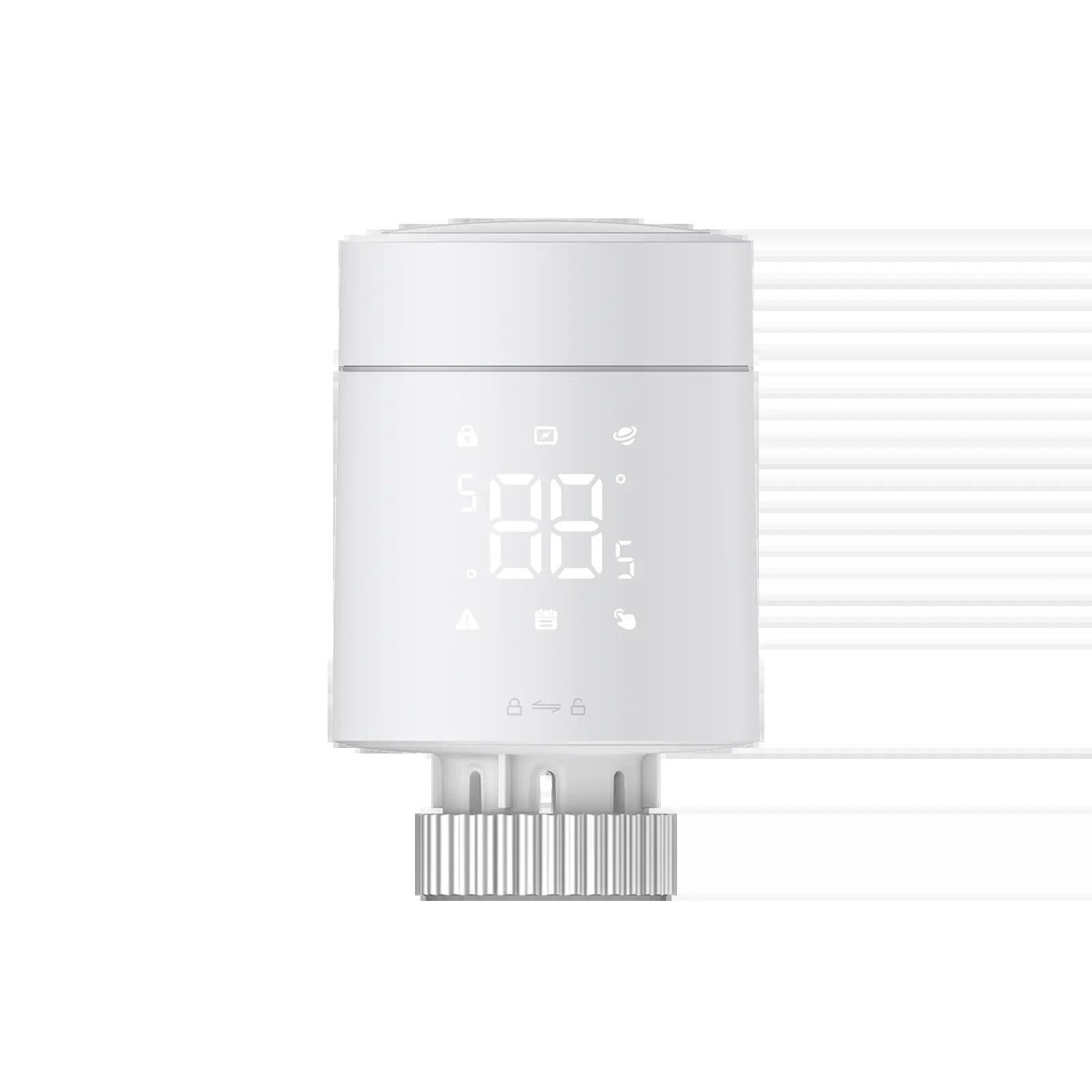
SwitchBot Smart Radiator Thermostat Matter Combo — $79.99 in the US, €109.99 / £109.99 for the EU/UK panel bundle. The combo includes the valve, a Home Climate Panel and a Matter-capable Hub Mini, so it’s a complete system in one box, with six adapters (Danfoss RA, RAV and RAVL, M28×1.5, Giacomini, Caleffi) covering most European radiators. About ten months of battery.
The mistake almost everyone makes with TRVs
A smart TRV controls the valve on one radiator. It does not control your boiler. If every valve in the house closes and the boiler keeps firing, you’re pumping hot water into a closed loop — bad for the boiler, useless for your bill, and you’ll wonder why “smart heating” saved nothing.
Proper installations pair TRVs with boiler control so the boiler stops when all zones are satisfied. Tado sells this as a system; Eve and Aqara leave it to you and your automation platform. Budget for it, or accept that you’ve bought comfort without the savings.
Tier three: mini-splits, where every room is already a zone
If you have ductless heads, you don’t have a zoning problem. You have four remotes in a drawer and no schedule. The fix is a controller that replaces the remote.
Sensibo Air Pro is $139, down from a $215 list price, and it’s the most complete option — an infrared controller with a built-in air quality sensor that reads VOCs, CO2 and particulates. It works with Google Home, Alexa, Apple’s Siri, SmartThings, IFTTT and an open API. Note what isn’t on that list: Matter. Sensibo’s official spec sheet still doesn’t claim it, so plan around Wi-Fi and their cloud.
Mysa for mini-splits is $149, works with HomeKit, Alexa and Google Home, has no subscription, and is the tidier-looking wall unit of the two. Mysa’s central HVAC thermostat does support Matter; the mini-split controller doesn’t, which is an odd gap in an otherwise coherent lineup.
Airzone Aidoo Pro is the professional answer. Instead of blasting infrared at the unit, it wires directly into the indoor unit’s control board on inverter and VRF systems, giving true two-way state. It comes in Wi-Fi, Ethernet and Zigbee 3.0 variants, costs more, and usually wants an installer — but it’s the only one of the three that actually knows whether the unit is on.
That distinction is the whole ballgame. Infrared is one-way and stateless. If someone picks up the original remote and turns the unit off, Sensibo and Mysa don’t find out; they infer state from their own temperature sensor and can be wrong for hours. Both mitigate it well, but it’s an architectural limit, not a bug they’ll patch.
For readers in Singapore and Southeast Asia, where split units are the default and running them 12 hours a day is normal, aircon control kits are the highest-ROI smart home purchase going — the scheduling alone typically pays for the device inside a year. The same logic applies to smart window air conditioners if you’re renting.
Why Matter still can’t zone your house
Matter 1.4 did serious work on climate: heat pumps, water heaters, solar, battery storage, demand response, plus thermostat scheduling and presets like home, away and vacation. Matter 1.5 added cameras, soil sensors and a new “closures” category covering window shades, drapes, awnings, gates and garage doors.
Read that closures list again. Awnings and gates made the spec. Dampers and registers did not. There is still no Matter device type for a vent, which is precisely why the one Matter smart vent on the market has to masquerade as a fan.
Thermostats and TRVs, by contrast, are well covered — which is exactly why the European radiator ecosystem has four credible Matter options while ducted North American homes have one non-Matter vendor and one fan in a grille. The spec follows the market, and the market for smart vents was never big enough to attract spec work. I wouldn’t hold my breath for Matter 1.7.
What I’d actually buy
Ducted, modest budget: ecobee SmartSensors at $79.99 for two. Occupancy-based averaging genuinely fixes a lot.
Ducted, one problem room, Apple household: one or two Cozy Home vents at $99. Boosting a single starved room is exactly what they’re for, and it’s the only Matter-native option available.
Ducted, whole-house comfort worth $1,200+: Flair, with realistic expectations about the 1/3 rule and a willingness to live outside Apple Home. If you’re using an installer anyway, ask about the Static Pressure Kit.
Radiators: Aqara W600 at £49.99 per radiator, or Eve Thermo at €79.95 if local-only control matters. Then solve boiler control, or you’ve only bought comfort.
Mini-splits: Sensibo Air Pro at $139 for the air quality data, Mysa at $149 for HomeKit and a nicer wall unit, Airzone Aidoo Pro if you want it to still work when someone grabs the real remote.
Everyone: don’t buy a cloud-dependent zoning system from a company you can’t picture existing in five years. Ask the Keen Home owners.
The bottom line
Room-by-room climate control is the last big unsolved problem in the mainstream smart home, and which solution you get is decided by plumbing and ductwork, not by any protocol decision. Europeans can zone a whole house for €400 and a screwdriver. North Americans are choosing between a $1,300 system with hard safety limits on how much it can actually do, and a $99 fan that only comes in one size.
Sensors first, mechanics second, and never buy a system whose brain lives on someone else’s server without asking what happens when they turn it off. In March 2026, a lot of people found out.