The 2026 smart home has a strange blind spot: the air you breathe. Matter 1.2 added both air purifier and air quality sensor device types all the way back in October 2023, and Thread has long since made hub-free HomeKit sensors a reality. And yet more than two years later, the big four air purifier brands — Dyson, Coway, Blueair, and Levoit — still route everything through their own walled-garden apps. If you want an air purifier that shows up natively in Apple Home, Google Home, or SmartThings without a bridge, your shortlist is still embarrassingly small.
This guide cuts through the noise. We’ll cover what actually works with Matter today, which “smart” purifiers are really just Wi-Fi purifiers with voice-assistant bolt-ons, and which models are worth buying anyway because the cleaning performance is that good.
The Matter gap in air purification
It helps to say this out loud: the Matter air purifier and air quality sensor device types have been available to manufacturers since Matter 1.2, and most of the industry still hasn’t shipped them. Dyson’s Big+Quiet Formaldehyde launched with a CO2 sensor — an industry first — but still phones home via the MyDyson app. Coway’s Airmega 400S works with Alexa and Google Assistant through the IoCare app, but it doesn’t speak Matter. Blueair’s HealthProtect 7770i does Alexa and Google, but no Matter. Levoit’s VeSync platform is the same story.
This matters for three reasons. First, your automations stay siloed — a motion sensor on Home Assistant can’t easily tell your Dyson to ramp up when someone walks in. Second, air-quality data stays trapped in proprietary apps, so it can’t feed dashboards or trigger cross-device routines. Third, when the cloud goes down (and it will), local control disappears with it.
The good news: a handful of smaller brands have filled the vacuum. The bad news: they can’t match the raw cleaning capacity of the big-room flagships.
The Matter-native picks for Apple Home, Google Home, and SmartThings
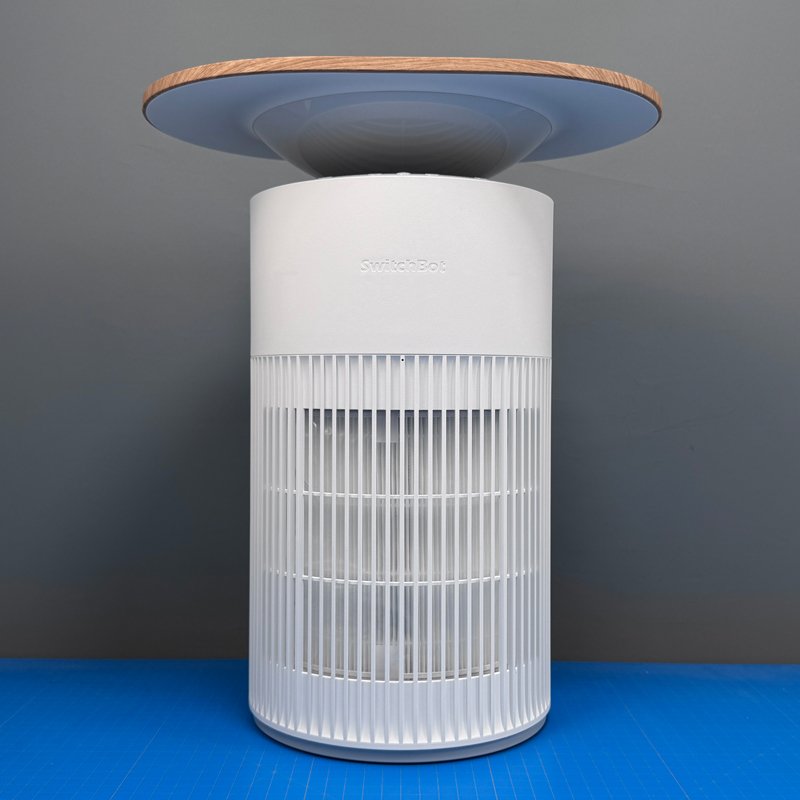
SwitchBot Air Purifier and Air Purifier Table ($220–$260)
As of early 2025, SwitchBot’s air purifiers support Matter natively over Wi-Fi — no SwitchBot Hub 2 required, which is a big shift from the company’s historical “hub for everything” approach. The standard model runs $219.99. The Table version, at $258.35, doubles as a nightstand with Qi wireless charging and customizable RGB lighting on top. Both get a CADR of around 236 CFM (400 m³/h), which covers small-to-medium rooms comfortably.
Three-stage filtration (pre-filter, H13 HEPA, activated carbon) hits the usual 99.97% on 0.3-micron particles, and SwitchBot rates it at 21 dB on the lowest setting — genuinely quiet. When you pair it via Matter, Apple Home exposes fan speed and filter life alongside the PM2.5 reading. That’s closer to full functionality than most Matter bridges manage.
The catch: coverage tops out around 350 sq ft in real-world use. Don’t buy this for a living room in a 3,000 sq ft open plan.
Airversa Purelle AP2 ($190)
The Airversa Purelle AP2 is the only air purifier on this list built from the ground up for Apple Home over Thread. No Wi-Fi setup, no account, no app — you just scan the HomeKit code and it joins your Thread network. The price is fair at around $189.99, and filter replacements are cheap relative to Dyson or Blueair.
It’s rated for rooms up to 1,000 sq ft on paper, but the three-stage HEPA filtration and 53 dB maximum noise suggest medium rooms are the sweet spot. The built-in PM2.5 sensor feeds Apple Home’s air quality graph, and you can trigger automations on thresholds (e.g. “if PM2.5 > 35, turn on the purifier in the nursery”).
This is the one to buy if you’re an Apple Home household and don’t want to think about it. The trade-off: it’s Apple Home only. There’s no Google Home or SmartThings support, because it’s HomeKit-over-Thread rather than Matter.
Aqara Air Quality Monitor with a big-brand purifier
A genuinely useful workaround if you already own a non-Matter purifier: pair an Aqara air quality sensor — the TVOC monitor or the newer Climate Sensor W100 — with a smart plug, and automate the purifier based on actual room data. It’s not native control, but it recovers most of the automation value for a fraction of the cost of replacing hardware. We covered this approach in detail in our 2026 Matter air quality face-off.
Big-room flagships (where Matter doesn’t yet matter)
If you have a 1,000+ sq ft open-plan room and terrible outdoor air, the Matter-native options above will choke. This is where you accept a walled-garden app in exchange for real cleaning power.
Dyson Purifier Big+Quiet Formaldehyde ($999–$1,099)
Yes, it’s $1,000. Yes, the MyDyson app is the only way in. But the Dyson Purifier Big+Quiet Formaldehyde is the only unit in this guide engineered for rooms up to 1,000 sq ft with genuinely low noise at high fan speeds (56 dB max). It’s also the only one with a solid-state formaldehyde sensor and a new CO2 sensor — Dyson’s first.
The H13 HEPA filter is 3.8x larger than the previous generation and rated for five years. CADR for smoke comes in around 200 CFM in independent tests, which is middling on paper, but the directional airflow (Dyson claims 32 ft of projection) means the unit actually moves air across a big room rather than cycling the same column.
You get Alexa and Google Assistant voice control, app-based scheduling, and a ten-year history graph of your air quality. You do not get Matter, HomeKit, or SmartThings. If this rules it out for you, it rules it out. For everyone else, it remains the best big-room purifier money can buy in 2026.
Coway Airmega 400S ($430–$650)
Coway’s Airmega 400S has been around for years and keeps holding up. AHAM-verified for 1,560 sq ft with a 410 CFM CADR, it’s the pure-cleaning-performance champion under $700. The IoCare app is genuinely decent — Auto, Eco, and Sleep modes work without you touching them, and filter replacement reminders are accurate.
Smart-home integration covers Alexa, Google Home, and Dash Replenishment through the IoCare app. No HomeKit, no Matter. If you want voice control and nothing else, this is fine. If you want deep automation through Apple Home or SmartThings, skip it.
Blueair HealthProtect 7770i (~$600–$800)
The Blueair HealthProtect 7770i is the allergy-and-pet household pick. Its HEPASilent Ultra tech uses electrostatic charging to trap particles on lower-density filters, which means very low noise (down to 25 dB) and a CADR of 400 dust / 435 smoke / 435 pollen. The SmartFilter RFID actually tracks real filter usage rather than days elapsed.
Smart features: Alexa, Google Assistant, and Blueair’s own app with “Welcome Home” geofencing. No Matter, no HomeKit. Coverage of 674 sq ft is modest for the price — this is less about big-room power and more about quiet, consistent performance for bedrooms and allergy sufferers.
The value tier
Levoit Core 600S-P ($250–$300)
The Levoit Core 600S-P is the best raw-dollars-per-CADR deal in 2026. $299 list, regularly $249 on sale, 391 CFM CADR, rated for 2,933 sq ft (at one air change per hour — the commonly misleading AHAM rating). For actual four-air-changes-per-hour performance, think 700 sq ft.
The VeSync app is unremarkable but works. Alexa and Google Assistant are supported. No Matter, no HomeKit. If you’ve bought into Levoit’s ecosystem — humidifiers, smaller purifiers — this slots in well. If you haven’t, there’s no reason to start here unless you’re on a strict budget.
Blueair Blue Pure 311i Max (~$250)
The Blue Pure 311i Max is Blueair’s value line and consistently ranks well for small bedrooms and home offices. CADR around 250 CFM, 388 sq ft coverage, and Wi-Fi with Alexa and Google Assistant. No Matter. At this price, it’s a direct competitor to the Levoit 600S, and the call comes down to form factor and app preference.
IKEA’s STARKVIND: the Matter tease
IKEA’s STARKVIND ($179 standalone, $249 table version) is the wildcard. It’s Zigbee-only today via the DIRIGERA hub, which technically bridges to Matter — but the purifier itself doesn’t speak Matter natively, and IKEA hasn’t confirmed a hardware refresh despite its aggressive 2026 Matter rollout for other products.
Coverage is modest (215 sq ft at the claimed 99.5% particle filtration), so this is a bedroom or small office unit. If you’re already in IKEA’s smart home ecosystem, the table form factor is genuinely useful. If you’re not, there are better value picks from Levoit and SwitchBot.
What about the “Matter-compatible” Amazon listings?
You’ll see listings for brands like xCREAS and WELOVE advertising Matter support at $100–$200. These are real and they work — WELOVE was actually the first Matter-certified air purifier back in 2024. The issue is long-term confidence: filter availability, warranty support, and firmware updates are all question marks with brands that live and die by Amazon listings. If you need Matter and you’re comfortable with that risk profile, WELOVE’s P200 via AiDot is the established option. Otherwise, pay the premium for SwitchBot or Airversa.
How I’d actually buy in 2026
- Small room (up to 400 sq ft), Apple Home household: Airversa Purelle AP2 at $190. Thread connectivity, no app nonsense, it just works.
- Medium room, mixed ecosystem (Google, Alexa, Apple): SwitchBot Air Purifier at $220. Matter gets you into all three.
- Big room, no Matter requirement: Coway Airmega 400S at $500 on sale, or Dyson Big+Quiet Formaldehyde at $1,000 if you want the formaldehyde sensor and quieter top-end operation.
- Allergies and pets first, bedroom use: Blueair HealthProtect 7770i.
- Budget pick, you already own a Levoit humidifier or similar: Core 600S-P at $249 on sale.
The honest take
Air purifiers are the last major smart home category that hasn’t capitulated to Matter, and the reason is simple: the brands with the best hardware have the least incentive. Dyson, Coway, and Blueair make more margin locking you into their app ecosystems — selling filter subscriptions, upselling models via in-app banners, and owning your air quality data. Matter costs them that lock-in.
The interesting question is whether pressure from Matter’s air purifier device type eventually forces the issue. So far it hasn’t, and there’s no public roadmap from the big three that suggests it will in 2026. Until then, if Matter-native is non-negotiable, you’re choosing between SwitchBot and Airversa. If cleaning performance is non-negotiable, you’re choosing between Dyson and Coway. Very few of us get to have both.
For 2026, the safest buy for most readers is still the SwitchBot Air Purifier Table. It’s not the most powerful, but it’s the one that will still work the way you expect in five years, regardless of what Apple, Google, or Amazon do next.