If you’ve spent any time wiring up a Matter-and-Thread smart home — local control, no clouds, no monthly bills — then walking into the baby monitor aisle in 2026 feels like stepping through a portal back to 2016. The cameras are gorgeous. The apps are slick. And almost every single one of them wants your credit card on file for a recurring subscription, lives entirely inside its own walled-garden app, and refuses point-blank to speak Matter, Thread, or even HomeKit.
I get it. When you’re sleep-deprived and staring at a crib at 3 a.m., you do not care about protocol diagrams. But a baby monitor is a camera you’ll keep for years — sometimes for a second kid — and the wrong choice can quietly cost you several hundred dollars in subscription fees on top of the hardware. So let’s do this properly. Here are the four monitors actually worth your money in 2026 — the Nanit Pro, the Cubo AI Plus, the Owlet Dream Duo, and Eufy’s subscription-free lineup — plus an honest accounting of the recurring fees, the cloud lock-in, and why the smartest smart-home standard on the planet still won’t watch your baby.
The subscription trap, explained first
Before we talk hardware, understand the business model, because it’s the single biggest factor in total cost of ownership.
Most premium baby monitors are sold at a reasonable hardware price and then monetized through an annual subscription that unlocks the features you actually bought the thing for: sleep tracking, AI alerts, cloud video history, and detailed analytics. The math gets ugly fast. A $250 monitor paired with a $200/year subscription costs roughly $850 over three years. A $200 subscription-free monitor costs… $200. Over the typical lifespan of crib-to-toddler use, the subscription can quietly become the most expensive part of the purchase.
The good news is that the picture is more nuanced than “everything is a ripoff.” Some brands keep core live monitoring free forever and only charge for the fancy analytics. Others lock genuinely useful safety features behind the paywall. Knowing which is which is the whole game.
Nanit Pro: the data nerd’s monitor
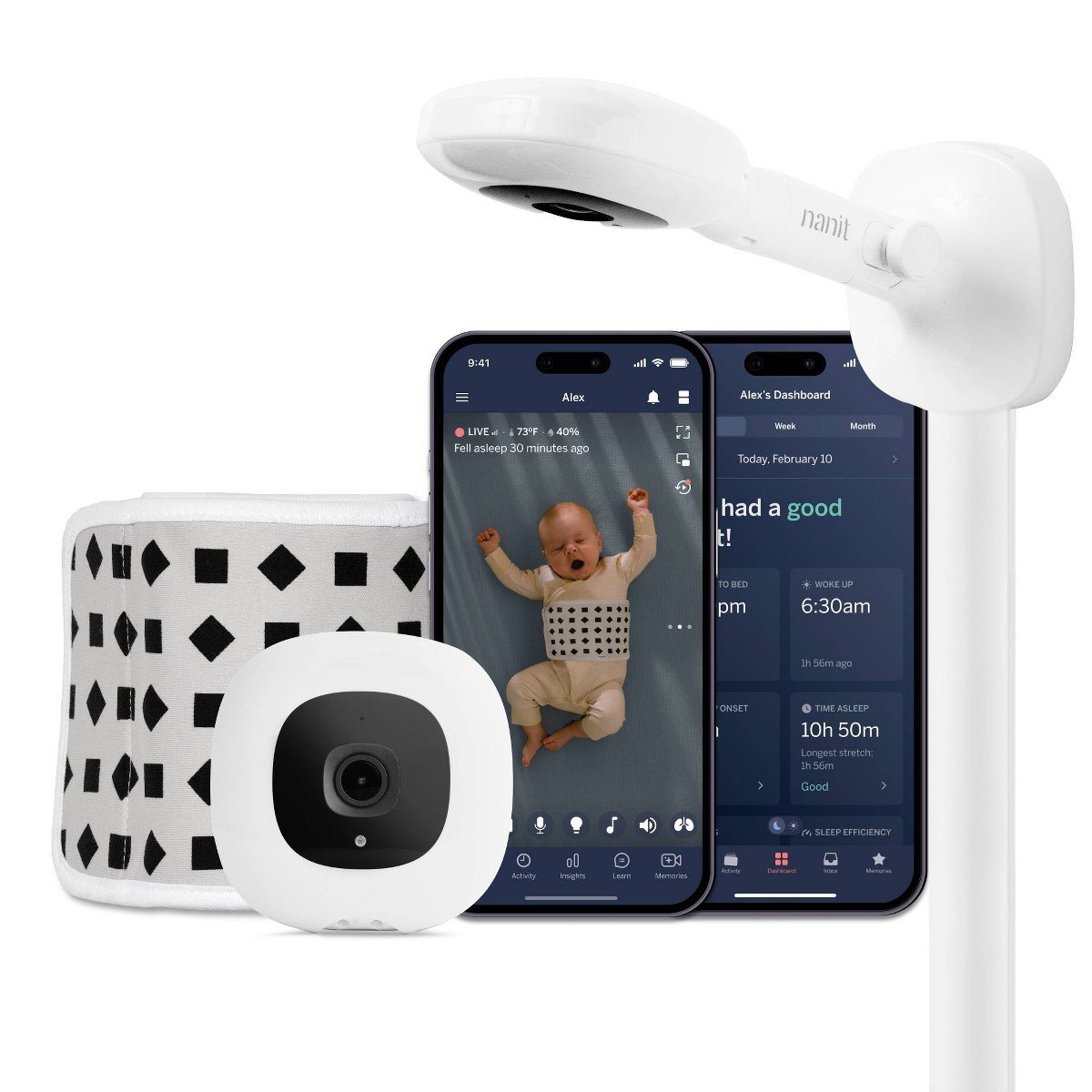
The Nanit Pro is still the one to beat if you care about sleep analytics, and it’s the monitor I’d hand to a first-time parent who loves a good dashboard. It mounts overhead for that signature top-down crib view, streams 1080p HD straight to your phone, and its sleep-tracking is genuinely best-in-class — it’ll tell you sleep onset, wakings, and sleep efficiency with a precision that borders on obsessive.
Pricing in 2026 lands around $249 with the travel Flex stand or roughly $289 with the wall or floor stand. The clever party trick is breathing motion tracking: instead of strapping a sensor to your baby, the Nanit camera reads a patterned fabric band — your Pro ships with a 0–3 month band in the box — and watches it rise and fall. Nothing electronic ever touches your child.
Here’s the catch, and credit to Nanit for not being the worst offender: core monitoring is free. Live HD video, sound and motion alerts, two-way audio, background audio mode, temperature and humidity readouts, the nightlight, white noise, and up to two caregivers all work with no subscription at all. The paid Nanit Insights plans — which range from a free Sleep tier up to $50, $120, and as much as $300 per year depending on how deep you want the sleep history, memories, and milestone tracking — are genuinely optional. The other quiet cost: continued breathing tracking means buying into the Breathing Wear line (swaddles and bands) as your baby grows out of that first band.
Best for: parents who want the richest sleep data and don’t mind that everything lives in Nanit’s app and on Nanit’s cloud.
Cubo AI Plus: the sharpest eyes and the smartest safety alerts
If image quality and AI safety alerts are your priority, the Cubo AI Plus is the most compelling camera here. It shoots 2.5K QHD video — visibly sharper than the 1080p you get from the Nanit Pro or Owlet’s camera — and its standout feature is genuinely useful: on-device AI that watches for a covered face or a rollover and fires an alert within seconds. For parents of newborns, that’s the feature that sells the whole product.
The adorable bird-on-a-perch design is more than a gimmick — the camera head detaches and remounts, so it can grow from a crib stand to a wall mount to a floor stand as your needs change. Pricing runs about $199 for the wall-mount version and $299 for the floor-stand bundle.
Cubo’s weakness is the same as everyone’s: the best stuff — sleep analytics, longer video history, the full suite of AI events — sits behind the Cubo Care subscription after the trial period. The hardware is a great deal; just go in knowing the recurring fee is part of the pitch, not an afterthought.
Best for: parents who want the best picture and proactive AI safety alerts, and will pay the subscription to keep them.
Owlet Dream Duo: the only one with a medical-grade vital signs claim
Owlet plays a completely different game. The Dream Sock is the only consumer baby monitor on this list that measures your baby’s pulse rate and blood-oxygen (SpO2) with pulse oximetry — and crucially, it earned FDA De Novo clearance back in November 2023 as an over-the-counter medical device for infant pulse oximetry. That’s a real regulatory milestone, not marketing fluff. The sock reads live vitals, and a bedside base station glows and chimes if the readings drift outside preset ranges.
The Dream Sock alone runs $299.99. The Dream Duo 3 bundle pairs the sock with Owlet’s 2K Dream Sight camera for around $379–399, giving you vitals plus video, cry detection, two-way talk, and room temperature and humidity in one box.
A dose of honesty: the FDA clearance is for pulse oximetry, and no gadget prevents SIDS — the medical consensus on safe sleep (back to sleep, bare crib) still does the heavy lifting. But for parents of preemies or babies with genuine health concerns, the peace of mind from live oxygen readings is worth real money, and Owlet is the only mainstream brand that can make that claim with a regulatory stamp behind it. It’s also the priciest path here, and you’re buying into another proprietary app and cloud.
Best for: parents who specifically want live oxygen and heart-rate monitoring with an FDA-cleared device.
Eufy: the subscription-free rebel
And then there’s Eufy, which built its entire baby-monitor pitch around the one thing the others won’t give you: no subscription, ever. This is the brand for people who read the section above on the subscription trap and recoiled.
Eufy’s classic play is the dedicated-screen monitor — a self-contained 5-inch parent unit that pairs directly with the camera over its own radio link. It doesn’t need your Wi-Fi, doesn’t depend on your router, and doesn’t route your baby’s video through a cloud you don’t control. At 3 a.m., rolling over and glancing at a screen on the nightstand is genuinely faster and less disruptive than fishing for your phone, unlocking it, and waiting for an app to connect. Local-only also means there’s simply no cloud account to breach.
For 2026, the lineup has grown. There’s a value 4K Wi-Fi camera model around $199, and the eufy S340 Smart Sock monitor, which bolts a pan-and-tilt 2K camera onto a wellness-tracking sock of its own — Eufy’s answer to Owlet, minus the FDA paperwork. The trade-off is real: Eufy can’t match Nanit’s sleep insights or Cubo’s AI polish, and the dedicated-screen models give up remote phone viewing entirely. But you pay once and you’re done.
Best for: privacy-minded, budget-minded parents who want zero recurring fees and zero cloud dependency.
The elephant in the nursery: none of these speak Matter
Here’s where this turns into a Smartifiers article rather than a parenting blog. You’d think that in 2026 — with Matter still failing to reach entire product categories like EV chargers — at least the camera in your nursery would plug into the smart home you’ve already built. It doesn’t.
Not one of these monitors supports Matter. None of them run on Thread. HomeKit support across the baby-monitor category is essentially nonexistent — Eufy’s SpaceView line, for example, explicitly doesn’t work with Alexa, Google Assistant, or HomeKit. Each monitor is an island: its own app, its own account, its own notification system that has no idea your Aqara presence sensors just detected you walking into the nursery or that your good-night scene already dimmed the lights.
There are real reasons for this. Baby monitoring is a liability-sensitive category — manufacturers want tight control over the alert pipeline, and “your baby’s oxygen alert was delayed because a Thread border router rebooted” is a headline no brand wants. AI features like Cubo’s covered-face detection and Owlet’s vitals processing also lean on proprietary cloud and on-device models that don’t map onto Matter’s current device types. Matter simply has no standardized concept of “baby monitor” yet, the way it now does for cameras and so many other categories.
The practical upshot: budget for the fact that your baby monitor will be a parallel system to your real smart home, at least for the next few years.
A smart-home workaround worth considering
If you’re already deep in an ecosystem and your needs are modest — you mostly want to see the crib, not track REM cycles — there’s a cheaper, more integrated path. A good general-purpose indoor security camera can double as a baby-watching cam and, unlike the dedicated monitors, actually lives inside your smart home. Something like an Aqara indoor camera gives you a HomeKit-Secure-Video-capable feed, local recording options, and integration with the rest of your automations — no separate baby-monitor subscription required.
The honest caveat: a security camera is not a baby monitor. You won’t get breathing tracking, vitals, cry-detection AI tuned for infants, or the reassuring bedside base station that screams when something’s wrong. For a newborn, especially one with health concerns, buy the real thing. For a toddler who just climbs out of bed, a smart camera you already own may be all you need. (Our sister site SmartHomeFirst digs deeper into using everyday cameras around the house.)
So which one should you actually buy?
- Want the best sleep data and a polished app? The Nanit Pro (~$249–289), and take comfort that core monitoring stays free even if you skip Insights.
- Want the sharpest picture and the best AI safety alerts? The Cubo AI Plus (~$199–299) — just accept the Cubo Care subscription as part of the deal.
- Want medical-grade oxygen and heart-rate monitoring? The Owlet Dream Duo 3 (~$379–399) is the only FDA-cleared option, and worth it for the right family.
- Want to never see a subscription invoice again? Eufy — a dedicated-screen model or the S340 sock, paid once, cloud-optional, and refreshingly boring in the best way.
My genuinely opinionated take: for most parents, the smart money is on Eufy for the no-nonsense monitoring and Nanit if you want the data and can live with the optional fees. Cubo wins on raw camera quality, and Owlet is the specialist you buy when vitals matter. Whichever you pick, do the three-year subscription math before you check out — not after the free trial quietly lapses. And don’t expect any of them to show up in your Apple Home, Google Home, or SmartThings app. In 2026, the nursery is still the last room in the house the smart home hasn’t reached.