Motorized curtains used to be a rich-person problem. You either paid a custom-shade company four figures to rip out your old track and install a hardwired system, or you did without. Retrofit curtain robots changed that math. These are little battery-powered motors that clip onto the curtain rod or track you already own, grip the fabric or the gliders, and drag your curtains open and closed on a schedule, a tap, or a voice command. No rewiring, no new hardware store, no landlord conversation.
In 2026 the category has matured into three real choices for most people: the SwitchBot Curtain 3, the Aqara Curtain Driver E1, and the flotilla of Zemismart (and Zemismart-adjacent Tuya) motors that undercut both on price. They solve the same problem in very different ways, and — this is the part nobody tells you up front — none of them speak Matter natively. Let’s get into what actually matters when you’re the one mounting these things at 11pm.
Why retrofit robots beat motorized rails (for most of us)
There are two ways to automate a curtain. You can replace the entire track with a motorized rail — Aqara’s own Curtain Controller C3 is one of these — where the motor lives inside a new rail and pulls a carriage. Or you can buy a robot that bolts onto your existing setup and does the pulling itself.
Motorized rails are quieter, stronger, and look cleaner because there’s no visible gadget. But they mean removing what you have, measuring a new rail to the centimeter, and often drilling. Retrofit robots are the opposite trade: five minutes of installation, fully reversible, works on the rod or track that’s already there, and you can take it with you when you move. For renters and anyone who doesn’t want a weekend project, the robot wins. For a permanent install in your forever home, the rail is the better long-term answer — more on that below.
The Matter question: everything here is bridged, not native
Because this site is obsessed with Matter and Thread, let’s kill the confusion immediately: not one of these curtain robots has a Matter or Thread radio inside it. Every single one reaches Matter through a bridge.
- The SwitchBot Curtain 3 talks Bluetooth to a SwitchBot Hub, and the hub exposes it to Matter over Wi-Fi.
- The Aqara Curtain Driver E1 talks Zigbee to an Aqara hub, and the hub bridges it into Matter as a window-covering device.
- Zemismart’s Matter models are typically Matter-over-Wi-Fi or bridged through a Tuya/Zemismart hub.
Why does this matter in practice? A bridged device inherits the bridge’s reliability. If your SwitchBot Hub drops off Wi-Fi, the curtain disappears from Apple Home even though the motor is fine. Bridged window coverings also occasionally lose their “position percentage” — the ability to open the curtain to exactly 40% — depending on the bridge’s firmware. None of this is a dealbreaker, but if you were hoping for a clean, radio-native Thread device you can pair directly to a HomePod, that product doesn’t exist in this category yet. Buy the ecosystem, not the promise.
SwitchBot Curtain 3: the flexible all-rounder
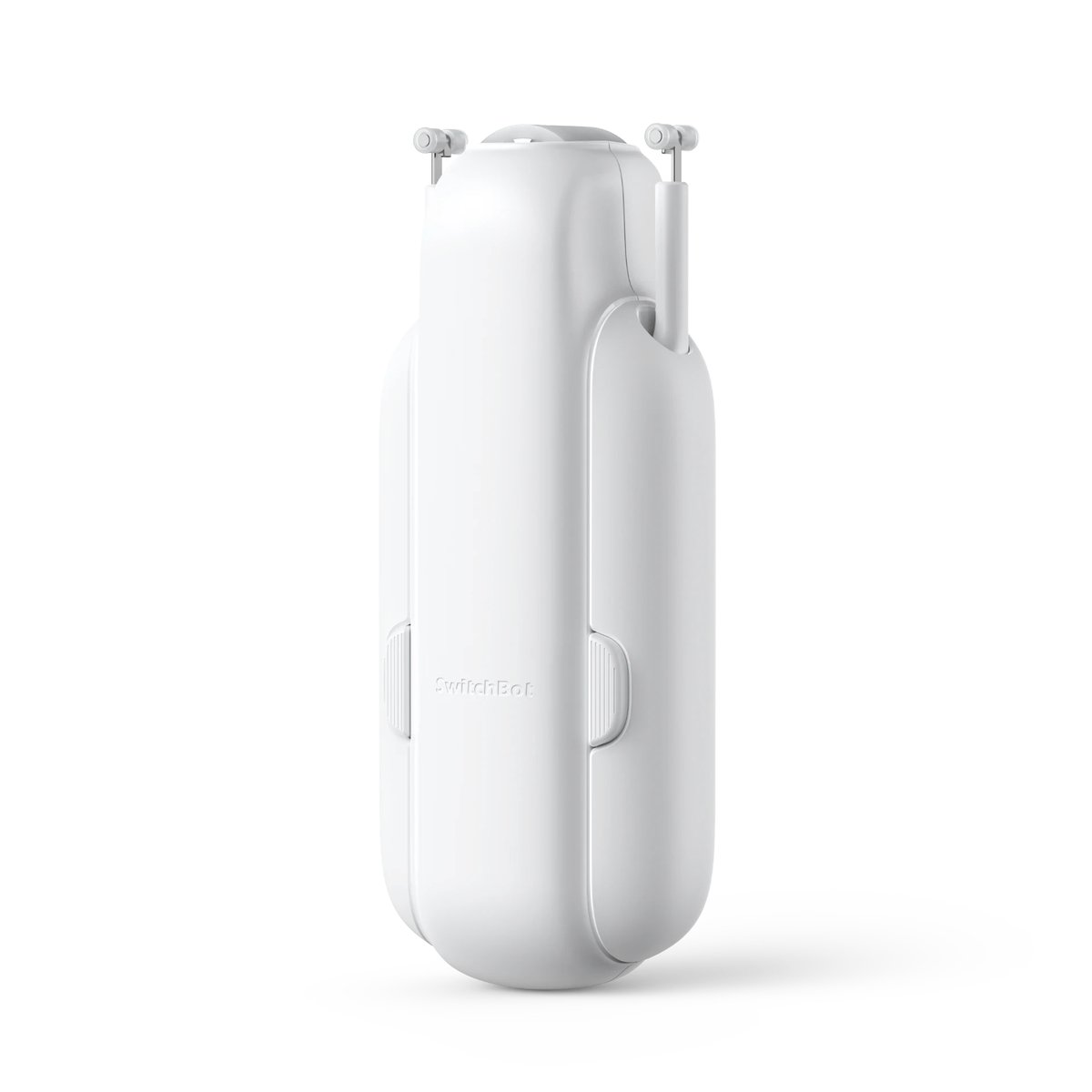
The SwitchBot Curtain 3 is the one I recommend to most people, and it’s mostly about fit. It handles rod-type curtains, U-rails, and I-rails; it works with extendable rods and even gently curved tracks; and it grips curtains most competitors refuse to touch. If you have a weird setup, this is the safest bet.
The Curtain 3’s headline feature is QuietDrift mode, a deliberately slow crawl that runs around 25 dB — genuinely quiet enough for a bedroom or nursery. Run it at full speed and it climbs toward the low 40s dB, which is about the noise of a small desk fan; noticeable, but brief. The motor is rated to pull heavy curtains up to roughly 15–16 kg (33 lbs), the strongest in this group.
Pricing is where SwitchBot plays smart. The Curtain 3 lists around $89.99 and frequently dips to $60–75 on sale. Battery life is rated up to eight months per charge, though with a couple of open/close cycles a day plus voice-triggered nudges you’ll realistically recharge every few months. The fix is the clip-on Solar Panel 3 (about $25), which tops the battery from ambient light and, for most windows, means you never touch the USB-C cable again. For Matter, you’ll need a SwitchBot Hub — the SwitchBot Hub 3 is a full Thread border router and Matter bridge, or SwitchBot sells a “Solar Matter Combo” that bundles the motor, panel, and a hub together.
The catch: it’s a visible plastic puck sitting on your rod, and on rod-type installs two panels means two motors (one per side) if you want both to part from the center. Budget accordingly.
Aqara Curtain Driver E1: the ecosystem play
The Aqara Curtain Driver E1 is the pick if you already live in Aqara’s world — the FP2 presence sensors, W100 climate sensors, and door sensors that make curtain automation genuinely useful (“open the bedroom curtains when motion is detected after 7am”). It comes in rod and track versions, so pick to match your hardware before you buy — they are not interchangeable.
Mechanically it’s a close match to the SwitchBot: it pulls curtains up to about 12 kg (26 lbs), runs quietly, and — this is its real advantage — is rated for up to six months of battery life, beating SwitchBot’s real-world numbers without a solar panel. Setup and daily reliability inside the Aqara app are excellent, and it plugs cleanly into HomeKit, Alexa, Google Home, and IFTTT.
Two honest caveats. First, price: the driver itself is around $90–100, and it has no Wi-Fi or Bluetooth of its own — it requires an Aqara Zigbee hub to function at all. If you don’t already own one, add an E1 hub ($30) or, better, an M3 hub ($100) that doubles as a Thread border router and the Matter bridge that exports the curtain to Apple Home, SmartThings, and the rest. Second, fit is fussier than SwitchBot — the E1 is happiest on standard rods and straight I-rails and won’t handle the exotic curved tracks SwitchBot shrugs off.
If you’re shopping in Asia, both my stores stock it — the Aqara Curtain Driver E1 at HomeSmart Singapore is the rod version most apartments need.
Aqara Curtain Controller C3: when you want a proper rail
If you’ve decided the visible-robot look isn’t for you and you’re willing to install once and forget, the Aqara Curtain Controller C3 is the grown-up option. It’s not a clip-on robot — it’s a plug-in DC rail motor system that pulls a carriage along a track, so there’s no gadget hanging off your curtain and no battery to ever recharge.
The payoff is real: it’s rated to move curtains up to a hefty 80 kg, and at its lowest speed it runs around 26 dB — quieter and smoother than any battery robot here. It’s Zigbee 3.0, so like the E1 it needs an Aqara hub and reaches Matter as a bridged window covering. Expect to pay roughly $130–150 depending on region and rail length, plus the effort of mounting a new rail. This is the “do it right the first time” pick for a living room where the curtains are big, heavy, and drawn every single day.
Zemismart and the Tuya wildcards
Then there’s Zemismart, the perennial value play beloved by tinkerers. Its ZM85EL-series curtain robots handle Roman rods and I/U-type tracks, run on rechargeable batteries, and land anywhere from about $60 to $120 depending on the variant and where you’re buying. In mid-2026 Zemismart even shipped a Matter-over-Wi-Fi curtain motor, and several models are Matter-certified as sub-devices of a Zemismart/Tuya hub.
The appeal is obvious: you get 90% of the SwitchBot experience for meaningfully less, and if you run Home Assistant, Zigbee-based Zemismart motors integrate locally and beautifully with no cloud in the loop. The trade-offs are just as real. Build quality and quality control are inconsistent unit to unit, the Tuya/Smart Life app is a cluttered mess compared to SwitchBot’s or Aqara’s, English documentation can be rough, and support is thin if something breaks. For a confident DIYer this is a great deal; for someone who wants it to just work out of the box, pay the extra $20 for a SwitchBot.
The things that actually matter day to day
Noise
This is the most under-rated spec. A curtain robot at full speed in a quiet bedroom at 6:30am will wake a light sleeper. SwitchBot’s QuietDrift (~25 dB) and the C3 rail (~26 dB) are the two genuinely bedroom-safe options. If your automation runs while anyone’s asleep, prioritize a quiet mode over everything else — you can always schedule the slow crawl to start ten minutes earlier.
Battery and charging
All the clip-on robots use rechargeable lithium batteries and USB-C. Real-world life lands in the two-to-six-month range depending on curtain weight and how often they cycle. The single best quality-of-life upgrade is a solar panel — SwitchBot sells one, and it turns “recharge every few months” into “never think about it again.” The C3 rail sidesteps this entirely by plugging into the wall.
Mounting and fit
Measure before you buy. Rod-type mounts and track/rail mounts are different products, and a robot built for a straight I-rail won’t ride a curved bay-window track. SwitchBot is the most forgiving across odd setups; Aqara is happiest on standard rods and straight rails; the C3 requires you to install its own rail. Nine out of ten returns in this category are “it didn’t fit,” not “it didn’t work.”
How to choose
- You want the safest all-rounder / a weird curtain setup: SwitchBot Curtain 3, plus the solar panel. Add a SwitchBot Hub if you need Matter or remote control.
- You already own Aqara gear: Aqara Curtain Driver E1. It plugs into the sensors and automations you already have, and your existing hub is the bridge.
- You want a permanent, silent, no-battery install: Aqara Curtain Controller C3 rail motor. Install once, forget forever.
- You run Home Assistant or you’re on a budget: a Zemismart Zigbee motor. More fiddling, less money, total local control.
A quick automation tip regardless of which you buy: pair the curtain with a light or presence trigger rather than a fixed clock. “Open at sunrise” is charming until sunrise is 5am in June; “open when the bedroom scene button is pressed, or at 7:30am on weekdays” is what you’ll actually keep.
The bottom line
Retrofit curtain robots are one of the highest-satisfaction smart home upgrades you can make — waking up to curtains that open themselves genuinely feels like the future, and it costs a fraction of a hardwired install. For most people the SwitchBot Curtain 3 with a solar panel is the right first buy: it fits almost anything, runs quiet, and forgets its own battery exists. Aqara owners should get the Curtain Driver E1 to stay in one app, anyone building a permanent setup should look hard at the C3 rail, and tinkerers will be perfectly happy saving money with Zemismart.
Just go in clear-eyed about Matter: in 2026 every option here is bridged, not native, so buy into the ecosystem whose hub you trust rather than chasing a Thread logo that isn’t printed on any of these boxes yet. For deeper Aqara buying guides, our sister site SmartHomeFirst covers the ecosystem in detail — but whichever you pick, measure your rod twice before you order.