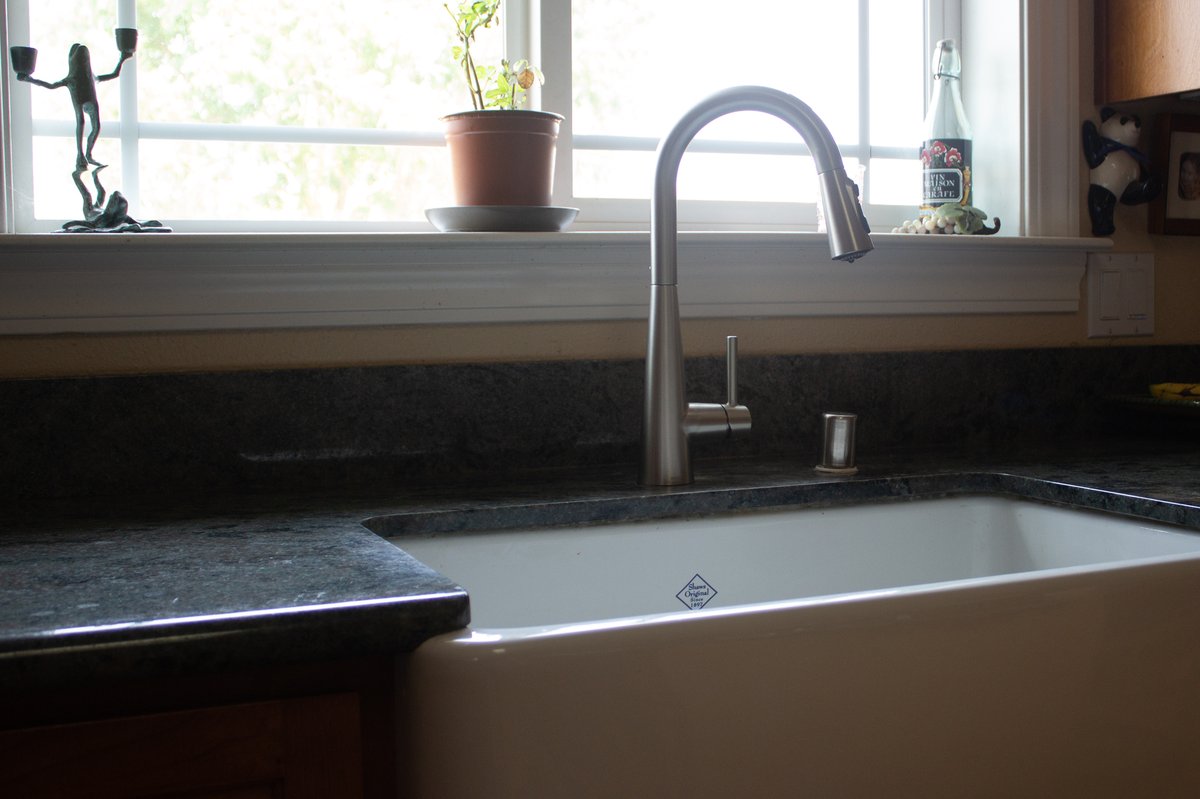
Your kitchen faucet is probably the dumbest thing you touch fifty times a day. You crank a handle, water comes out, you crank it back — and if your hands are covered in raw chicken or bread dough, that handle becomes a small biohazard you have to wrestle anyway. Smart faucets fix exactly this problem, and in 2026 the category has finally matured past gimmick territory into something genuinely useful. Wave to start, tap with a wrist, or just say “dispense two cups” and walk away.
But here’s the thing nobody tells you before you drop several hundred dollars: the three big players — Moen, Delta, and Kohler — each made a completely different bet about how smart a faucet should be, and those bets shake out very differently depending on which voice assistant runs your home. And every last one of them still refuses to speak Matter, which means your fanciest fixture is also the one appliance that won’t show up in your unified smart home dashboard.
Let’s sort out which one actually deserves a spot on your sink.
The three philosophies
Smart faucets sound like a single product category, but the big three approached it from three different directions.
U by Moen is the accessible one. Moen’s smart faucet — most commonly sold as the Arbor (model 7594EV) — leans on wave-to-activate motion sensing plus voice, and it undercuts the competition dramatically on price. You’ll find it for roughly $340 to $460 depending on finish, with chrome typically the cheapest and specialty finishes like matte black or bronze pushing toward $590. For a voice-and-motion faucet from a major brand, sub-$400 is the number that makes people stop scrolling.
Delta VoiceIQ is the voice-first one. Delta pairs its long-running Touch2O tap-anywhere technology with a voice layer called VoiceIQ. The flagship Trinsic VoiceIQ runs around $860, and there are cheaper bodies like the Essa and Leland that use the same brains in a plainer shell. Delta’s whole pitch is metered dispensing you trigger by name — “fill the coffee pot,” “give me a cup” — with the tap-to-start Touch2O sensor as a reliable fallback for when voice recognition has an off day.
Kohler Konnect is the premium, connected one. The Crue (K-22974) and its pricier sibling the Sensate are the faucets you buy when you want the faucet itself to be a genuine smart home device — not just a voice-triggered valve, but a fixture that monitors water usage, flags unusual flow, and — crucially — actually works with Apple Home. The Crue lists around $1,148 but street prices hover near $860; the Sensate typically lands a bit lower and runs on hardwired AC power rather than batteries.
Three brands, three theories of what “smart” means at the sink. The right one for you depends almost entirely on the logo on your smart speaker.
The Apple Home problem (and why Kohler wins it by default)
If you run an Apple household, this section is the whole article, so let me be blunt: Kohler is your only real option.
Kohler’s Konnect platform — the software behind both the Crue and the Sensate — is the only smart faucet ecosystem that supports Apple Home alongside Alexa and Google Assistant. The Sensate has been the reference point here for years as the lone HomeKit-certified smart kitchen faucet, and the Crue brings that same Konnect compatibility to a slightly more affordable body.
Delta and Moen, by contrast, both stop at Alexa and Google. No HomeKit, no Siri, no “Hey Siri, fill a glass.” For an Alexa or Google home that’s a non-issue — both work beautifully. But if you’ve built your house around iPhones and HomePods, a Delta or Moen faucet will respond only to Amazon’s or Google’s assistants, which likely means adding an Echo or Nest speaker to your kitchen just to talk to your tap. At that point you’ve undermined the whole reason you went Apple.
This is the single most important decision factor, and it’s worth checking before you fall in love with a particular faucet’s looks. If you’re still weighing which voice ecosystem to commit your whole house to, our breakdown of Gemini for Home vs. Alexa+ vs. Siri is the place to start — the faucet should follow that decision, not drive it.
Voice dispensing: does anyone actually use it?
Every one of these faucets can pour a measured amount of water on command. Ask for two cups, get two cups. It demos beautifully. The honest question is whether you’ll use it after week two.
The answer, based on how reviewers and owners actually talk about these things, is: sometimes, and more than you’d expect. Baking is the killer app — “dispense 500 milliliters” while your hands are in the dough is legitimately great. Filling a pet bowl, a coffee maker, or a pasta pot to a repeatable amount removes a small daily annoyance. Moen leans into this hardest with named app presets you configure yourself (“baby bottle,” “pasta pot”) that fire at a set volume and temperature — a genuinely thoughtful touch if you do the same tasks on repeat. TechHive’s long-term U by Moen review landed on the same verdict: gimmicky on paper, quietly indispensable in practice.
Delta’s version is the most refined on the voice side. Naming a pour and triggering it hands-free is the feature reviewers keep circling back to, and because Touch2O lets you also just tap the spout to start and stop, you’re never stranded when the microphone mishears “cup” as “stop.” That redundancy — voice and touch and the handle — is Delta’s quiet advantage.
Kohler’s Crue handles voice dispensing capably too, and adds a three-function sprayhead with a Boost mode that cranks flow rate up about 30% for filling big pots fast. Where Kohler pulls ahead is the monitoring side: the Konnect app tracks your water usage over time and will ping you when it detects unusual flow — a small but real step toward leak awareness that neither Delta nor Moen offers at the faucet itself.
A quick reality check on all of them, though: voice metering is calibrated around North American plumbing and units, and the microphones live in the faucet, so a loud kitchen (running extractor fan, kids, a dishwasher mid-cycle) will degrade recognition. Touchless wave activation and the physical handle remain the workhorses; voice is the party trick you’ll use more than you admit but less than the marketing implies.
Power, plumbing, and the install reality
Two practical details trip people up.
First, power. Moen’s and Delta’s faucets ship running on batteries — typically six AA cells tucked into a control box under the sink — with an optional AC adapter sold separately if you’d rather not swap batteries every year or so. Kohler’s Sensate is hardwired to AC, which is cleaner long-term but means you need an outlet under the sink (most kitchens have one for the disposal, but confirm before you buy). The Crue splits the difference depending on configuration. None of this is hard, but it’s the kind of thing you want to know before the box is open and the old faucet is already in the trash.
Second, the control box. Every smart faucet has a brain box that lives in the cabinet under your sink and connects the faucet to power and Wi-Fi. It’s not huge, but it takes up real estate next to your disposal and cleaning supplies, and the faucet’s cables have to reach it. If your under-sink cabinet is already a jungle of pipes and a water filter, measure first.
While you’re down there with the cabinet open, it’s genuinely worth dropping a cheap Aqara water leak sensor on the cabinet floor. A smart faucet adds a powered valve and more connection points under your sink — exactly the spot where a slow drip can go unnoticed for months and rot out your cabinet base. Even the leak-monitoring on Kohler’s Konnect only watches flow through the faucet; it won’t catch a supply-line weep behind it. A $20 puck that screams (and pings your phone) the instant it gets wet is the cheapest insurance in the house.
And now, the Matter problem
Here’s where the smart faucet category quietly falls on its face. Not one of these faucets — not the $340 Moen, not the $860 Delta, not the four-figure Kohler — supports Matter.
That matters (pun regrettably intended) because Matter is supposed to be the universal language that lets every device in your home show up in a single app, controllable from any ecosystem. Your Matter bulbs, locks, plugs, and thermostats all speak it. Your faucet does not. So even in a Kohler-plus-Apple setup — the most integrated combination available — the faucet lives in a slightly walled-off corner, reachable through Konnect’s own cloud integration rather than as a native, local Matter device.
Why the holdout? Partly it’s that Matter simply doesn’t have a well-defined device type for a metered water valve or faucet — the standard grew up around lighting, sensors, locks, and climate, and a “pour me 500ml” fixture doesn’t map cleanly onto any existing Matter cluster. Partly it’s that these faucets lean on cloud-connected voice dispensing that manufacturers would rather keep inside their own apps. And partly it’s simple inertia: faucet companies move on a plumbing-industry timeline, not a consumer-electronics one. The upshot is that the smart faucet remains one of the last islands in an increasingly Matter-connected home — a recurring theme for any big-ticket appliance category, the same way robot vacuums and EV chargers still can’t fully join the party.
If local control and ecosystem independence matter to you more than voice dispensing, that changes the math. A dumb-but-excellent touchless sensor faucet paired with a smart valve or a local voice setup like Home Assistant Voice may get you 80% of the practical benefit without locking your fixture into one brand’s cloud.
A note for readers outside North America
If you’re reading this from Europe, Asia, Australia, or basically anywhere that isn’t the US or Canada, temper your expectations: this whole category is overwhelmingly North American. Moen, Delta, and Kohler are US brands, their voice-dispensing features are tuned to US plumbing and units, and availability elsewhere ranges from spotty to nonexistent (often via importers at a markup, with warranty headaches to match).
In Europe, touchless and app-connected faucets from the likes of Grohe and Hansgrohe are the more realistic buy, though they generally emphasize sensor activation over the named-preset voice dispensing the US brands built their pitch on. In much of Asia, the practical smart-kitchen path is a good touchless sensor faucet plus separate smart-home water monitoring rather than an all-in-one voice faucet. It’s not the answer North American buyers get, but it’s the honest one.
So which should you buy?
- You run Alexa or Google and want the best value: Get the U by Moen Arbor. Wave activation, voice, app presets, and a sub-$400 entry price make it the easiest smart faucet to recommend to most people. It does the 90% that matters for a fraction of the flagship price.
- You run Alexa or Google and want the best voice experience: Get a Delta VoiceIQ faucet. The Touch2O tap-to-start fallback plus polished named-pour dispensing is the most reliable hands-free experience, and you can pick the body (Essa, Leland, Trinsic) to fit your budget and style.
- You run Apple Home — or want water monitoring: Get the Kohler Crue (or step up to the Sensate). It’s the only ecosystem that speaks to Apple Home, and the Konnect app’s usage tracking and flow alerts are features the others simply don’t offer. You’ll pay for it, but it’s the most genuinely connected faucet you can buy.
Whichever you choose, go in clear-eyed: you’re buying a very good touchless faucet with a useful voice trick bolted on — not a fully integrated Matter citizen. For most kitchens, that trade is worth it. Just don’t expect your tap to show up next to your smart bulbs anytime soon.