The smartest thing in your bathroom is now your cat’s toilet — except it doesn’t speak Matter
Walk through the 2026 smart home category as a casual observer and you’ll notice something strange. Your $30 light bulb supports Matter. Your $60 smart plug supports Matter. Your $200 robot vacuum supports Matter. Your $700 self-cleaning litter box, the most expensive single-purpose device most cat owners will ever buy, supports… Wi-Fi and a proprietary app, and that’s about it.
The big four — Whisker’s Litter-Robot 4, PetKit’s Pura Max 2, Casa Leo’s Leo’s Loo Too, and PetSafe’s ScoopFree SmartSpin — are all genuinely impressive pieces of engineering. They’ve replaced one of pet ownership’s nastiest daily chores with a clean, quiet, deodorized, app-tracked routine. They detect your cat’s weight to the gram, count visits, flag anomalies that hint at urinary issues, and ping your phone when the drawer is full. And every single one of them lives in a walled garden.
That tension — premium hardware, premium subscription, second-class smart home citizen — is the story of this category in 2026. Here’s how the contenders actually stack up, and how to integrate them into a real connected home anyway.
What “smart” actually means in a 2026 litter box
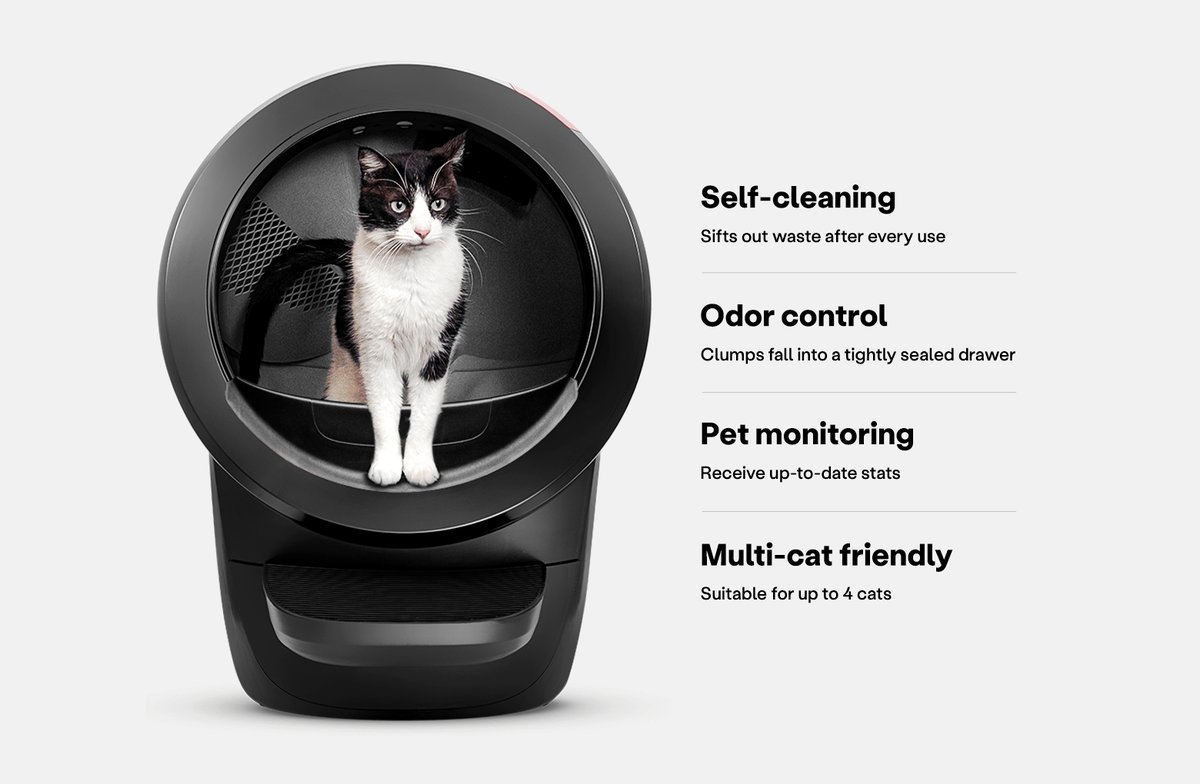
The dumb version of this product category is a tray with a rake on a timer. The smart version is fundamentally a health-monitoring instrument that happens to scoop poop. The four current top-end boxes all share a similar feature set:
- Per-cat weight tracking via four load cells under the base, accurate enough to spot the gradual weight loss that often precedes a vet diagnosis by months.
- Visit logging — how long each cat stays, how often they visit, deviation from baseline.
- AI cat identification in some models, using either entry weight (PetKit, Litter-Robot via Whisker app) or onboard cameras (PetKit’s Purobot Max Pro 2).
- Safety sensors — weight plates, infrared curtains, anti-pinch detection — to prevent the rotating-globe nightmare that haunted early designs.
- Push notifications for full drawers, stuck cycles, error states, and anomalies in usage patterns.
This is a real, useful data feed. The Whisker Home Assistant integration exposes everything from cycle state to per-cat weight history as native entities — which is where this gets interesting for anyone running a serious smart home setup. More on that below.
Litter-Robot 4 ($699): the one everyone benchmarks against
Whisker’s flagship is now in its fourth generation, and after years of iteration it’s still the device every other brand gets compared to. At $699 it’s also the most expensive of the bunch.
The hardware feels appropriately premium — a 24 lb empty weight gives it a planted, vault-like quality that the plastic competition doesn’t quite match. The OmniSense safety system uses three independent layers (weight plate, infrared fence, motion detector) to make absolutely sure no cat is inside the globe before it cycles, which is the single most important box to check in this product category. The QuietSift mechanism is noticeably quieter than the original Litter-Robot 3, though still louder than Casa Leo’s claimed ~30 dB.
Where it pulls ahead operationally: the SmartScale weight tracking via four load cells is the most refined in the segment, and the Whisker app’s per-cat profiles, weight charts, and visit logs are exposed cleanly via the official Home Assistant integration. Wi-Fi is 2.4 GHz only (a recurring theme across this category).
The strongest single argument for the LR4 is multi-cat households. Larger globe capacity means longer intervals between drawer empties, the OmniSense system handles bigger cats more reliably, and the cat-identification logic is unusually accurate when profiles differ by more than a pound or so. It is the obvious pick for anyone with two-plus cats or one cat over about 15 lb.
Read Tom’s Guide’s robotic litter box roundup for the long-form testing notes; their cats agreed with the consensus.
PetKit Pura Max 2 ($299–$459): the AI-first value play
PetKit’s Pura Max 2 has had the most aggressive price collapse of any litter box on the market — its $459.99 MSRP is now routinely available at $299.99 on Amazon, putting it at roughly half the cost of a Litter-Robot 4. That alone makes it worth a serious look, but the case isn’t purely about price.
The Pura Max 2 is the quietest of the four in side-by-side testing, with a 20 cm entry height that’s meaningfully easier for older cats and kittens than the Litter-Robot’s higher step-in. The build quality doesn’t feel as tank-like as the LR4, but it’s well-engineered, and the smaller footprint genuinely matters in apartments.
Where PetKit gets aggressive is the app. The standard experience already tracks weight, visit duration, and usage anomalies. The optional Care+ subscription at $7.99/month unlocks the deeper AI health insights — per-cat baseline modeling, predictive flags for urinary issues, that kind of thing. Whether that’s worth ~$96 a year is genuinely debatable, and that’s a fairer way to frame it than the marketing does.
For Home Assistant users, the community-maintained PetKit integration covers most of the device’s data — though without the official-vendor backing that Whisker’s integration enjoys.
The honest summary: Pura Max 2 is the best automatic litter box under $300 in 2026, and the right pick for single-cat homes that want a strong app-first experience without paying the Whisker premium.
Leo’s Loo Too ($600+): the quiet underdog
Casa Leo’s Leo’s Loo Too is the box almost nobody talks about first, and that’s a shame because it’s genuinely competitive. It sits between the Pura Max 2 and Litter-Robot 4 on price (around $600 depending on color and bundle), and it leans hard into one specific differentiator: noise.
At a claimed ~30 dB the motor is functionally inaudible from a closed bedroom, which is the kind of spec that sounds boring on paper and matters enormously the first time your apartment-mate complains about a 3 AM cleaning cycle. The four-color palette (Pink, Grey, Green, Blue) also acknowledges, finally, that this object lives in your home and doesn’t have to look like server hardware.
Safety coverage is comparable to the LR4 — radar motion detection, four weight sensors, anti-pinch sensors that halt rotation instantly. UV-C odor protection in the waste drawer is a nice extra. App integration is solid, with Alexa and Google Assistant voice control, and a sealed waste drawer that comfortably holds 1-2 weeks of waste for a single cat.
There is no official Home Assistant integration for Leo’s Loo Too, which is the meaningful trade-off versus Whisker for anyone serious about local control. If you can live with the Casa Leo app as the primary interface, it’s a credible alternative for buyers who specifically want the quietest possible operation and don’t need the LR4’s multi-cat capacity headroom.
PetSafe ScoopFree SmartSpin ($349–$399): the budget pick that actually delivers
PetSafe’s SmartSpin is the dark horse of the 2026 lineup. At $399 MSRP — and frequently $349 on sale — it lands squarely between premium and entry-level, while delivering most of the features that justified $600+ price tags two years ago.
The SmartSpin uses a different mechanism from the rotating globe designs above: it spins a sifting tray that drops waste into a sealed deodorized drawer below. The My PetSafe app handles weight tracking, visit logging, and unusual-activity alerts. Wi-Fi is again 2.4 GHz only.
The compromise is the small ecosystem and the lower ceiling on advanced AI features — you don’t get the per-cat health modeling of PetKit Care+, and there’s no equivalent of the Whisker Home Assistant integration. Apartment Therapy and Tom’s Guide both landed on the same verdict: it’s not as refined as the LR4, but it’s a remarkable amount of automation for the money.
The Matter gap, and why it matters
None of these devices support Matter. Not “support is coming.” Not “support is partial.” None of them, full stop.
That’s a striking omission for a $300-$700 product category in 2026. The current Matter specification doesn’t yet define a device type that maps cleanly onto a litter box — Matter 1.4 added explicit categories for dishwashers, laundry washers, dryers, robot vacuums, ovens, cooktops, extractor hoods, and refrigerators, and Matter 1.5 added cameras, soil sensors, irrigation systems, and unified closures. A litter box that reports drawer-full status and per-cat weight could plausibly map to the generic appliance or sensor framework, but no vendor has chased the certification.
The practical consequence: you cannot put a litter-box status tile on the same Apple Home, Google Home, or SmartThings dashboard as your lights, sensors, and locks. The litter box lives in its own app, sends its own push notifications, and has its own subscription. For anyone who’s spent the last two years consolidating their smart home onto Matter, that’s an irritating regression.
This isn’t really a technical limitation — it’s a business one. Pet hardware brands have built recurring revenue around app engagement, subscription tiers, and proprietary data. Opening their device up to Matter dilutes that moat. Expect this to change slowly, and probably starting with the LavvieBot or one of the smaller Chinese OEMs before the incumbents move.
Where Home Assistant fills the gap (mostly)
If you run Home Assistant, the picture is dramatically better. The Litter-Robot has an officially blessed Whisker integration that exposes cycle state, drawer level, last cycle time, per-cat weight, and any error states as native entities. You can drive automations from any of them — turn on the bathroom exhaust fan when a cycle starts, log weight to a long-term database, alert you if visit duration spikes past baseline.
PetKit has a well-maintained community integration, and the LavvieBot S (a more niche but interesting alternative) has one too. Leo’s Loo Too and the PetSafe SmartSpin don’t currently have first-class Home Assistant support, which is the strongest argument for going Whisker if you’re already deep in the HA ecosystem.
For anyone building a connected pet-care stack more broadly — automatic feeder, water fountain, litter box, treat camera — the integration story is still uneven across vendors. We covered the feeder side of this in our 2026 smart pet feeder showdown; pairing a Whisker Feeder Robot with a Litter-Robot 4 currently gives the most coherent single-vendor experience, while pairing a PetKit feeder with the Pura Max 2 gives the best AI/app experience. If you’re outfitting a full smart pet area in Asia and want to add a hub-connected feeder to the mix, the Aqara Pet Feeder C1 bridges into Apple Home and Matter natively, which fills part of the protocol gap that the dedicated litter brands won’t.
Subscription fatigue is real, and worth pricing in
A genuine warning: factor the recurring costs into your purchase decision.
- Whisker doesn’t require a subscription for the LR4’s core smart features — weight, cycle history, drawer alerts all work freely — but their Insights bundle adds-on a deeper analytics package.
- PetKit Care+ is $7.99/month for advanced AI health monitoring. Skippable; the base app is still useful.
- PetSafe offers most of its smart features in the base app without subscription, which is part of why the SmartSpin punches above its weight on value.
- Litter refills — particularly for proprietary crystal/disposable-tray systems like the PetSafe ScoopFree Crystal — are the real recurring cost trap. The SmartSpin uses standard clumping litter, which neutralizes that issue.
Over a five-year ownership window, a “cheaper” $349 box on a $20/month proprietary litter plan ends up more expensive than a $699 box you fill with $20 bags of regular clumping clay. Run the math before you commit.
Buying recommendations, by use case
- Multi-cat household (2+ cats), or one large cat (15 lb+): Litter-Robot 4. The capacity, safety system, and per-cat identification all justify the price here.
- Single-cat apartment, value-conscious, comfortable in the PetKit app: PetKit Pura Max 2 at the $299 sale price. Best value in the segment.
- You specifically need the quietest possible operation and don’t run Home Assistant: Leo’s Loo Too. The ~30 dB motor and cleaner aesthetic earn it the spot.
- You want a real automatic box but $699 feels absurd, and you’ll use the manufacturer app, not Home Assistant: PetSafe ScoopFree SmartSpin at $349-$399.
- You run Home Assistant and want a first-class integration: Litter-Robot 4 or (with a community integration) PetKit Pura Max 2.
The bigger picture
The 2026 smart litter box market is in roughly the same place the smart lock market was in 2022 — premium hardware, mature apps, real health data, and a stubborn refusal to join the broader smart home protocol stack. Matter solved the smart-lock problem with Matter 1.2; the equivalent for pet hardware will likely arrive over the next 18-24 months, probably from a challenger brand looking for differentiation rather than from Whisker or PetKit.
Until then, the practical advice is simple: pick the box that fits your cat and your wallet, accept that it will live in a separate app, and use Home Assistant if you want it on the same dashboard as the rest of your smart home. The hardware is good enough that the ecosystem friction is worth tolerating — for now.