Chamberlain’s myQ Pet Portal was supposed to be the future of this category. A motorized panel that slid open inside your actual patio door, triggered by a Bluetooth collar, roughly $3,000 installed, and a CES Best of Innovation award in the Smart Home category to show for it. Go to myqpetportal.com today and you’ll find it is no longer accepting new orders.
That is the smart pet door market in a single sentence. The most ambitious product in it is dead, and the thing you should probably still buy is a boring microchip flap from a British company better known for cat bowls.
Meanwhile every other category in your house has been dragged into a shared standard. Locks, lights, blinds, thermostats, even dishwashers have Matter device types now. The hole in your back door that a live animal walks through twenty times a day? Nothing. Not a device type, not a proposal, not a rumour. Here’s what actually exists in 2026, what it costs in USD, and which one I’d put in my own door.
Matter has no idea what a pet is
Let’s get the protocol question out of the way, because it’s the first thing anyone asks.
There is no Matter device type for a pet door. Matter has door locks, it has window coverings, Matter 1.5 brought in a unified Closures device type covering shades, awnings, gates and garage doors, and Matter 1.6 added NFC commissioning and joint fabric administration — genuinely useful stuff. None of it describes a flap that opens for a specific animal and stays shut for the neighbour’s tomcat.
Could a manufacturer expose a pet door as a generic lock? Technically yes. Nobody has, and the reason is that a lock abstraction throws away everything interesting. “Locked/unlocked” can’t express which pet, which direction, or curfew mode where the cat can come in but not go back out. That last one is the single most-used feature in the whole category and there is no standard way to represent it.
So every smart pet door in 2026 is a cloud island. Its own app, its own account, its own outage. Plan accordingly.
Three ways a door decides you’re a cat
Before the product-by-product stuff, the identification method matters more than the brand, because it determines the failure modes you’ll live with.
Microchip reading. The door reads the ISO FDX-B chip already implanted between your pet’s shoulder blades, plus several older US formats. Nothing extra on the collar. This is the most elegant approach and the most physically constrained one — the antenna has to get within a few centimetres of the chip, which is why microchip flaps make your pet poke their head fully into the tunnel before unlocking. Cats learn this in a day. Anxious dogs sometimes never do.
Collar tag / RFID key. A fob on the collar. Reads from further away, works regardless of chip format, supports bigger and faster animals — and stops working the moment the collar comes off, which for indoor-outdoor cats wearing breakaway collars is a matter of when, not if.
Camera and AI. The newest approach. A camera looks at the animal, a model decides whether it’s yours, and optionally whether it’s carrying something. Enormous potential, enormous surface area for failure, and a camera pointed at your garden that phones home.
SureFlap Microchip Pet Door Connect — still the default
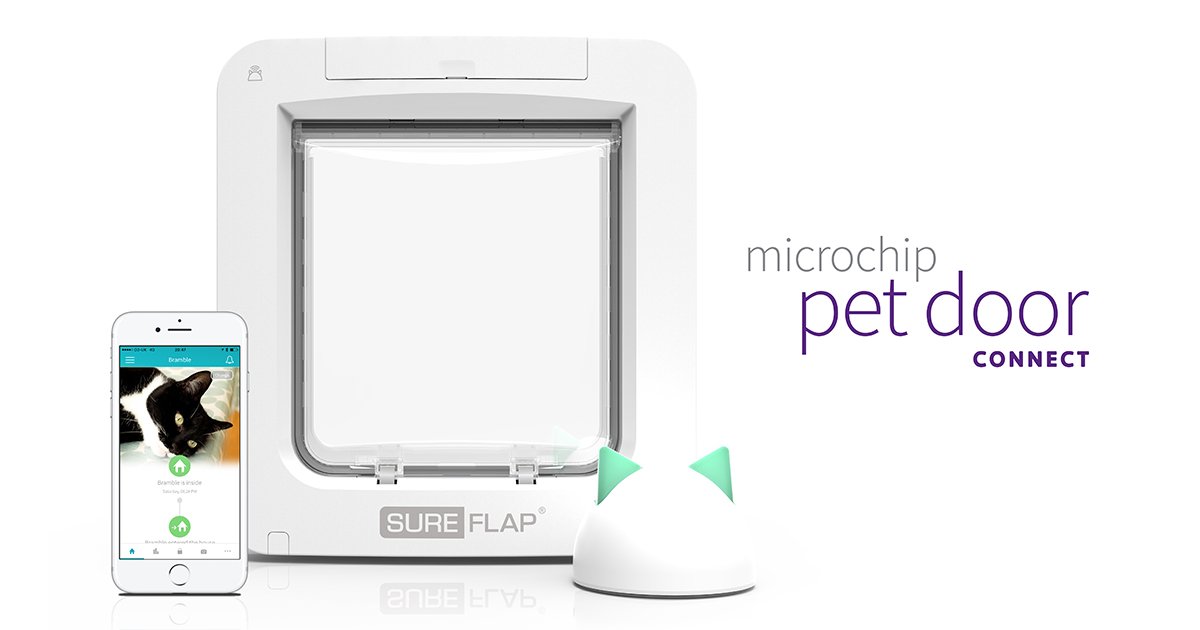
Sure Petcare’s Microchip Pet Door Connect runs about $221, sized for large cats and small dogs. The smaller Microchip Cat Flap Connect sits closer to $170. Either way you also need the Sure Petcare Hub at roughly $49 — the “Connect” in the name refers to a proprietary radio link to that hub, not to Wi-Fi. The flap itself has no network interface at all.
That sounds like a tax. It isn’t, really. Keeping the radio dumb and low-power is why the flap runs for the better part of a year on AA cells while a Wi-Fi door is either mains-wired or eating batteries.
What you get for the money: per-pet permissions, curfew scheduling, in/out notifications, and a surprisingly good indoor/outdoor state model — the app tracks where each animal currently is, not just that something passed through. For multi-cat houses this is the feature that justifies the whole purchase.
What you don’t get: local control. The app talks to Sure Petcare’s cloud, the hub talks to Sure Petcare’s cloud, and if that cloud has a bad afternoon your scheduling stops. The flap keeps reading microchips and keeps letting your cat in — the fail-safe behaviour is correct — but the smart layer goes dark.
There’s no subscription, which in 2026 deserves more credit than it gets. Plenty of pet hardware has quietly moved the other way.
PetSafe SmartDoor Connected — no hub, bigger dogs, bigger price
PetSafe’s SmartDoor Connected goes the other way: 2.4 GHz Wi-Fi straight into the door, no hub, and street pricing that lands somewhere around $400 to $440 depending on size and retailer. That’s roughly double the SureFlap once you’ve bought the hub, and you should know what the premium buys.
Mostly it buys size. The large model handles dogs up to around 100 lb, which is well beyond what any microchip flap will do. Identification is by collar key rather than implanted chip, and PetSafe pairs it with the My PetSafe app for schedules, remote lock/unlock and entry notifications. The medium version can also read microchips directly, which is a nice hedge for households with both a cat and a dog.
It runs on batteries, with a wall adapter sold separately. Buy the adapter. A Wi-Fi radio that has to stay associated for instant remote commands is not a battery-friendly workload, and a pet door that goes flat while you’re away is the exact scenario you bought it to avoid.
The honest summary: it’s the right answer if your dog is too big for a microchip flap, and an expensive answer if it isn’t.
Pawport — $699 to bolt onto the door you already own
Pawport is the most genuinely new idea in the category and the one I find hardest to price-justify. It’s a motorized cover that retrofits over an existing pet door — you’re not cutting a new hole, you’re upgrading the hole you’ve got. Steel deadbolts on a dual locking system, anti-pinch sensing, a weather seal, Bluetooth collar tag, and sizes from medium through extra large. $699, with a Designer Series and a set of Signature Series finishes if you’d rather your back door not look like lab equipment.
Power is corded by default, with an optional rechargeable battery and even a solar panel as add-ons. That tells you something about the power budget of a motorized deadbolt system: it’s real, and the battery option is a convenience, not the intended configuration.
Two caveats. First, Pawport markets app control and voice assistant integration, but does not list Matter or Apple Home support — so it’s another island, and the deepest kind, because a motorized bolt failing closed is a bigger deal than a passive flap failing unlocked. Second, at $699 plus installation reality, you’re in the price bracket where the dead myQ Pet Portal used to live. That’s not a knock on the hardware, which is the most serious-looking thing here. It’s a reminder to weigh how long the company needs to survive for your door to keep working, which is exactly the calculation we laid out in our piece on how to check a device’s support lifespan before you buy.
If you’re renting, Pawport is also the only product here that doesn’t require cutting anything new — assuming a pet door already exists. If it doesn’t, you’re back to the constraints in our no-drill renter’s guide, and the answer is unfortunately “ask your landlord.”
Flappie — the one that checks your cat’s mouth
The Swiss-made Flappie solves a problem no other door even attempts: the dead mouse on the kitchen floor at 4am. A night-vision camera and an on-device model inspect the cat as it approaches, and if it’s carrying prey, the flap simply doesn’t unlock. Flappie claims over 90% accuracy at catching prey-laden entries, and it detects across a range that includes mice, birds, and — because Switzerland is apparently thorough — snakes.
Engadget covered it well when it first surfaced. Pricing is the interesting part: $399 outright, or $199 up front with an $8.90/month app subscription over two years. Do the arithmetic — the subscription path costs about $412 over the term. It’s financing dressed as a service tier, and the outright purchase is the better deal unless you genuinely want to spread the cost. Swiss pricing sits around 450 CHF. Staggered deliveries began in March 2026, so availability outside Europe is still uneven; check your region before you get attached to the idea.
Is it worth $399 to not step on a rodent? If you have an outdoor cat and a carpet, you already know your answer.
Petvation, and why I’d wait
Petvation’s facial-recognition door has been circulating since its Kickstarter campaign: a 120-degree wide-angle camera, full-body modelling to distinguish similar-looking animals, up to 32 registered pets, and a claimed 99% accuracy for single-pet households. Crowdfunding pricing ran from $139 early-bird up to $199, with a stated $229 retail target.
I want it to be real. But “claimed accuracy from a crowdfunding page” and “accuracy in a rainy December at dusk” are different numbers, and the graveyard behind this category is full of funded pet doors. Treat anything in this bucket as a bet, not a purchase, and don’t spend money you’d mind losing.
The Home Assistant escape hatch
If you run Home Assistant — and if you’re reading this you probably do — SureFlap is the only realistic choice, because it’s the only one with a maintained integration path.
The official Sure Petcare integration has shipped in core since 0.104 and sits at just over 2,000 active installations in Home Assistant’s analytics. It exposes per-pet inside/outside state, the flap each pet last used, and who last manually changed a pet’s location. There’s also a more feature-complete community integration and the underlying surepy Python library if you want feeders and water stations covered too.
Be clear about what it is, though: it’s a cloud integration. It polls Sure Petcare’s API. Nothing here is local, and a community effort to run the flaps over a local MQTT broker has never become a maintained, supportable path. You’re automating on top of someone else’s server.
What that unlocks is still worth having. Cat comes in after 10pm, hallway light goes to 5% instead of full. Nobody’s been through the flap in 14 hours, send a nudge. Pair the pet’s outdoor state with a presence sensor so the house stops arming a motion-triggered alert every time the cat crosses the living room.
The things the spec sheets skip
Insulation. Every pet door is a hole in your building envelope. The motorized ones seal better than a passive flap, which genuinely matters in a cold climate and shows up on your heating bill.
Security. A pet door is an opening in a locked door. Microchip flaps lock the flap, not the frame, and a determined person with a coat hanger has options. If you care, the motorized deadbolt designs are meaningfully harder to defeat — and none of them should be your only line of defence.
The false-negative spiral. A door that fails to open for your pet even occasionally teaches the animal not to trust it. Once a cat decides the flap is unreliable, it will sit and yowl at the human-sized door instead, forever. Identification reliability isn’t a spec-sheet nicety in this category; it’s the whole product.
Cheap DIY monitoring. You don’t need a $700 door just to know when the cat came in. A contact sensor on a passive flap and a notification rule gets you 80% of the information for under $20 — Aqara’s P2 door and window sensor is Zigbee, runs for years on a coin cell, and bridges to Matter via any Aqara hub. If you’re assembling a broader setup for a pet at home alone, HomeSmart’s check-on-your-pet bundle is a saner starting point than a motorized flap.
What I’d actually buy
Cat, or a dog under roughly 40 lb: SureFlap Microchip Pet Door Connect plus the Hub. About $270 all in, no subscription, no collar to lose, and the only option with a real Home Assistant story. This is the recommendation for most people and it isn’t close.
Dog over 40 lb: PetSafe SmartDoor Connected, plus the wall adapter. You’re paying for size, not sophistication, and that’s fine.
You already have a pet door and want it to be a real door: Pawport, eyes open about the $699 and about the single-vendor dependency.
Outdoor cat, functioning hunter, patient owner: Flappie, bought outright rather than subscribed, and only if it ships properly in your region.
Anything crowdfunded: wait.
The bottom line
The rest of your house converged on Matter and got better for it. Pet doors didn’t, and there’s no sign they will — the category is too small, the device model too weird, and the incumbents have no incentive to make their flaps interoperable with anything.
What that means practically is that this is one of the few remaining places where you should buy on hardware reliability and company longevity rather than protocol support. There’s no standard to future-proof you here. Pick the identification method that suits your animal, prefer no subscription, prefer batteries you can replace over a service you can’t, and accept that the smartest part of your smart home is going to be the part your cat ignores entirely.
If you’re building out the rest of the pet stack, we’ve covered smart feeders and self-cleaning litter boxes in depth — and the protocol situation there is, remarkably, no better.