Google stopped making the Nest Protect in March 2025, and a lot of people still haven’t noticed. The alarms on their ceilings keep working, so why would they? The catch is that every Nest Protect has a hard 10-year expiry. The second-generation model launched in 2015, so the first units are already timing out. Each one that dies leaves a gap on the ceiling, and the market that’s supposed to fill it is messier than it should be.
Smoke alarms are the one device where “smart” can’t be allowed to get in the way of “works.” So here’s the honest state of things in 2026. There’s a direct Nest replacement, a cheap Wi-Fi option from Kidde and Ring, a small wave of Matter-over-Thread alarms that finally put fire safety in Apple Home and Home Assistant, and a few things you should know before you trust any of them.
First, the non-negotiables
Before we talk apps and protocols, three rules that matter more than any feature list:
- Certification for your region. In the US and Canada, look for UL 217 (smoke) and UL 2034 (CO) listings. In Europe it’s EN 14604 for smoke and EN 50291 for CO. An alarm without the right listing may not satisfy local code, your landlord, or your insurer, however clever its app is.
- The alarm has to work with the network down. Every product below sounds its own siren without Wi-Fi or Thread. The smart layer adds phone alerts and automations on top; it doesn’t replace the beep.
- Interconnect is a safety feature, not a convenience. If a fire starts in the basement, the alarm outside your bedroom needs to go off too. Some smart alarms do this natively. Others make you build it yourself with automations, and I’d be careful about trusting that.
The direct Nest successor: First Alert SC5
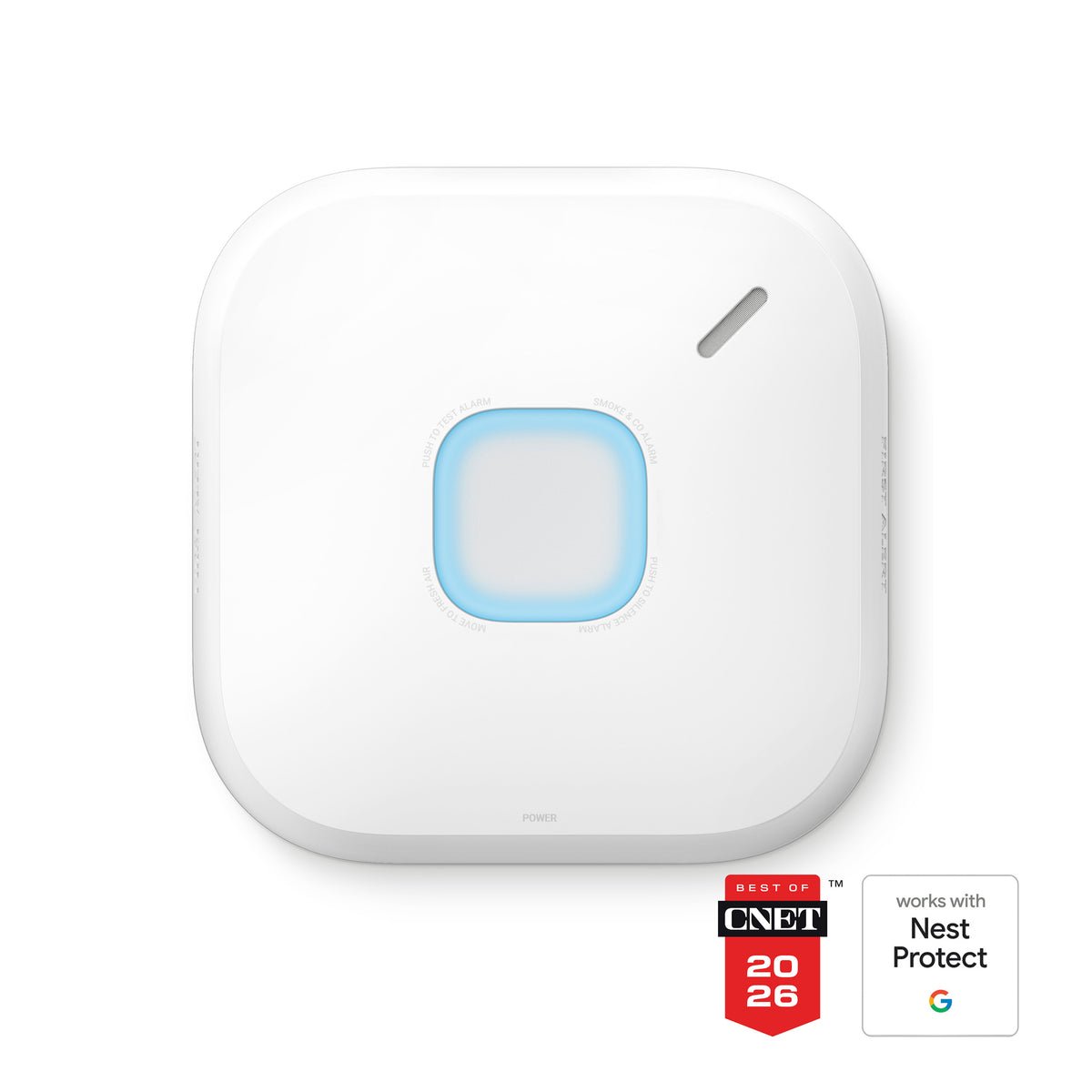
When Google announced the Protect’s end, it also named the replacement: the First Alert SC5 Smart Smoke & CO Alarm, co-developed with Google and sold in the US and Canada for $129.99 in battery and hardwired versions. 9to5Google’s coverage of the announcement has the full backstory.
What makes the SC5 matter is that it interconnects wirelessly with the Nest Protects you already own. Mix old and new, and when one detects smoke, they all sound, with a voice telling you what the danger is and where. It uses both a photoelectric smoke sensor and an electrochemical CO sensor, gives “Heads-Up” early warnings, and fits the existing Nest mounting plate. The hardwired version includes a quick-connect adapter for the old Protect wiring, so you won’t need an electrician for a like-for-like swap.
Setup goes through the First Alert app, then links into the Google Home app. That’s the limitation: this is a Google Home product. You won’t get native Apple Home or Matter support, and at $129.99 each it’s as expensive per room as the Protect was. Tom’s Guide rates it their top smart smoke detector but also says it isn’t quite as good as the Nest Protect it replaces.
Buy it if: you have a house full of Nest Protects that are expiring one by one, or you’re committed to Google Home. For those people, nothing else lets you replace units gradually and keep whole-home interconnect.
The budget Wi-Fi pick: Kidde Smart Alarms with Ring
Kidde and Ring announced these at CES 2025, and they now go for about $55 for the smoke-only model and about $75 for the smoke + CO combo. At launch they were a Home Depot exclusive. The hardwired combo alarm runs on 120V AC with AA battery backup, connects over 2.4 GHz Wi-Fi, and uses photoelectric smoke and electrochemical CO sensors.
The smartest thing Kidde did: the hardwired version interconnects over the existing wire with up to 24 Kidde devices. Swap one old hardwired Kidde alarm for a smart one, and it can send you app alerts when any alarm in the interconnected chain goes off. For a house already wired with Kidde units, that’s about the cheapest way to get phone notifications for the whole place.
Alerts arrive in the Ring app, and there’s Alexa integration. The real selling point for some buyers is optional professional monitoring for $5 a month (or $50 a year), with emergency dispatch, and you don’t need a Ring Protect plan. If you already use Ring for security (see our DIY home security showdown), this fits right in.
The downsides: it’s Wi-Fi only with no Matter, US-focused, and tied to the Ring app. If you care about local control, it isn’t for you.
Buy it if: you want the lowest cost per room for smart alerts, already use Ring or Alexa, or want cheap monitored fire protection.
Matter finally reaches the ceiling
Matter added a dedicated Smoke CO Alarm device type in version 1.2, back in 2023. For about two years hardly anything shipped with it. That changed in 2026, and the new crop runs almost entirely on Thread: battery-powered, low-power mesh, and local control without a manufacturer cloud in the middle.
The payoff is real. Matter Alpha’s roundup of Matter smoke and CO detectors gives a good overview. In Apple Home, a Matter alarm shows up in the “Alarm Sensors” category as proper smoke and CO sensors, not a generic contact sensor hack. SmartThings and Home Assistant support them natively too. Google Home and Alexa can pair them, but how well they’re displayed and alerted on is less consistent. Test before you rely on it.
Heiman S1-M: the UL-listed Thread option
The Heiman S1-M is the one to look at for North America. It’s a Matter-over-Thread photoelectric smoke alarm, listed to UL 217 and certified by the California State Fire Marshal, selling for around $40. It uses dual-wavelength (red + infrared) sensing to tell real smoke from steam and dust, runs about five years on a single CR123A, and sounds an 85 dB siren.
The caveats are serious enough to spell out. It’s smoke only, with no CO sensing. Heiman sells a separate C1-M CO detector for that. Units don’t interconnect with each other natively, so the whole-house alarm has to come from an automation in your hub. And owner reviews are divided: many people report pairing trouble, and a few report false alarms. Europeans get the HS1SA-M (Thread, EN 14604) and the HS1SA-E (Zigbee), both roughly €30.
Sensereo MSC-1: smoke and CO, Europe first
The Sensereo MSC-1 is the most complete Matter alarm so far. It combines photoelectric smoke and electrochemical CO sensing over Thread and has a small LCD that shows live CO readings in ppm. It’s certified to EN 14604 and EN 50291, priced at $69.99, and works with Apple Home, Google Home, SmartThings, Home Assistant and Homey. A smoke-only sibling, the MS-1, costs $49.99.
Two things to know. The CR123A battery lasts about three years in normal use, well short of the sealed 10-year cells in traditional alarms, which is Thread’s power cost. More importantly, UL certification is still pending, so it’s a Europe-only choice for now. North American buyers should wait. Sensibly, you can’t silence it from an app. You have to press the physical button.
Owl Wired: the everything sensor
Owl Wired goes the other way. It’s a hardwired, Matter-over-Wi-Fi 6 unit that combines smoke and CO detection with motion, sound, temperature, humidity and air quality sensors, for $179 in the US and Canada. It works with Apple Home, Google Home and Alexa without a hub. It’s interesting as a single ceiling device that replaces three sensors. Its product page doesn’t make its UL listings easy to find, though, so confirm them with the retailer before you rely on it as your code-required alarm.
The Zigbee route: Aqara and friends
If you already have a Zigbee hub, Zigbee smoke alarms are the most mature smart option: cheap, long battery life, and well supported locally. The Aqara Smart Smoke Detector is the best-known one. It runs Zigbee 3.0, claims up to 10 years of battery life, and connects through an Aqara hub. Through the hub it appears in Apple Home, and it also works with Home Assistant via ZHA or Zigbee2MQTT. Group several on the same Aqara hub and they’ll all sound together, which gives you software interconnect that doesn’t depend on building your own automation.
The trade-offs are the usual Zigbee ones. It needs a hub, there’s no CO sensing, certifications vary by regional model, and availability differs a lot between markets. For Aqara households in Asia and Europe, it’s still an easy choice.
What about the Matter-over-Thread interconnect problem?
This is the design gap nobody has solved cleanly yet. Traditional alarms interconnect by wire or by dedicated RF radios that work with no router, no hub and no internet. First Alert’s SC5 and Kidde’s hardwired units keep that. Most Matter alarms don’t: when one S1-M hears smoke, the others only sound if your hub runs an automation telling them to, and your Thread border router is up, and the hub is up.
That’s fine as a bonus layer. It’s not fine as your only interconnect, especially if your local building code requires interconnected alarms in new builds and renovations, as many do. Power cuts are exactly when this gets tested. Our blackout backup guide explains why your border router should be one of the devices on a UPS.
So what should you actually buy?
| Situation | Pick | Why |
|---|---|---|
| Replacing expiring Nest Protects | First Alert SC5 ($129.99) | Only option that interconnects with the Protects you still have |
| Cheapest smart alerts, US | Kidde + Ring ($55–$75) | Hardwired interconnect with existing Kidde alarms, optional $5/mo monitoring |
| Apple Home / Home Assistant, US | Heiman S1-M (~$40) + separate CO alarm | UL-listed, local Thread, but add conventional interconnect |
| Apple Home / Home Assistant, EU | Sensereo MSC-1 ($69.99) | Smoke + CO in one Matter device, EN-certified |
| Existing Aqara or Zigbee setup | Aqara Smart Smoke Detector | Mature, long battery, grouped alarms through the hub |
My practical advice for most people is a hybrid setup. Keep certified, interconnected conventional alarms as the backbone, because that’s what keeps you alive. Then add one or two Matter or Zigbee alarms, or a smart unit that joins the existing wired chain the way Kidde’s does, so your smart home can react: turn on every light to full brightness, unlock the front door for firefighters, shut off the HVAC so it doesn’t spread smoke, and push a critical alert to your phone. If you’re setting this up for an elderly relative, pair it with the fall-detection sensors from our aging-in-place guide.
Last thing: look at the manufacture date on the alarms already on your ceiling. If there’s a Nest Protect up there from 2016, it’s close to its 10-year end, and it’ll tell you so at a bad time. Order the replacement now, not at 3 a.m.