Every smart home guide loves to talk about the flashy stuff — the doorbells that recognize faces, the locks that open with your palm, the presence sensors that know which corner of the room you’re standing in. But the humble temperature and humidity sensor might be the most quietly useful device you can buy. It’s the trigger behind half the automations that actually make a home feel smart: the fan that kicks on when the nursery hits 25°C, the dehumidifier that fires before mold gets a foothold, the notification that your wine fridge is drifting warm.
The problem is that “temp and humidity sensor” spans a huge range — from $13 Bluetooth pucks to $70 Thread-connected precision instruments — and the spec sheets rarely tell you which one belongs in your setup. So let’s fix that. Here’s how the five sensors worth your money in 2026 actually compare, across ecosystems, protocols, and the kind of real-world nagging accuracy that separates a useful trigger from a false alarm.
Why the protocol matters more than the price
Before you look at a single price tag, figure out how the sensor is going to talk to the rest of your home. This is where most people get burned. A $13 Govee puck and a $40 Aqara sensor can read the exact same temperature — but only one of them can trigger an automation across your Apple Home, Google Home, or Alexa setup without a phone app sitting in the middle.
There are essentially four camps:
- Bluetooth-only (Govee H5075, SensorPush HT1): the sensor logs data locally and pushes it to a phone app over a short-range radio. Great for spot-checking a cigar humidor or a greenhouse. Useless for whole-home automation unless you add a gateway.
- Wi-Fi (Govee H5179): connects straight to your router, works with Alexa and Google Home, no hub required. Convenient, but Wi-Fi sensors sip battery faster and add clutter to your network.
- Zigbee (classic Aqara sensor): rock-solid, low-power, sub-30-second automation triggers — but it needs an Aqara or compatible Zigbee hub to exist.
- Matter-over-Thread (Aqara W100, Eve Weather): the 2026 gold standard. Local, fast, low-power, and natively visible to every major platform at once. This is the camp to be in if you’re building for the long haul.
If you take one thing away from this guide: buy for the protocol your home already speaks, not for the number on the box. A cheap sensor that can’t talk to your hub is an expensive mistake in disguise. For a broader look at where the standard is heading, our breakdown of what Matter 1.6 actually changed is worth a read.
Aqara Climate Sensor W100 — the do-everything pick ($39.99)
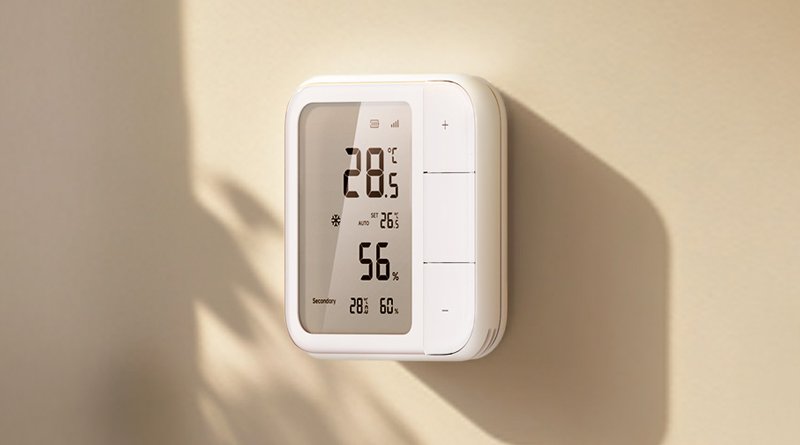
If I had to put one sensor in most homes in 2026, it’d be the Aqara Climate Sensor W100. Aqara took what used to be a boring category and bolted on a genuinely useful 3.4-inch LCD, three programmable buttons, and — critically — a choice of radios. You can run it as Matter-over-Thread for native, hub-optional integration with Apple Home, Google Home, and Alexa, or pair it to an Aqara hub over Zigbee 3.0 to unlock the deeper automation features Aqara’s own app offers.
Accuracy is where it earns its keep: ±0.2°C for temperature and ±2% RH for humidity, which is tight enough that you can trust it as an automation trigger rather than a rough guide. The display pulls double duty, showing both the sensor’s own readings and, if you like, data pushed from a paired thermostat. Those three side buttons are the sleeper feature — each supports single, double, and long presses, giving you up to nine shortcuts for scenes or device control right on the wall. It’s effectively a climate sensor and a scene controller in one puck.
Battery life is a claimed 2.4 years on Zigbee (2.3 on Thread) from two CR2450 coin cells, which is excellent for a device driving a live display. The knock, per reviewers, is that some of the Matter-side smarts still feel a touch unfinished — button-to-Matter mapping in particular lags behind what you get inside the Aqara app. But as a piece of hardware at $39.99 (roughly €40 in Europe, and notably cheaper through Asian retailers), nothing else this flexible comes close. Readers in Singapore and the region can grab it locally via HomeSmart’s W100 listing.
The classic Aqara Temperature & Humidity Sensor — the automation workhorse (~$20)
Don’t overlook Aqara’s original cube-shaped Temperature & Humidity Sensor. It’s Zigbee-only and has no screen, but at around $20 it’s the cheapest way to sprinkle reliable, locally-processed triggers throughout a home that already runs an Aqara hub. Where a Wi-Fi sensor might take 30–60 seconds to relay a reading through the cloud, this thing fires automations locally in well under 30 seconds, and a single CR2032 lasts well over a year.
If you’re a Home Assistant or Apple Home user with an existing Zigbee coordinator, buying three or four of these to scatter around bedrooms, the bathroom, and a storage closet is one of the highest-value moves in the smart home. Just remember: no hub, no party. It cannot stand alone.
SwitchBot Meter Pro — the value champion ($19.99)
The SwitchBot Meter Pro is what you buy when you want a crisp, readable desktop display and a path into a smart home ecosystem without overspending. At $19.99, it shows temperature and humidity on a clean e-ink-style front panel, logs data over Bluetooth to the SwitchBot app, and — this is the important part — can expose readings to Apple Home, Alexa, and Google Home via Matter once you add a SwitchBot Matter-enabled hub (the Hub 2 or Hub Mini). SwitchBot even sells a “Meter Pro Matter Combo” that bundles the sensor with the hub for people starting from scratch.
SwitchBot’s headline claim is Bluetooth range — up to 120 meters line-of-sight, versus roughly 20 meters on a typical Aqara puck — which matters if you’re monitoring a detached garage or a far corner of a large house. Accuracy is very good (SwitchBot uses a Sensirion sensing element), and the standalone display means non-techy household members can just glance at it. The catch is the two-tier setup: the sensor alone is a Bluetooth gadget, and Matter/HomeKit access only appears once the hub is in the picture. Budget for both if automation is the goal.
If you want CO2 and air-quality data on top of temperature and humidity, SwitchBot’s Meter Pro CO2 monitor is a 5-in-1 upgrade — though at that point you’re crossing into dedicated air-quality-monitor territory and should weigh it against purpose-built units.
Eve Weather — the Apple Home purist’s outdoor pick (~$70)
Eve Weather is the priciest sensor here at around $70, and it knows exactly who it’s for: the Apple Home devotee who wants outdoor-grade, no-app-required climate data. It’s Matter-over-Thread out of the box, weather-resistant enough to live on a balcony or patio, and it adds barometric pressure to the usual temp-and-humidity duo, which lets it do lightweight local weather trending.
Because it’s Thread-native, Eve Weather needs no proprietary bridge — just a Thread border router (an Apple TV 4K, HomePod, or equivalent) and a home hub. Data syncs directly into the Home app with a genuinely slick history graph, and Eve’s own app remains one of the few that stores your logs locally rather than in a vendor cloud, which privacy-minded folks will appreciate. It’s overkill for a spare bedroom, but for tracking your actual outdoor conditions or a three-season porch, it’s the most elegant option going. Just know that its polish is heavily tilted toward Apple’s ecosystem; Android and Alexa users get a less refined experience.
Govee H5075 and H5179 — the no-ecosystem bargains ($13–$15)
Sometimes you don’t want a smart home. You want to know if the baby’s room got too warm, or whether the basement is creeping toward damp. That’s the Govee lane, and it’s very good at it.
The Govee H5075 ($14) is Bluetooth-only: pair it to the Govee app, get alerts when readings cross a threshold, and export two years of logged data to a spreadsheet. No hub, no ecosystem, no automations across other brands — just a dependable, accurate little logger with a readable display. The Govee H5179 ($15) swaps Bluetooth for Wi-Fi, which means it works with Alexa and Google Home for voice queries and remote monitoring from anywhere, again with no hub required.
Neither Govee plays nicely with Apple Home or Matter, and neither is what you’d build a serious automation routine around. But for spot-monitoring a wine fridge, greenhouse, guitar case, or nursery, spending $14 instead of $40 is the smart move. Just go in knowing you’re buying a thermometer with alerts, not a smart home citizen.
SensorPush HT1 — the precision instrument ($54.95)
The SensorPush HT1 is the odd one out here, and deliberately so. It’s a Bluetooth sensor aimed at people who care about data integrity above ecosystem integration — think reptile keepers, cigar aficionados, museum-grade storage, food producers. At $54.95 it’s expensive for a hub-less Bluetooth device, but you’re paying for a calibrated, high-accuracy sensing element and a rock-solid logging app that graphs long-term trends beautifully.
Out of the box it’s local-only, but SensorPush sells a Wi-Fi Gateway that turns it into a remote-monitoring system with cloud alerts — so you can get a phone notification the moment your basement humidor drifts out of range while you’re on holiday. It won’t trigger your smart lights or talk to Matter, and it’s not trying to. If your priority is trustworthy numbers over years rather than automations across brands, nothing on this list beats it.
So which one should you actually buy?
Here’s the short version, because the specs blur together fast:
- You run Apple Home, Google Home, or Alexa and want one great all-rounder: the Aqara W100. Matter-over-Thread, a real display, programmable buttons, and a fair $39.99. It’s the default recommendation for a reason.
- You already have an Aqara or Zigbee hub and want cheap, reliable triggers everywhere: buy a handful of the classic Aqara Temperature & Humidity Sensors at ~$20 each.
- You want the best display-plus-ecosystem value and don’t mind adding a hub: the SwitchBot Meter Pro at $19.99 (plus a SwitchBot Matter hub).
- You’re deep in Apple Home and want outdoor/patio data: Eve Weather, around $70.
- You just want to know a number and get an alert — no smart home involved: Govee H5075 ($14 Bluetooth) or H5179 ($15 Wi-Fi).
- You need laboratory-grade accuracy and long-term logging: the SensorPush HT1 at $54.95.
The mistake I’d steer you away from is buying purely on price. A $13 Govee is a genuine bargain if all you need is a reading — and a genuine dead end if you were hoping to trigger your thermostat or fans from it. Match the radio to your home first, then let the budget decide. Do that, and a $20 puck can quietly become the trigger behind the automations you end up bragging about. Pair one of these with a good smart thermostat or a voice assistant that can read the values back to you, and you’ve built the invisible nervous system that makes the rest of the smart home worth having.