Heating season is here in the northern hemisphere, Black Friday lands on November 27, and the thermostat aisle has had its busiest year in a long time. Apple now has its own thermostats, built by LG and Schneider Electric. Aqara shipped its first North American thermostat. Honeywell Home put a 5-inch screen on the wall, and ecobee and Google kept selling the two models everyone already recommends.
The question that matters this month: buy now, or wait for Apple’s $199.95 thermostats? My short answer is that it depends less on the hardware than on which app you want running your heating, and on what kind of heating you have. Here’s how it breaks down.
First, what kind of heating do you have?
Nearly everything in this article is a 24-volt wall thermostat for the ducted forced-air systems and heat pumps that dominate North America. If you live in the UK or Europe with a combi boiler and radiators, most of these products won’t fit, and the choice is different (more on that below). If you’re in Australia or Asia with split-system air conditioners, a wall thermostat isn’t the upgrade you want at all. A mini-split controller is, and we covered those in our room-by-room climate control guide.
For North American buyers, check one thing before you shop: the C-wire. Smart thermostats need constant 24V power, and many older homes lack the “common” wire that supplies it. Every product here either includes an adapter or sells one for $24 to $30. Take a photo of your existing wiring before you order. It answers most compatibility questions in thirty seconds.
The big shift: Adaptive Temperature
The feature driving this year’s thermostat news is in Apple’s Home app, not on any thermostat. Adaptive Temperature debuted with iOS 26 in September 2025. It uses on-device intelligence from your iPhone to shift heating and cooling between home, away and wind-down-for-the-night settings without a schedule. Its sibling, Clean Energy Guidance, moves heating and cooling into cleaner, cheaper grid periods if you’re on a compatible utility plan in the contiguous US.
The catch is that support arrives model by model. A thermostat that works with Apple Home doesn’t automatically get these features. As of today, the confirmed list is short:
| Thermostat | Price (US) | Adaptive Temperature | Protocol | Status |
|---|---|---|---|---|
| Aqara Thermostat Hub W200 | $159.99 | Yes | Matter, Thread, Zigbee hub | Shipping |
| LG Smart Thermostat | $199.95 | Yes | Matter over Thread | From December |
| Schneider Home Smart Thermostat | $199.95 | Yes | Matter over Thread | From December |
| Honeywell Home X8S / X7S / ElitePRO | X8S $219.99 | Promised via update | Matter | Update expected Q1 2027 |
| ecobee Smart Thermostat Premium | $259.99 | Not announced | HomeKit (no Matter) | Shipping |
| Google Nest Learning Thermostat (4th gen) | $279.99 | Not announced | Matter | Shipping |
If you live in Apple Home, that table is most of the decision. If you don’t, skip to the ecobee and Nest sections, because the most mature software is still there.
Apple’s Home Collection thermostats: LG and Schneider
Apple announced its Home Collection on October 13 alongside HomeView, and the two thermostats are the least flashy and possibly most useful parts of it. (Our full rundown of Apple’s launch covers the cameras, the lock and HomeView itself.)
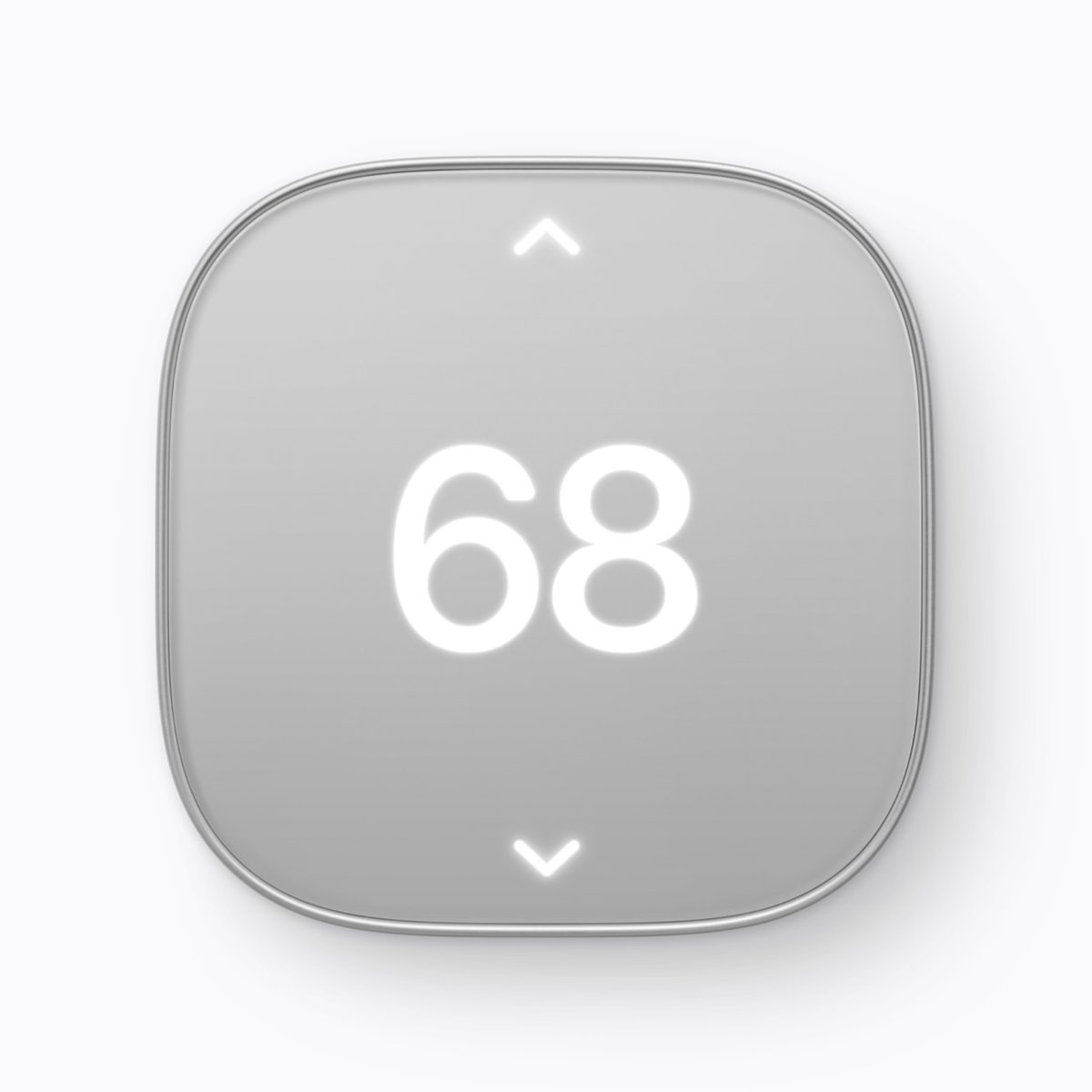
The LG Smart Thermostat (Essence White) and the Schneider Home Smart Thermostat (Silver + White) cost $199.95 each. Optional room sensors are $39.95, and C-wire power adapters are $24.95 for either brand. Schneider also sells a $14.95 trim plate for covering the outline of an old thermostat. Both are Matter compatible and run over Thread, so they keep working on your local network if Wi-Fi drops. Both detect wiring on the device to help with DIY installation, and Apple says ADT will install them for an extra charge if you buy at an Apple Store in the US.
What sets them apart is the sensors. These thermostats can read temperature and humidity from the standalone room sensors and from sensors already built into HomeView, HomePod and HomePod mini. If you own a couple of HomePods, you already have multi-room sensing without buying anything else. Nest and ecobee charge extra for that.
The limitations are just as clear. They’re sold in the US and Canada only, and Clean Energy Guidance works only in the contiguous US with a compatible utility plan. Apple says availability “begins in December, with select accessories available starting early 2027,” and doesn’t say which items fall into which window. Nobody has reviewed them yet, so nobody knows how well they handle multi-stage heat pumps or how much you can adjust on the thermostat itself rather than in the app. Those are exactly the details that separate good thermostats from frustrating ones.
Who should wait for them: Apple-only households with simple systems (single-stage furnace and AC, or a basic heat pump) who’d like the thermostat to work like a first-party Apple device. If your current thermostat still works, waiting a month or two for real reviews costs nothing.
Aqara Thermostat Hub W200: Apple’s features, available now
If you want Adaptive Temperature this winter rather than next, the Aqara Thermostat Hub W200 is the only thermostat that has it today. It costs $159.99, and the C-wire adapter is $29.99 extra if you need it. It was Aqara’s first thermostat designed for North America and the first thermostat of any brand to support Adaptive Temperature. It does Clean Energy Guidance too.
It’s also a hub. The W200 connects Aqara’s Zigbee and Thread devices, uses mmWave radar to sense when someone is near (which wakes the screen and feeds presence into its schedules), and can show snapshots from Aqara doorbells and cameras. Pair it with an Aqara Climate Sensor W100 in the bedroom and you have a room sensor setup for well under the price of a Nest. (We compared the W100 with rivals in our temperature and humidity sensor showdown.)
Heat pump owners should read the fine print. MacRumors’ review found that the minimum outdoor temperature for running the compressor can’t be set below 20°F. In a cold-climate heat pump home, that means the W200 may hand over to expensive electric auxiliary heat sooner than it needs to, and unlike ecobee there’s no way to minimize aux heat use. The reviewer also noted that schedules in the Aqara app and in Apple Home can’t be used together, and that the glossy screen collects fingerprints.
Buy it if: you use Apple Home, have a furnace or a heat pump in a mild climate, and want Adaptive Temperature now. Skip it if: you’re in a cold climate with a heat pump. The aux heat controls aren’t there yet.
Honeywell Home X8S: the touchscreen that’s getting smarter
The Honeywell Home X8S is Resideo’s premium thermostat. At a $219.99 list price, it has a 5-inch touchscreen, presence sensing, and live video from a Ring doorbell on the display, which is a strange but genuinely handy trick. It’s Matter certified, so it works with Apple Home, Google Home, Alexa, SmartThings and Home Assistant. Room sensors are sold separately, while the older T9 includes one in the box.
The X8S matters for this buying guide because of a promise. On October 22, Resideo said a software update expected in Q1 2027 will bring Adaptive Temperature and Clean Energy Guidance to the ElitePRO, X7S and X8S, with no new hardware or professional visit required. That’s an expected date, not a ship date. But it makes the X8S the safest “buy now, get Apple’s features later” choice for people who also use non-Apple platforms.
The caveat: Matter Alpha’s review called it “a stunning thermostat with minimal Matter support.” Over Matter, the X8S behaves much like Honeywell’s cheapest model. Its extra features stay in Resideo’s own app.
ecobee: still the heat pump pick, still no Matter
ecobee Smart Thermostat Premium ($259.99) remains the thermostat I’d put in a cold-climate heat pump house. It supports heat pumps up to two stages of heating and cooling plus two stages of auxiliary heat, and its installer settings let you control when the compressor locks out and when aux heat kicks in. The W200 can’t offer that yet. It also includes a SmartSensor and a Power Extender Kit in the box, along with radar occupancy sensing, an air quality monitor, and a built-in speaker with Alexa. Siri works through it if you pair a HomePod.
The cheaper Smart Thermostat Essential is now $139.99 on ecobee’s store, up from its $129.99 launch price, with the $24.99 Power Extender Kit sold separately.
The frustrating part is Matter. ecobee supports Apple HomeKit, Alexa, Google Assistant and SmartThings, but four years after Matter launched, it still isn’t on the list. ecobee hasn’t announced Adaptive Temperature support either. If you’re an Apple user, ecobee works well in the Home app today, but don’t count on it getting Apple’s new climate features.
Google Nest Learning Thermostat (4th gen): best for Google homes
The Nest Learning Thermostat (4th gen) costs $279.99 and includes a Nest Temperature Sensor (2nd gen). It has been discounted to $229.99 in earlier sales, so watch for it on Black Friday. It’s still the best-looking thermostat on this list, and Google’s AI-driven Smart Schedules remain some of the most hands-off scheduling you can buy. It also supports Matter, so it can join Apple Home or SmartThings, though setup has to start in the Google Home app first.
Extra sensors cost about $40 each, or around $100 for a three-pack. Google hasn’t said anything about Apple’s Adaptive Temperature, which is no surprise. The budget Nest Thermostat ($129.99 list, often less) also supports Matter. It’s the cheapest way to get a reputable, Matter-compatible thermostat from a big brand, though it doesn’t learn your habits and doesn’t support remote sensors.
One trust issue is worth knowing about. On October 25, 2025, Google ended app and remote control for the first- and second-generation Nest Learning Thermostats. They still run their schedules, but they’re no longer smart. Before you buy any connected thermostat, check how long the maker promises updates. Our guide to smart home device support periods explains how.
The wildcard: Eve Thermostat
Eve announced its first North American thermostat at CES in January: the Eve Thermostat, $129.95, Matter over Thread, with no account, subscription or cloud. It includes a trim plate, and an optional C-wire adapter is available for older systems. On price and privacy, it’s the most appealing thermostat of 2026. But it was due in Q1, and Eve’s own launch announcement still doesn’t answer the questions a buyer needs answered, such as heat pump support and Adaptive Temperature. Its US listing still said “coming soon” when we checked. Treat it as a maybe until reviews arrive.
Outside North America: a different market
UK and Europe. Google won’t launch new Nest thermostats in Europe. It pointed existing owners to tado, and that’s the right call for most boiler-and-radiator homes. The tado Smart Thermostat X works over Matter and Thread. The wireless starter kit (£159.99 RRP, often discounted) has a built-in Thread border router, while the wired version needs tado’s Bridge X or another border router. Pair it with smart radiator valves for real room-by-room control. Eve’s European “Eve Thermostat” is a different product: a 230V wall unit for water-based underfloor heating that doesn’t control boilers or heat pumps. Aqara’s W200 isn’t designed for British or European heating.
Australia, Asia and the Middle East. If your home runs on split-system or ducted reverse-cycle air conditioning, a mini-split controller or the air conditioner maker’s own app will do more than any thermostat here.
Where Matter is heading
Matter 1.6, released June 17, added Thermostat Suggestions. A platform or utility can now send a thermostat a recommended change, such as easing off during a demand-response event, and the thermostat can weigh it against your comfort settings and explain if it declines. It’s the standards-based version of Clean Energy Guidance, and over time it should make features like Apple’s less tied to one ecosystem. (Our Matter 1.6 explainer has the details.) For now, buy for the features that work today.
What I’d actually buy
- Apple Home, simple system, current thermostat still works: Wait for reviews of the LG or Schneider models in December. If you have HomePods, their built-in sensors make the $199.95 price better value than it looks.
- Apple Home, want it this winter: Aqara W200 at $159.99, unless you have a cold-climate heat pump.
- Cold-climate heat pump, any platform: ecobee Smart Thermostat Premium. Its aux heat controls save more money than any AI feature.
- Google Home household: Nest Learning Thermostat (4th gen), ideally on a Black Friday deal.
- Mixed household (Alexa, SmartThings, Home Assistant, plus some Apple): Honeywell Home X8S. You get Matter today and Adaptive Temperature, if Resideo delivers, next year.
- Tight budget: Nest Thermostat, the most affordable Matter thermostat from a major brand.
- UK and Europe: tado Smart Thermostat X with radiator valves.
The bottom line
For a decade, thermostat shopping meant picking ecobee or Nest and getting on with your life. In 2026, the platform you use matters more than the brand. Apple has turned climate control into a Home app feature that thermostats must specifically support, and the list of supported models is short but growing. If you use Apple Home and your thermostat is working fine, the smartest move this month may be to wait four weeks. Everyone else can buy now, especially on Black Friday, and check that what they buy offers the integration they need, not just the one on the box.