The smart window AC problem nobody talks about
It is late May, the first genuinely sweaty week of the year has arrived, and a familiar ritual is playing out in millions of homes: dragging a window air conditioner out of a closet, wrestling it onto a sill, and rediscovering that the “smart” features you paid extra for still amount to one thing — a manufacturer app you open twice a year.
That is the quiet embarrassment of this category. For most of the past decade, “smart” on a window AC has meant Wi-Fi plus a voice assistant, and nothing more. Your air conditioner could hear Alexa, but it could not talk to your thermostat, your smart blinds, or a presence sensor in the same room. Each unit was a little island with its own login.
Matter was supposed to fix exactly this. Matter 1.2, released in October 2023, added “room air conditioner” as an official device type — a standardized, local way for a window unit to join any smart home as a first-class citizen. More than two years later, in the 2026 cooling season, exactly one major brand has actually shipped it.
This guide ranks the units that matter (pun fully intended) by how well they behave as smart home devices — not by how photogenic their apps are. Prices are in USD; window ACs are overwhelmingly a North American form factor, and we will get to what the rest of the world should do near the end.
What “smart” should actually mean here
Two things separate a genuinely smart window AC from a dumb one with a chip in it.
The first is the inverter compressor. Old-school ACs are on/off: the compressor slams to full power, overshoots the target, shuts off, and the room temperature sawtooths up and down all night. An inverter modulates compressor speed continuously, holding a steady temperature while drawing roughly a third less energy and running far quieter. Every unit I actually recommend below is an inverter — but a couple of brands still sell cheaper fixed-speed models in the same product family, and I will flag those. A non-inverter window AC in 2026 is not worth your money no matter how clever its app looks.
The second is how it connects, and this is where the category falls apart. A Wi-Fi AC that only speaks to its own cloud app is a hostage to that cloud. When the servers hiccup, the smarts die. When the company loses interest in the app — and appliance brands lose interest constantly — your “smart” AC quietly becomes a regular one.
Matter solves this because it runs locally. A Matter room air conditioner pairs directly with Apple Home, Google Home, Amazon Alexa, Samsung SmartThings, and Home Assistant, and keeps working on your own network even if the manufacturer disappears. More importantly, it can finally join real automations: cool the bedroom when a presence sensor sees you and the temperature crosses 26°C; pause when a window contact sensor opens; throttle back when your energy monitor flags peak pricing. We covered this same local-versus-cloud divide when we looked at why most smart air purifiers still refuse to support Matter — the air conditioner story is, sadly, almost identical, with one bright exception.
Midea U-Shaped — the only one that speaks Matter
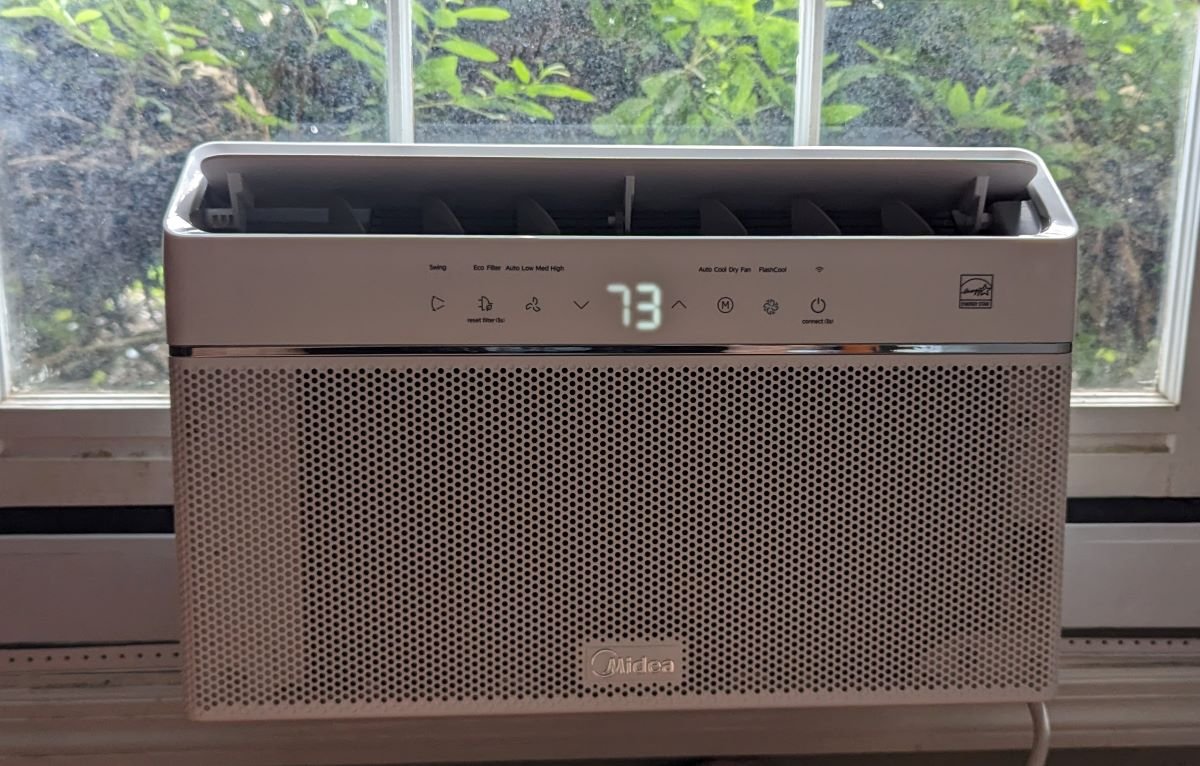
The Midea U-Shaped Smart Inverter is the unit to beat, and not only because of Matter. Its signature trick is the U-shaped chassis: the window sash slides down through a gap in the middle of the unit, so you keep most of your window — and can still open it — while the AC is installed. The same shape routes compressor noise outside, which is how Midea gets the U down to a genuinely library-quiet 32 dBA on its lowest setting.
It is also the first Matter-certified window air conditioner sold in the US — Midea announced it back in 2023 — and, as of this writing, still effectively the only one. The Matter-enabled U pairs directly with Apple Home, Alexa, Google Home, and SmartThings, with no Midea account required after setup. That is a real, structural advantage over every other unit here, and the reason it tops this list.
Pricing is reasonable for what you get: roughly $379 for the 8,000 BTU model (good for 350 sq ft), $429 for the 10,000 BTU (450 sq ft), and $479 for the 12,000 BTU (550 sq ft), with frequent discounts at warehouse clubs and during seasonal sales. Midea claims up to 35–37% energy savings versus a conventional unit, and the inverter-plus-U-shape combination genuinely delivers on quietness — Tom’s Guide’s testing reached the same conclusion on cooling performance.
One honest caveat: Midea sells both Matter and non-Matter versions of the U, and the difference is not obvious on a store shelf. Before you buy, confirm the specific model carries the Matter logo — look for an explicit “Works with Matter” badge on the box and the listing. Get the right SKU and the U is the easy pick for anyone who actually runs a smart home.
GE Profile ClearView — the design favorite that skipped the standard
If the Midea U’s idea is “keep your window,” the GE Profile ClearView’s idea is “keep your view.” The unit sits low against the sill with a slim profile, so you keep the upper portion of the window clear and let natural light through. It is the best-looking installed window AC on the market, and GE’s flex-depth design fits walls from 4.5 to 13.75 inches thick — a genuine help in older homes and oddly-built apartments.
The ClearView range spans 6,100 to 12,200 BTU, but the ones to buy are the two true inverter models — the 10,300 BTU PHNT10CC and 12,200 BTU PHNT12CC — which run ultra-quiet down to around 40 dB and carry Energy Star certification. The smaller 6,100 and 8,300 BTU ClearView units are conventional fixed-speed; skip them. Inverter prices start around $429 and climb past $500 for the PHNT12CC.
The frustration is the smarts. The ClearView connects through GE’s SmartHQ app with Alexa and Google Assistant support — and that is the entire story. No Matter, no Apple Home, no SmartThings beyond cloud workarounds. GE Appliances builds Matter into plenty of its larger products, so the omission on a flagship 2026 air conditioner is a choice, not a technical limitation. If you live entirely inside the Google or Alexa world and care most about how the unit looks in the window, the ClearView is excellent. If you want it wired into automations, you are leaning on a single-vendor cloud.
Windmill and July — style first, standards never
Windmill and July are the Instagram brands of window air conditioning, and they have done real good for the category: both proved a window AC does not have to be a beige eyesore. Windmill’s units come in clean white with a fabric-look front; July sells its 8,000 BTU unit in six colors with swappable front panels, treating the AC as a piece of decor rather than an appliance to hide.
Both are competent inverter machines. Windmill’s WhisperTech models use the more climate-friendly R32 refrigerant and run quietly; pricing spans roughly $329 for the 6,000 BTU up to about $549 for the 10,000 BTU WhisperTech. July’s 8,000 BTU unit lands around $399.
But on the criteria that matter for this site, both fall short. Each offers a phone app plus Alexa and Google voice control, and neither supports Matter, Apple Home, or local control. July compounds the problem with a genuinely odd design decision — the controls and display sit on top of the unit, so you cannot read the set temperature without standing directly in front of the window. Windmill’s weak spot is a one-year warranty, short for an appliance you expect to run hard every summer for a decade. Buy these if you want your AC to look good. Do not buy them expecting a real smart home device.
LG Dual Inverter — the efficiency pick
LG’s Dual Inverter line — the LW6023IVSM, LW8022IVSM, LW1022IVSM, and the big 14,000 BTU LW1522IVSM — is the choice for buyers who care about the electricity bill above all else. LG’s dual-inverter compressor is among the most efficient in the category, with the company claiming up to 35% energy savings, and even the largest 14,000 BTU unit holds noise to around 44 dB.
Connectivity runs through the LG ThinQ app with Alexa and Google Assistant. As with GE, there is no Matter and no Apple Home. ThinQ is a more mature, more reliable app than most appliance software, so the cloud-island problem stings a little less here — but it is still a cloud island. The LG units are the right call if raw efficiency and a big-room BTU rating top your list, and smart home integration is a nice-to-have rather than a hard requirement.
What about the rest of the world?
Here is the global footnote. The window air conditioner is largely a North American obsession. In Europe, much of Asia, and Australia, homes overwhelmingly use split systems, mini-splits, or portable units instead — window-mounted ACs are rare, and many window designs simply cannot accommodate them.
If you are outside North America, the smart-cooling question usually becomes: how do I make the AC I already have smarter? For a wall-mounted split unit, the answer is an infrared bridge or a dedicated smart AC thermostat that learns your remote’s signals — a far cheaper upgrade than replacing the unit. An infrared smart air-con controller can bring scheduling, geofencing, and voice control to a “dumb” split for a fraction of a new AC’s price. It is also the most renter-friendly route, which fits neatly with our no-drill smart home guide for renters.
Worth noting: Midea, a genuinely global appliance giant, also sells Matter-certified portable air conditioners and is expanding direct operations in markets such as Australia. So even where window units are uncommon, Midea is currently the brand carrying the Matter banner for room cooling.
So what should you actually buy?
For most readers of this site — people who run automations and want their devices to outlive a manufacturer’s enthusiasm for an app — the Midea U-Shaped Smart Inverter, in its Matter version, is the clear winner. It is quiet, efficient, fairly priced, and the only window AC that joins your smart home as a real, local, standards-based device. Just verify the Matter logo before you pay.
If you want the best-looking unit in the window and live in a Google or Alexa household, the GE Profile ClearView is a beautiful, well-built machine — you are simply accepting a single-vendor cloud. If the power bill is your single biggest concern, the LG Dual Inverter range is hard to beat on efficiency. And if your AC is a design statement first and a smart device a distant second, Windmill and July will look the part — just go in clear-eyed that the “smart” label here is doing very light work.
The bigger picture is the disappointing one. Matter handed this entire industry a finished, certified standard for room air conditioners back in 2023. In 2026, one company has picked it up. Until that changes, “smart window AC” remains, for almost every brand, a marketing phrase rather than a promise — and Midea is the only one keeping it. For the official lineup and current sizing, Midea’s own window air conditioner page is the place to start, and CNN Underscored’s tested roundup is a good cross-check on raw cooling performance.