Something big changed in home energy monitoring over the past year, and it wasn’t a product launch. It was a series of exits.
Sense — for a decade the default answer to “how do I see what my house is using?” — stopped selling its home energy monitor on December 31, 2025. Schneider Electric quietly discontinued its Pulse smart panel. Production of the original IoTaWatt, the open-hardware darling of the self-hosting crowd, ended in April 2025.
And yet, in March 2026, Eaton wrote SPAN a $75 million check.
That’s a confusing market to shop in. So let’s untangle it. Here’s what actually works in 2026, what it costs, what it does to your data — and why, after four spec releases dedicated to energy, Matter still has no idea what a breaker panel is.
First, decide whether you want to measure or to switch
Almost every bad purchase in this category comes from blurring these two things.
Measuring means clamping current transformers (CTs) around wires in your panel and reading how much each circuit draws. It’s non-invasive, reversible, and cheap — $100 to $200 buys you circuit-level visibility for the whole house.
Switching means the device can actually turn circuits off. That’s a smart panel: it replaces or bolts onto your load center and gives software control over individual breakers. It’s an electrical project with permits and an electrician, and it costs ten to thirty times as much.
Most people asking “what’s using all my power?” want the first thing and get quoted for the second. The honest version of this article is that roughly 90% of readers should stop after the next section.
The clamp-on tier: $100–$200
Emporia Vue 3 — the default recommendation
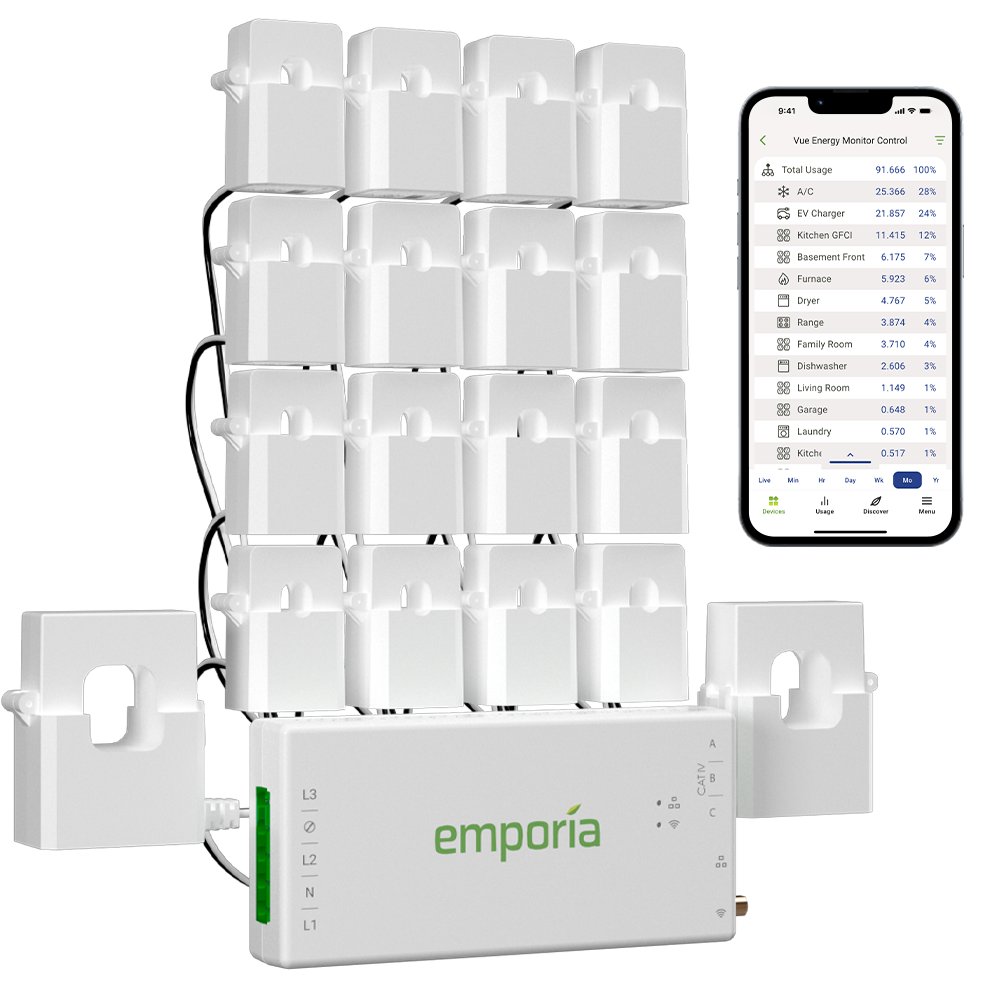
The Emporia Vue 3 runs $99.99 to $199.99 depending on configuration. The base unit ships with two 200A CTs for your mains; step up and you add eight or sixteen 50A clamps for branch circuits. There’s a three-phase variant at $109.99 to $209.99, which matters a lot outside North America.
Connectivity is 2.4 GHz Wi-Fi (802.11b/g/n) with a 10/100 Ethernet port as a fallback — a genuinely useful inclusion, since breaker panels are frequently the worst Wi-Fi location in the house. Emporia rates accuracy at ±2%. No subscription.
What makes the Vue 3 the default isn’t the hardware, though — it’s that the hardware is an ESP32. That means you can flash it with ESPHome and cut the cloud out entirely, feeding circuit-level data straight into Home Assistant over your LAN. It isn’t officially sanctioned and it isn’t a five-minute job, but the community components are mature and widely used.
Be clear-eyed about the out-of-box experience, though: it’s cloud-first, high-resolution data is retained only for a limited window, and there is no first-party Home Assistant integration. If you never intend to flash it, you’re accepting a vendor dependency — and this is a category where vendors have just demonstrated they will leave.
Shelly Pro 3EM — the local-first pick
The Shelly Pro 3EM is a DIN-rail three-phase meter with 120A clamps, ±1% accuracy on active energy, and Wi-Fi, Ethernet, and Bluetooth. US pricing sits around $150–$160 depending on retailer.
Its advantage over the Emporia is philosophical. Shelly devices expose a full local HTTP and WebSocket API with no cloud account required, and Shelly formally joined the Works with Home Assistant program in July 2025. There is no flashing step, no reverse-engineered integration, no cloud to sunset. You plug it in and Home Assistant finds it.
Two honest caveats. First, three channels is three channels — this is a mains-and-a-couple-of-big-loads device, not a sixteen-circuit breakdown. Second, DIN rail is a European assumption. If your panel is a North American load center, you’ll need a separate enclosure and a plan, which turns a simple install into a small project.
IoTaWatt — buy only if you find one
IoTaWatt remains the only genuinely open option top to bottom: open firmware, published schematics, no cloud account, and a native Home Assistant integration. It’s beloved for good reason.
But production of the original units ended in April 2025 on supply-chain grounds, and remaining stock has been scarce and expensive. The project isn’t dead — the firmware is still maintained and there’s been community discussion about an ESP32-based successor — but in 2026 this is a “grab it if you see it” product, not something to plan a build around.
The panel tier: thousands of dollars, and a real argument about whether it’s worth it
SPAN is the name in smart panels. It replaces your entire load center with a software-controlled one, giving you per-circuit shutoff, load management, and the ability to prioritize circuits during a backup event. Hardware runs roughly $3,500; installed, quotes commonly land somewhere between $4,500 and $8,000 depending on region, permitting, and how much your existing panel fights back.
The March 2026 Eaton investment is the most interesting thing to happen to this category in years. Canary Media reported the $75 million deal explicitly as a cost-reduction play, with Eaton bringing manufacturing scale and distribution to a product that currently costs about twice what conventional equipment does. Joint solutions were slated for the second quarter of 2026.
The same piece contains the most useful skepticism I’ve read on smart panels. Analyst Ben Hertz-Shargel questioned whether dedicated energy hardware inside the home is necessary at all, given that smart meters and controls embedded in appliances can do much of the same work more cheaply. SPAN CEO Arch Rao’s counter is the honest case for the category: a panel gives you holistic oversight that per-device controls can’t, and it’s most valuable when you’re avoiding a service upgrade or adding significant new load.
That’s the real buying trigger. If you’re adding an EV charger, a heat pump, and an induction range to a 100A service, a smart panel that manages load can be cheaper than upsizing your service. If you just want a pie chart of your electricity bill, this is an absurd amount of money.
Lumin takes the middle path — it installs alongside your existing panel rather than replacing it, controlling a subset of circuits — which keeps labor down. And Schneider’s Pulse, the third name you’ll find in older comparisons, has been discontinued. Ignore any 2026 “buyer’s guide” that still recommends it; several of the top search results do, which tells you something about that corner of the web.
The $20 option nobody puts in the comparison charts
Here’s the option that gets skipped because it doesn’t fit the category: a DIN-rail Matter switch with metering built in.
The SONOFF BASIC-1GSP, covered by CNX Software in June 2026, is $19.90. It mounts on DIN rail inside a distribution box, handles 32A (7,680W at 240V), speaks Matter over 2.4 GHz Wi-Fi, does double-pole switching for genuine isolation, and reports voltage, current, power, and energy in real time. Overload protection trips within three seconds.
For twenty dollars per circuit you get measurement and switching on exactly the circuits you care about — the water heater, the EV charger, the aircon. Put three or four in and you’ve covered most of your discretionary load for under $100, with Matter commissioning into Apple Home, Google Home, Alexa, or SmartThings.
The caveats matter. This is a 240V, 32A, DIN-rail product — it fits European and Asian consumer units far more naturally than North American panels. Energy reporting currently surfaces through eWeLink, Home Assistant, and SmartThings rather than uniformly across every Matter controller. And this is mains wiring: an electrician, not a weekend.
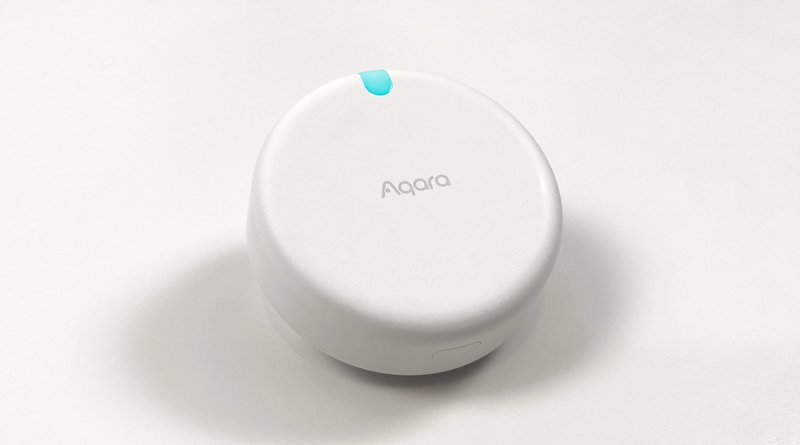
If DIN rail isn’t an option, the same logic works at the load end. A back-box relay like the Aqara Dual Relay Module T2 gives you switching and power measurement on two circuits from behind an existing switch plate, and a high-current wall switch like the Aqara H1 20A handles a water heater or aircon — the biggest schedulable loads in most homes — without touching the panel at all.
Why Matter still can’t see your breaker box
You’d be forgiven for assuming this was solved. Matter has spent four consecutive releases on energy.
Matter 1.4 was the big one. Per the Connectivity Standards Alliance, it added device types for solar power (inverters, arrays, hybrid solar-battery systems), batteries and Battery Energy Storage Systems, heat pumps, water heaters, and mounted load control. It introduced the Device Energy Management cluster, which lets power-hungry devices shift their start times based on forecasts, plus a mode cluster for choosing between device-local and grid-wide optimization.
What it did not add — and what nothing since has added — is a device type for an electrical panel, a breaker, or a whole-home energy meter. Matter can model your water heater. It cannot model the thing your water heater is plugged into.
Matter 1.6, released in June 2026, didn’t change this. It’s a commissioning and multi-admin release: NFC-based setup (you can commission a bulb before it’s screwed into the fixture), Joint Fabric for genuinely shared cross-ecosystem administration, thermostat suggestions, and smoke alarms that report when they’ve been removed from the mounting plate. All welcome — see our breakdown of what Matter 1.6 actually means — but none of it is energy infrastructure.
The practical consequence: Home Assistant is the integration layer for panel-level energy in 2026, and there is no sign of that changing. Every product in this article either has a native HA integration, has a community one, or can be flashed into having one. None of them will show up natively in Apple Home as “the house.” If you’re serious about energy data, Home Assistant isn’t optional.
The utility path: cheapest of all, if you qualify
There’s a fourth option that requires touching nothing electrical. Emporia’s Vue Utility Connect is $39.99 and plugs into a wall outlet. It joins your smart meter’s Zigbee Smart Energy Profile home area network and reads whole-home consumption directly from the meter, refreshing roughly every 30 seconds.
The catch is a big one: it only works where the utility broadcasts over Zigbee SEP and participates. Emporia’s supported list covers SCE and PG&E in California, PPL and FirstEnergy in Pennsylvania, Ohio Edison, and Burlington Electric and Green Mountain Power in Vermont. Check before you buy.
This is also, notably, exactly the direction Sense went. Rather than selling boxes, Sense is embedding its disaggregation software into next-generation utility smart meters, which it expects to reach tens of millions of homes. Existing Sense owners keep their app, firmware updates, and support — this was a business-model exit, not an abandonment. But the strategic bet is clear: the meter wins, eventually.
“Eventually” is doing heavy lifting there. Meter rollouts run on decade timescales and vary wildly by country. If you want data this year, you’re still buying hardware.
What I’d actually buy
If you want to know where your power goes and you use Home Assistant: Emporia Vue 3 with 16 sensors (~$200), flashed with ESPHome. Best data-per-dollar in the category, and flashing removes the vendor risk that just took out Sense.
If you want local-first with zero fuss: Shelly Pro 3EM. Fewer channels, better accuracy, first-party HA support, and no reverse-engineering. Budget for an enclosure if you’re on a North American panel.
If you have three or four loads you care about: Skip whole-home monitoring entirely. Put $20 DIN-rail Matter switches on the water heater, the EV charger, and the aircon. You get control as well as data, which whole-home monitors never give you.
If you’re electrifying a house on 100A service: Get a smart panel quote — SPAN if you’re replacing the panel, Lumin if you’re not. Compare it against the cost of a service upgrade, because that’s the actual decision. Wait for the Eaton-scaled products if you can; cost reduction is explicitly the point of that deal.
If you’re on a supported utility: Try the $39.99 Utility Connect first. It’s cheap enough that discovering its limits costs you almost nothing.
One last thing. The lesson of the last twelve months isn’t that this category is dying — Eaton doesn’t invest $75 million in dying categories. It’s that cloud-dependent consumer energy hardware is a fragile business, and the products that survived the shakeout are the ones you can point at your own server. Buy accordingly.
For the loads that drove you here in the first place, we’ve covered EV chargers and Matter’s gap there and why smart window air conditioners are still a mess.