If you’ve spent any time smoking a brisket, you know the specific flavour of dread that comes from watching a Bluetooth connection drop at 2am with six hours left on the cook. For a decade, wireless meat thermometers were basically a compromise: a clever probe crippled by a radio designed to move audio between your phone and your earbuds, not through a foil-wrapped hunk of beef inside a steel smoker forty metres from your bedroom.
That’s finally changing. The interesting story in 2026 isn’t sensor accuracy — everyone is within a degree now — it’s radio. Two of the four thermometers worth your money have abandoned Bluetooth entirely for sub-1 GHz radio, and the difference is not subtle. Meanwhile, the smart home standard that was supposed to unify everything has quietly declined to acknowledge that cooking exists at all.
Here’s how the four serious contenders actually compare, what they cost, and which one belongs in your kitchen.
The radio problem nobody talks about
Bluetooth Low Energy operates at 2.4 GHz. So does your Wi-Fi, your Zigbee mesh, your microwave, and roughly every other wireless thing in your home. Worse, 2.4 GHz is physically bad at penetrating the two things a meat thermometer must penetrate: dense wet protein, and a metal cooking chamber.
A probe buried in a nine-kilo pork shoulder inside a closed kamado is, from a radio perspective, sitting inside a poorly-tuned Faraday cage wrapped in saltwater. Manufacturers have papered over this with “boosters” — a charger that sits next to the grill and relays the signal — which works, right up until you walk to the far end of the house.
Sub-1 GHz radio (the same band family used by LoRa and many long-range industrial sensors) trades bandwidth for penetration and range. A meat thermometer sends a handful of temperature readings per second. It needs essentially no bandwidth. It is close to the perfect application for a low-frequency radio, and it’s mildly embarrassing that the industry took until 2025 to notice.
The practical result: sub-GHz systems hold connection through grill walls and house walls where Bluetooth simply won’t. If you’ve ever restructured your network to keep IoT gear stable, you’ll recognise the pattern — this is the same physics discussed in our guide to building a separate smart home Wi-Fi network, just applied to dinner.
MEATER Pro — $129.95
The MEATER Pro is the default recommendation, and for most people it’s still the right one. Formerly sold as the MEATER 2 Plus, it was renamed when the Pro XL arrived, which caused some confusion — if you see “MEATER 2 Plus” on a shelf, it’s the same probe.
The specs are genuinely good. Five internal sensors plus one ambient sensor in a 5mm probe, internal readings to 221°F (105°C), ambient to 1000°F (537°C), which means you can lay it directly over open flame without cooking the electronics. It’s fully waterproof and dishwasher safe. Charging is fast: five minutes in the charger gets you a two-hour cook, thirty minutes gets you a full day. The charger itself runs about two years on a single AAA.
The catch is the radio. MEATER Pro is Bluetooth 5.2 — long-range Bluetooth, to be fair, rated at 2,500 ft open-air, but the honest number is the one MEATER themselves publish: roughly 250 ft in a typical home. That’s fine for a steak on the patio. It is not fine for an overnight cook with the phone upstairs.
If you want to break out of that, MEATER pushes you up to the MEATER Pro XL at $349.95 — four probes, an OLED display on the block, a standalone mode that works without your phone, and crucially built-in Wi-Fi so the block relays to MEATER Cloud. It’s a lot of money, but it’s the only way to get MEATER’s ecosystem to reach beyond the backyard.
Worth knowing: MEATER isn’t independent. Traeger acquired parent company Apption Labs in July 2021 for around $100 million, which is why MEATER integration shows up natively in Traeger’s grills.
Buy it if: you cook steaks, chicken and the occasional roast, mostly within earshot of the grill, and you want the most refined app in the category.
Combustion Predictive Thermometer (Gen 2) — from $149
Combustion Inc. is the engineer’s choice, and it shows in both the good and annoying ways.
The Predictive Thermometer crams eight sensors into one probe — a full temperature gradient from the core of the meat out through the surface and into the ambient air. That’s not a spec-sheet flex. Knowing the gradient is what lets Combustion do the thing it’s named for: genuinely predict when your food will hit target, including the stall and the carryover cooking after you pull it. Everyone else estimates. Combustion models.
Gen 2 fixed the two real complaints about the original. The ambient sensor was relocated for more accurate pit readings, and the high-temperature range jumped from 600°F to 900°F. Build quality is arguably the best here: nitrogen-flushed, hermetically sealed with a brazed ceramic bond, and IP69K rated.
There’s also a food-safety feature nobody else offers properly. SafeCook tracks cumulative bacterial destruction over time rather than just peak temperature — including the time coming up to temp and the resting period — and tells you when the cook has cleared USDA safety guidance. Chicken held at 60°C for long enough is as safe as chicken blasted to 74°C, and considerably better to eat. Combustion is the only mainstream probe that does that maths for you, which matters enormously if you cook sous vide or low-and-slow poultry.
Pricing is modular, and this is where it gets annoying:
- Probe alone: $149 (Bluetooth only, via Combustion’s MeatNet mesh)
- Probe + Wi-Fi Booster: $189
- Probe + Wi-Fi Display: $199
- Two probes + Wi-Fi Display: $349
MeatNet is clever — probes and boosters relay for each other, so a multi-probe setup self-heals — but it’s still 2.4 GHz Bluetooth underneath. You need the Booster or Display to get off-network monitoring. The Booster does earn its keep otherwise: it recharges the probe up to 16 times, and a probe stored in it stays charged for nine months.
Buy it if: you want the most data and the smartest predictions, you cook sous vide or overnight, and you don’t mind buying a booster.
ThermoWorks RFX — $159 starter kit
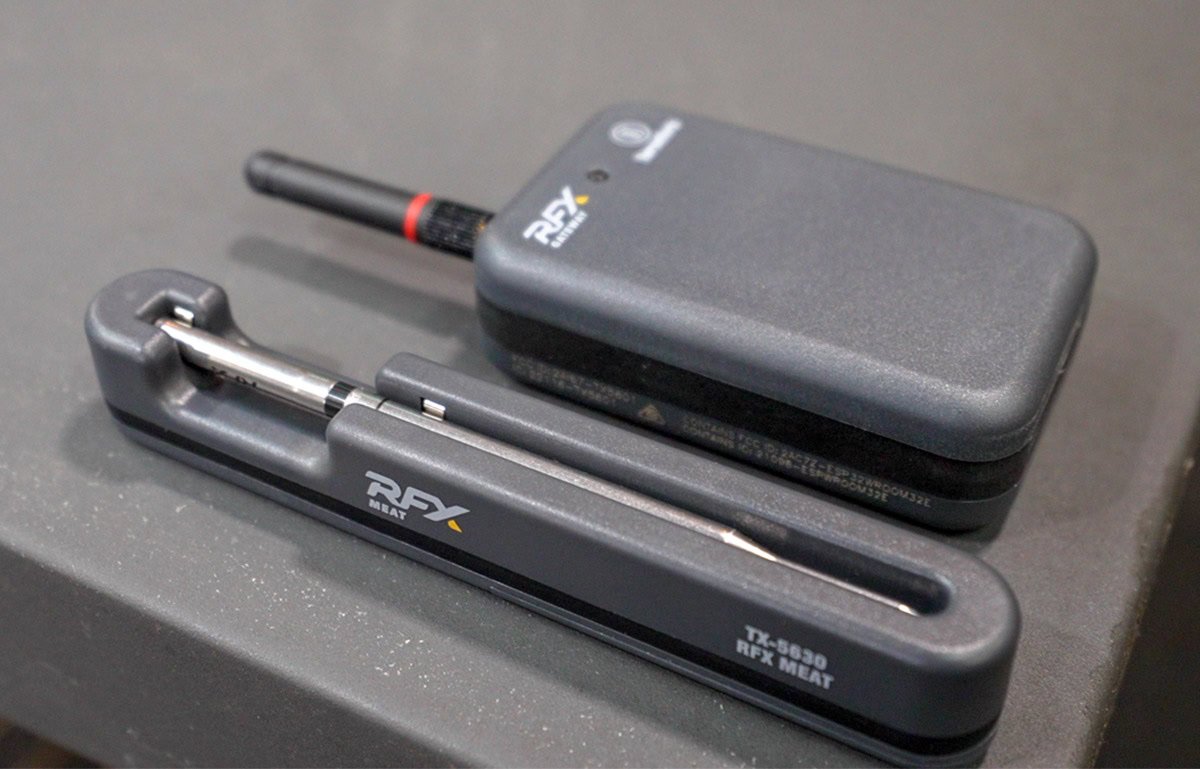
This is the one that changed the category. ThermoWorks — the company behind the Thermapen that every professional kitchen owns — built the RFX system around a patent-pending sub-1 GHz link from probe to gateway, and it works exactly as advertised: 1,500 feet line of sight, and reliably through smoker walls that eat Bluetooth alive.
Engadget’s review called the accuracy “unparalleled”, measuring readings within about 0.9°F. The rest of the spec sheet is similarly serious: probe rated to 1,000°F, IP69K (dishwasher safe, and genuinely fine for deep frying and sous vide), and a charging story that embarrasses everyone else — ten minutes of charging for up to 52 hours of cook time. A single Gateway will handle up to 70 probes, which is well past the point of being a home product and squarely into catering territory.
Pricing is à la carte:
- RFX Starter Kit (1 probe + Gateway): $159
- 2-probe kit: $239 · 4-probe kit: $349
- Extra RFX MEAT probe: $99 · Gateway alone: $79
The architecture is the compromise. The probe talks sub-GHz to the Gateway; the Gateway talks Wi-Fi to ThermoWorks’ cloud. That means the Gateway must be powered and on your network for the system to do anything. There’s no meaningful Bluetooth-direct offline mode, so if your internet drops mid-cook, you’re reading temperatures on a phone that can’t reach them. It’s also more boxes to keep track of, and the starter kit ships without a case.
Buy it if: you smoke seriously, your pit is far from your house, and connection dropouts have ruined a cook for you before. This is the one that just doesn’t drop.
Typhur Sync Gold Dual — $199.99
Typhur is the newcomer that took the sub-GHz idea and made it cheaper. The Sync Gold Dual gives you two probes for $199.99, each with six sensors, communicating over Sub-1G to a base station that then bridges to both Bluetooth and Wi-Fi.
Range claims are aggressive — 3,000 ft open air, around 700 ft through walls — and in practice it holds up through kamado and offset smoker walls. The handles are ceramic rated to 1,000°F rather than the stainless everyone else uses. And Typhur does something no competitor bothers with: every unit is NIST-verified to ±0.5°F and ships with an individual calibration certificate.
The base station has an LCD, so like the MEATER Pro XL and the Combustion Display you can run the cook without your phone. Two probes at $199.99 undercuts a two-probe ThermoWorks kit by $40 and a two-probe Combustion setup by $150.
The reservations are the usual newcomer ones: the app is less mature than MEATER’s, the long-term firmware support story is unproven, and the model naming is a mess — Sync, Sync Gold, Sync Gold Lite, Sync One, Dual, Quad. The entry-level Sync One regularly appears for $35–50 and is a perfectly reasonable first wireless probe if you just want to stop overcooking chicken breasts.
Buy it if: you want sub-GHz reliability and two probes without paying ThermoWorks money.
The Matter problem: cooking doesn’t exist
Here’s the part that should annoy anyone building an actual smart home. Not one of these devices speaks Matter or Thread. Not one.
That’s not laziness on the manufacturers’ part — there is no cooking thermometer or food probe device type in the Matter specification, full stop, through Matter 1.6. Matter 1.3 added oven, cooktop, extractor hood and microwave oven device types. Matter 1.4 handled water heaters, heat pumps and solar. Matter 1.5 brought cameras and closures. Matter 1.6 delivered NFC commissioning and Joint Fabric. At no point did anyone define a way for a temperature probe stuck in a pork shoulder to report to your home.
So your smart home cannot know dinner is ready. It can’t flash the lights when the brisket hits 203°F, or announce it on your speakers, or turn on the kitchen extractor when the pit temperature spikes — not natively, anyway. This is the same gap we documented across the rest of the kitchen in our look at Matter’s appliance problem: the certified device types exist on paper, the products mostly don’t, and the useful bits are missing.
What actually works today: Home Assistant
If you want your thermometer talking to your house, Home Assistant is the only real answer, and the quality varies a lot:
- MEATER has an official Home Assistant integration. It exposes internal and ambient temperature per probe. The catch: it’s cloud polling and requires a MEATER Cloud account plus a Wi-Fi-capable hub or Block — so the Bluetooth-only MEATER Pro can’t feed it on its own. You’ll need the Pro XL or a Block.
- Combustion has an actively maintained community integration that discovers probes over Bluetooth directly, including through MeatNet repeaters. This is the only genuinely local option in the category, and it’s the one I’d build automations on.
- ThermoWorks has a community
ha-thermoworks-cloudintegration built on thethermoworks-cloudPython library, still in active development as of mid-2026. Be warned: the default scan interval is 1,800 seconds. Thirty minutes is useless for grilling — drop it to 10–30 seconds or the integration is decorative. - Typhur has no Home Assistant integration worth mentioning. App only.
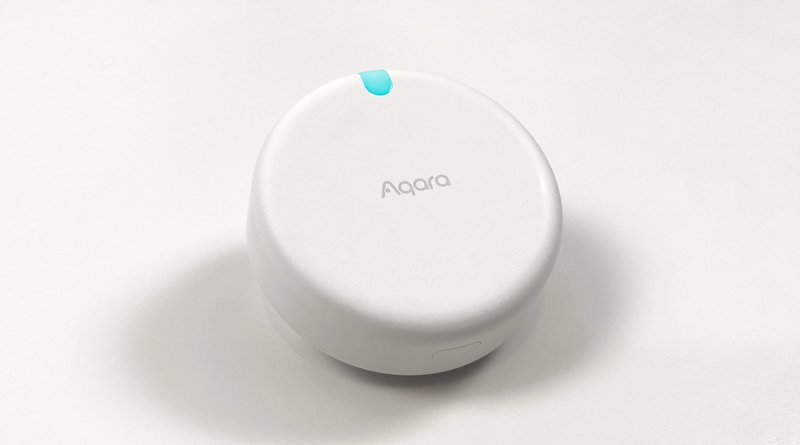
If you just want some awareness of the cooking area in your smart home while the standards bodies catch up, the workaround is unglamorous but effective: put a proper ambient sensor near the grill or in the kitchen. Something like the Aqara Climate Sensor W100 will happily report to Matter, HomeKit or Home Assistant and trigger ventilation or alerts — it just can’t tell you a thing about what’s happening inside the meat. For a broader comparison of what these little sensors can and can’t do, see our temperature and humidity sensor showdown.
So which one?
Most people should buy the MEATER Pro at $129.95. The app is the best in the category, the probe is excellent, and if you cook within a hundred feet of your grill the Bluetooth limitation never becomes a problem. It’s the least amount of thinking for the most reliable result.
If you smoke overnight, buy the ThermoWorks RFX starter kit at $159. The extra $30 buys you a radio that doesn’t quit, and the 52-hour battery means you’re not doing a 3am probe swap. Accept that you need the Gateway online.
If you’re a data person, buy Combustion at $189 with the Booster. Eight sensors, real predictive modelling, pasteurization tracking, and the best local Home Assistant story in the category. It’s the only one of these that makes your smart home genuinely smarter.
If you want two probes for the least money, the Typhur Sync Gold Dual at $199.99 is the value play — sub-GHz reliability and NIST-certified accuracy for less than a comparable ThermoWorks or Combustion setup, with a less polished app as the trade.
And if you’re just starting out, a $35–50 Typhur Sync One will still save more overcooked chicken than any amount of agonising over radio protocols.
One last thing: none of these will get Matter support in 2026, because there’s nothing to support. The Connectivity Standards Alliance has spent three specification releases adding ovens, cooktops, extractor hoods, water heaters, solar inverters and cameras. Adding a temperature probe — arguably the single most automation-ready object in any kitchen — apparently hasn’t come up. Until it does, your brisket and your smart home will remain strangers.